

If this is your first diesel and you want the truck that is easiest to live with, buy the LBZ Duramax. If you want the truck you can fix with hand tools in a driveway in January, buy the 12 valve Cummins. If you want the cheapest way into a legend and you are a Ford person, buy the 7.3 Powerstroke. All three are pre DPF trucks with no DEF, and all three will outlast the truck around them if the body is solid.
- The LBZ is the best first diesel for most buyers: 360 hp, 650 lb ft, a six speed Allison, and the most modern truck of the three.
- The 12 valve Cummins is the simplest engine ever put in a pickup, with no computer and a mechanical fuel pump, but the Dodge around it needs a hard look.
- The 7.3 Powerstroke is the cheapest way in and the toughest sounding of the three, but it is also the oldest and the slowest.
- On every one of these, buy on body condition first. Rust kills more of these trucks than engines do, and a clean body with records beats a cheap truck with stories.
If this is your first diesel and you want the truck that is easiest to live with, buy the LBZ. If you want the truck you can fix with hand tools in a driveway in January, buy the 12 valve. If you want the cheapest way into a legend and you are a Ford person, buy the 7.3. Those three sentences are the whole article in short form, and everything below is the evidence for them.
These three engines are the ones every first time diesel buyer in Canada ends up choosing between. All three are pre DPF trucks with no DEF to buy and no filter to plug. The question is which one fits the buyer standing in front of it.
| 7.3 Powerstroke | 5.9 Cummins 12 valve | LBZ Duramax | |
|---|---|---|---|
| Years | 1994 to 2003 | 1989 to early 1998 | 2006 to 2007 |
| Best power | 275 hp, 525 lb ft | 215 hp, 440 lb ft | 360 hp, 650 lb ft |
| Injection | HEUI, electronic | Bosch P7100, mechanical | Common rail, electronic |
| Transmission | 4R100 auto, ZF6 manual | 47RE auto, NV4500 manual | Allison six speed auto |
| Emissions | None, no DPF, no DEF | None, no DPF, no DEF | EGR only, no DPF, no DEF |
| Buy in price | Lowest of the three | Middle | Highest of the three |
What does the 7.3 Powerstroke do best?
The 7.3 is the cheapest legend on this list, and it sounds like one. Built by Navistar and fitted to Ford Super Duty trucks from 1999 to 2003 in its best form, it makes 275 hp and 525 lb ft with HEUI injection, which uses high pressure oil to fire the injectors. It is loud, it is slow by modern standards, and it will probably still be running when the truck around it has rusted away.
What the 7.3 does best is be simple to own. Parts are everywhere, every shop in Canada has worked on one, and you can rebuild almost anything on it in a home garage. The engine itself rarely strands you. What strands a 7.3 is the stuff around it: the cam position sensor, the glow plug relay, and old batteries that cannot spin a big V8 fast enough on a minus 30 morning.
The weak link is the 4R100 automatic, which does not forgive a tuner, heavy towing, and neglected fluid. The ZF6 manual is the one to hunt for. My 7.3 Powerstroke legend and my blowby test cover the engine and the first check I run before money changes hands.
What does the 12 valve Cummins do best?
The 12 valve is the simplest diesel engine ever fitted to a pickup. From 1994 to 1998 it ran a Bosch P7100 inline mechanical pump, which means no computer decides how much fuel the engine gets. Turn a screw and you add fuel. It will run with a dead battery once it is started, and on fuel quality that would make a modern common rail engine quit.
From the shop: a customer brought me his 1996 Ram 2500 last spring because it would not start after sitting all winter. He had already bought a new starter and a set of batteries, and he was ready to buy an injection pump. I checked the fuel shutoff solenoid first, found a five dollar fuse, and the truck fired on the second crank. That is the 12 valve in one story. The fix is usually the simplest thing on it.
The catch is the Dodge around the engine. The 47RE automatic is the weakest transmission of the three trucks here, and a rebuild with a proper torque converter is a three to five thousand dollar job in Canada. The bodies rust in the same places every time, and the killer dowel pin inside the timing cover can work loose and destroy the engine if it was never fixed. My 12 valve guide and my used truck checklist walk through the inspection step by step.
What does the LBZ Duramax do best?
The LBZ is the newest, strongest, and most civilised truck on this list, and it is not close. Built for the 2006 and 2007 classic body GM trucks, it makes 360 hp and 650 lb ft, roughly 90 hp more than the best 7.3 and 145 hp more than the best 12 valve. It is backed by the Allison six speed automatic, the best transmission any of these trucks ever got. It rides better and tows with less drama than either of the older trucks.
What the LBZ does best is be a truck you can actually use every day without making excuses for it. It starts clean in the cold, it holds highway speed on grades, and it does all of that with no DPF and no DEF. It does have EGR, but an EGR valve is a small job next to a DPF replacement.
The price is the problem. Clean low kilometre LBZ trucks are the dearest of the three by a wide margin, with US dealers asking US$24,900 to US$42,900 for good examples in November 2026. When you inspect one, check injector balance rates, check the transfer case for pump rub, and check every panel for rust. My LBZ guide has the full breakdown.
Which one should you buy first?
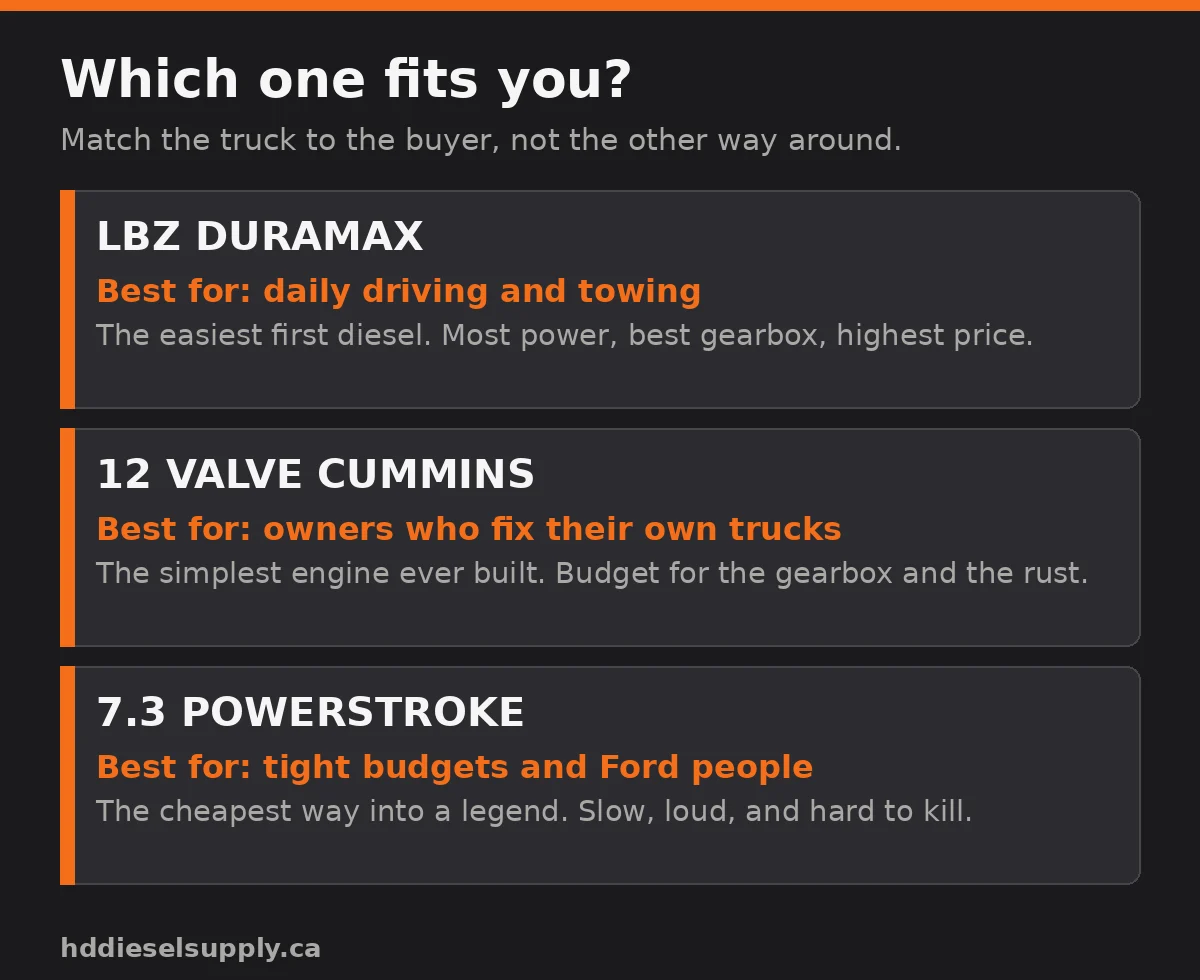
Buy the LBZ if you need a daily driver, a tow rig, and a family truck in one vehicle, and your budget reaches past $25,000. It is the one I recommend to buyers who want a diesel without a project attached to it.
Buy the 12 valve if you do your own work and you want the simplest engine ever built. Budget for the transmission and the rust, pay for an inspection before you buy, and you will own a truck that holds its value like nothing else.
Buy the 7.3 if your budget is tight or you want the lowest cost way into a legendary engine. Spend the money you save on batteries, glow plugs, and a transmission service, and keep a spare cam position sensor in the glovebox.
One warning applies to all three: buy on body condition first. Rust kills more of these trucks than engines do.
What do you check on any of the three before you pay?
The same four checks, on every truck, no exceptions. First, the frame and body: rockers, cab corners, bed supports, and frame rails, poked with a screwdriver. Second, the engine cold: start it from dead cold and watch for white smoke that does not clear. Third, the transmission: drive it until fully warm and feel every shift under load. Fourth, the paperwork: maintenance records, ownership history, and a lien check.
Pay for a prepurchase inspection from a diesel shop that knows the engine you are buying. It costs a couple of hundred dollars in most Canadian cities, and it has saved my customers from five figure mistakes more times than I can count. My inspection checklist lists every check I run.
What I would do with your money
If you gave me $25,000 and told me to buy a first diesel tomorrow, I would buy the cleanest LBZ I could find with records and a solid frame, and keep $2,000 back for the small jobs every twenty year old truck needs. If you gave me $12,000, I would buy a 12 valve with a manual transmission, fix the killer dowel pin, and drive it for the next decade. If you gave me $8,000, I would buy a 7.3, put new batteries and glow plugs in it before winter, and carry that spare cam sensor.
There is no wrong answer on this list. There is only a wrong truck for your budget, your skills, and your patience. Pick the one that matches all three and inspect it like your money depends on it, because it does.
Frequently asked questions
Should I buy a 7.3 Powerstroke as my first diesel?
Yes, if you want the lowest buy in price and you are comfortable with an old truck. The 7.3 is simple, parts are everywhere, and any shop in Canada knows it. Say no if you need a daily driver that starts first try at minus 30, because tired glow plugs, a weak relay, and old batteries will test your patience every January.
12 valve Cummins vs LBZ Duramax: which one is better for towing?
The LBZ tows better. It makes 360 hp and 650 lb ft against 215 hp and 440 lb ft for the best 12 valve, it holds speed on grades without working as hard, and the six speed Allison manages the load far better than the old 47RE. The 12 valve will still pull a 10,000 lb trailer all day, but the LBZ does it with less noise, less effort, and a better ride.
What is the cheapest first diesel truck to own?
The 7.3 Powerstroke, by a clear margin. Rough drivers start around $5,500 in Canada, and clean ones still cost less than a clean LBZ. The 12 valve sits in the middle, with honest work trucks from about $6,000 to $12,000. The LBZ is the dearest of the three, with clean low kilometre trucks asking US$24,900 to US$42,900 at US dealers in November 2026.
Is an LBZ Duramax worth the premium over a 7.3 Powerstroke?
For most first time buyers, yes. You get roughly 90 more horsepower, a far better transmission, a quieter cab, and a truck that is four years newer, all with no DPF and no DEF. The premium only stops making sense if your budget is tight and you can do your own work, because then the cheaper 7.3 leaves money in your pocket for the repairs an old truck will need.