

A little blowby is normal on a 7.3 Powerstroke. Even a healthy engine puffs a light mist from the oil filler with the cap off, and a well kept 7.3 can run 400,000 km or more before ring wear shows up in the numbers. Worry when the cap dances or blows off the filler neck, when blue smoke follows the vapour, or when the engine drinks more than a litre of oil between changes. The oil cap test takes ten minutes and tells you whether to keep driving or book a compression test.
- Every 7.3 has some blowby. A light mist from the oil filler at idle is normal, smoke and oil spray are not.
- The oil cap test is free and takes ten minutes: set the cap loose on the filler neck and watch what it does at idle and at 1,500 rpm.
- A shop measures blowby with a manometer on the oil fill neck. More than about 6 inches of water at full rpm is excessive, and a healthy engine reads around 0.9 to 1.4 ACFM on a flow meter.
- A healthy 7.3 reads 400 psi or more on a compression test, with all eight cylinders within 10 to 15 percent of each other. Readings near 300 psi with heavy blowby point at worn rings.
A 7.3 Powerstroke with blowby is the oldest argument in the diesel world, and most of it comes from people testing the wrong thing and panicking about the result. Some blowby is normal on this engine. I have watched owners talk themselves into a rebuild over a wisp of vapour that a brand new 7.3 would make too. I have also watched owners ignore a cap that danced clean off the filler neck until the engine was drinking a litre of oil every thousand kilometres. This guide shows you how to tell which one you are looking at, in your driveway, in ten minutes, with no tools at all.
What is blowby, and why does a 7.3 make more of it?
Blowby is combustion gas slipping past the piston rings into the crankcase instead of pushing the piston down. It happens in every engine, gas or diesel, because piston rings are a seal with a gap, not a perfect wall. The gas has to go somewhere, so the engine vents it out of the crankcase and back into the intake to be burned.
The 7.3 makes more visible blowby than a modern diesel for two reasons. First, it is an old design with generous ring gaps and big clearances, built in an era when a little crankcase vapour was accepted as normal. Second, most 7.3s on the road today have 300,000 km or more on them, and rings lose tension with age and mileage. A well kept 7.3 can run about 400,000 km before you notice real power loss, and even then the loss is often only 5 to 10 percent. Past 800,000 km the wear is obvious to anyone driving it. The engine earns its reputation as a million kilometre motor, but it earns it while puffing.
That is why the test matters more than the sight of vapour. Vapour alone tells you almost nothing. Pressure, smoke, and oil use tell you everything.
How do you run the oil cap test at home?
Warm the engine up first. A cold engine reads differently, and cold oil vapour on a winter morning looks like smoke. Drive it until it is at normal temperature, park it level, and leave it idling.
Pull the oil filler cap off the valve cover and set it back down loose on the filler neck, upside down, so it just rests there. Do not hold it. Watch it for thirty seconds at idle, then have someone hold the throttle at about 1,500 rpm while you watch again.
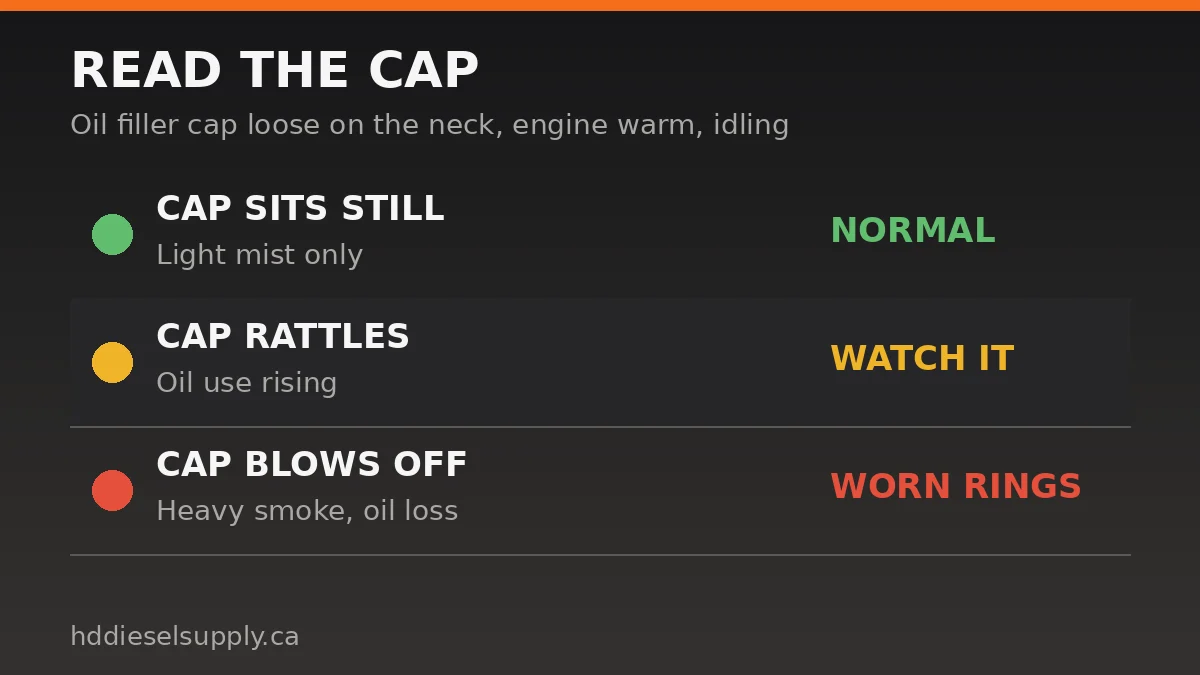
That is the whole test. There are three results, and they mean very different things.
What does the cap test actually tell you?
A cap that sits still, maybe trembling a little from engine vibration, means normal blowby. A light mist of vapour rising past it is fine too. This is the result most healthy 7.3s give, including high mileage ones that still pull strong. Keep driving, keep changing your oil on time, and check it again at the next service.
A cap that rattles and shuffles around the neck but stays put means wear is starting. The rings are letting more gas past than they used to. Check your oil level over the next few weeks. If the engine is using more than a litre between oil changes, or you see blue smoke from the tailpipe under load, book a compression test. The truck is not dying, but the clock is running.
A cap that dances hard, lifts off the neck, or gets blown off entirely means severe blowby. The rings are done, or a piston is cracked. Expect heavy oil use, hard starting when cold, and power loss on hills. Do not buy a truck that does this without a compression test and a price that reflects a rebuild. Do not keep towing heavy with a truck that does this either, because the next failure is usually a seal blowing out from crankcase pressure.
One caution from the shop floor: never confuse engine vibration with blowby. A 7.3 shakes at idle, and that shake alone can shuffle a loose cap. The test is about the cap lifting from pressure, not wobbling from shake. If you are unsure, hold your hand a few inches above the filler neck. Steady vapour you can barely feel is normal. A hard pulsing push of hot gas that you feel clearly in your palm is not.
How does a shop measure blowby properly?
The cap test screens. A shop measures. The factory method uses a manometer, which is a simple gauge that reads pressure in inches of water, connected to the oil fill neck with the crankcase vent blocked off. On a 7.3, more than about 6 inches of water at full rpm, around 3,400, counts as excessive. Under that, the engine passes, even if it looks smoky to an owner who has never seen a diesel vent before.
Some shops use a flow meter instead, which reads blowby in ACFM, actual cubic feet per minute. Ford published data puts a healthy 7.3 at around 0.9 to 1.4 ACFM. I watched a shop video recently where a worn 7.3 with 800,000 km on it read 2.15 ACFM, and the engine was burning oil and down on power to match. That gap, 1.4 against 2.15, is the difference between an engine with life left and an engine on borrowed time. Numbers beat opinions every time.
Neither tool is expensive for a shop to own, and a blowby measurement takes less than half an hour. If you are buying a 7.3, ask the seller to let your mechanic run one. A seller who refuses is telling you something.
What does a compression test add?
A compression test tells you which cylinder is the problem, and whether the problem is rings or valves. You need a diesel compression tester rated to at least 500 psi, with an adapter that fits the glow plug holes. Pull all eight glow plugs, disable the fuel system so the engine cannot start, and crank each cylinder the same number of times, six to eight compression strokes, while you record the reading.
A healthy 7.3 reads 400 psi or more per cylinder, and all eight should sit within 10 to 15 percent of each other. Readings around 300 to 345 psi with heavy blowby sit on the edge. The engine will still run, but it is tired, and cold starts will get harder every winter. A cylinder at 100 psi or with no compression at all has a burnt piston, a cracked piston, or a valve that is not sealing.
The wet test separates rings from valves. Squirt a small amount of oil into the low cylinder through the glow plug hole and test it again. If the number jumps up, the rings are the leak, because the oil temporarily seals them. If the number stays low, the leak is past a valve, because oil does nothing for a valve seat. That one trick saves owners from paying for a full rebuild when the real fault is in the heads.
My guide on why the 7.3 Powerstroke legend still matters covers what makes this engine worth saving. A rebuild is the right call on a truck with a solid frame and a clean body. Published 2026 figures put a Power Stroke rebuild at US$15,000 to US$20,000 before Canadian shop labour and exchange, so get the compression numbers first and decide with real math. My repair or replace guide lays out the rule I use in the shop.
What else can look like blowby but is not?
Three things fool owners into a rebuild diagnosis they do not need.
First, a plugged crankcase vent. The 7.3 vents crankcase gas back into the intake through a vent on the valve cover. When that vent or its hose plugs with sludge, pressure has nowhere to go, so it pushes out of the filler neck, the dipstick tube, and every seal it can find. Clean the vent and the hose before you spend a dollar on engine work. This is the cheapest fix in this whole guide and the one most often skipped.
Second, turbo seal leakage. Worn turbocharger seals let oil into the intake, which burns as blue smoke and coats the intake tubes. Owners see the smoke, see oil in the intake, and blame the rings. Pull the intake boot and look at the compressor wheel. Oil pooling in the intake with a clean filler neck points at the turbo, not the pistons.
Third, plain condensation. On a cold morning a 7.3 puffs white vapour from the filler neck that disappears into the air within a few feet. That is water vapour from combustion and cold oil, not blowby, and it fades as the engine warms. Blue smoke that hangs in the air and smells like burning oil is different, and so is vapour that is still pouring out after a full hour on the highway.
My call on your 7.3
Test it warm, with the cap loose on the neck, and believe what the cap does. A cap that sits still means your engine is fine, no matter how much vapour you think you see. A cap that rattles means start watching your oil and book a compression test at the next service. A cap that blows off means get the numbers before you spend anything, because you are deciding between a rebuild and a different truck.
The 7.3 earned its legend by being honest about its wear. It does not hide a tired engine the way a modern diesel with sensors on everything can. It shows you, right there at the oil filler, every single time you open the hood. Learn to read it, and the truck will tell you exactly how much life it has left.
Frequently asked questions
Should I buy a 7.3 Powerstroke with blowby?
It depends on how much. Light vapour from the oil filler with the cap sitting still is normal on this engine and no reason to walk away. A cap that dances off the filler neck, blue smoke from the tailpipe, and oil use over a litre between changes mean worn rings, so budget for a rebuild or negotiate the price down by the cost of one. Always run a compression test before you pay, because the cap test alone cannot price the truck.
How much blowby is normal on a 7.3 Powerstroke?
A light mist of vapour from the oil filler at idle is normal, and even a brand new 7.3 puffs a small amount of air with the cap off. What is not normal is steady smoke, oil mist spraying out of the filler, or the cap lifting off the neck. On a flow meter, a healthy 7.3 reads around 0.9 to 1.4 ACFM. A reading over 2 ACFM means serious ring wear.
Oil cap test vs compression test: which one should I trust?
The oil cap test is a screening tool and the compression test is the verdict. The cap test costs nothing and tells you in ten minutes whether blowby is severe, but it cannot measure how bad it is or which cylinder is at fault. A compression test gives you a number for every cylinder, so it tells you whether the problem is rings, valves, or nothing at all. Use the cap test to decide whether the compression test is worth paying for.
Can I fix 7.3 blowby without rebuilding the engine?
Not if worn rings are the cause. No additive, thicker oil, or vent mod restores ring seal once the rings and cylinder walls are worn. What you can fix without a rebuild is a plugged crankcase vent, which traps pressure and looks exactly like bad blowby, and leaking turbo seals, which push oil into the intake. Check both before you accept a rebuild quote.