

The LBZ Duramax (2006 and early 2007) is the last Duramax without a DPF, with a built up block, the reliable Bosch CP3 pump, 360 hp and 650 lb ft, and the first six speed Allison. It is the strongest stock bottom end of the early Duramax family and the easiest one to keep alive for 500000 km.
- 2006 and early 2007 only: 360 hp, 650 lb ft, last Duramax with no DPF
- Bosch CP3 injection pump and strengthened block, forged steel rods
- First six speed Allison 1000, and 2006 was the last year with a manual option
- Watch glow plugs, injector harness rub, EGR, and rust on the truck itself
Ask ten diesel mechanics which Duramax they would buy with their own money and eight of them will say the same thing: the LBZ. I am one of the eight. Fourteen years turning wrenches in Alberta and Ontario shops, and the LBZ is the engine I recommend when a customer asks me what to hunt for.
That does not mean it is perfect. Nothing is. But the LBZ got a rare combination right: strong internals, simple emissions, and a transmission that works with the engine instead of against it. Here is the full story.
What the LBZ actually is
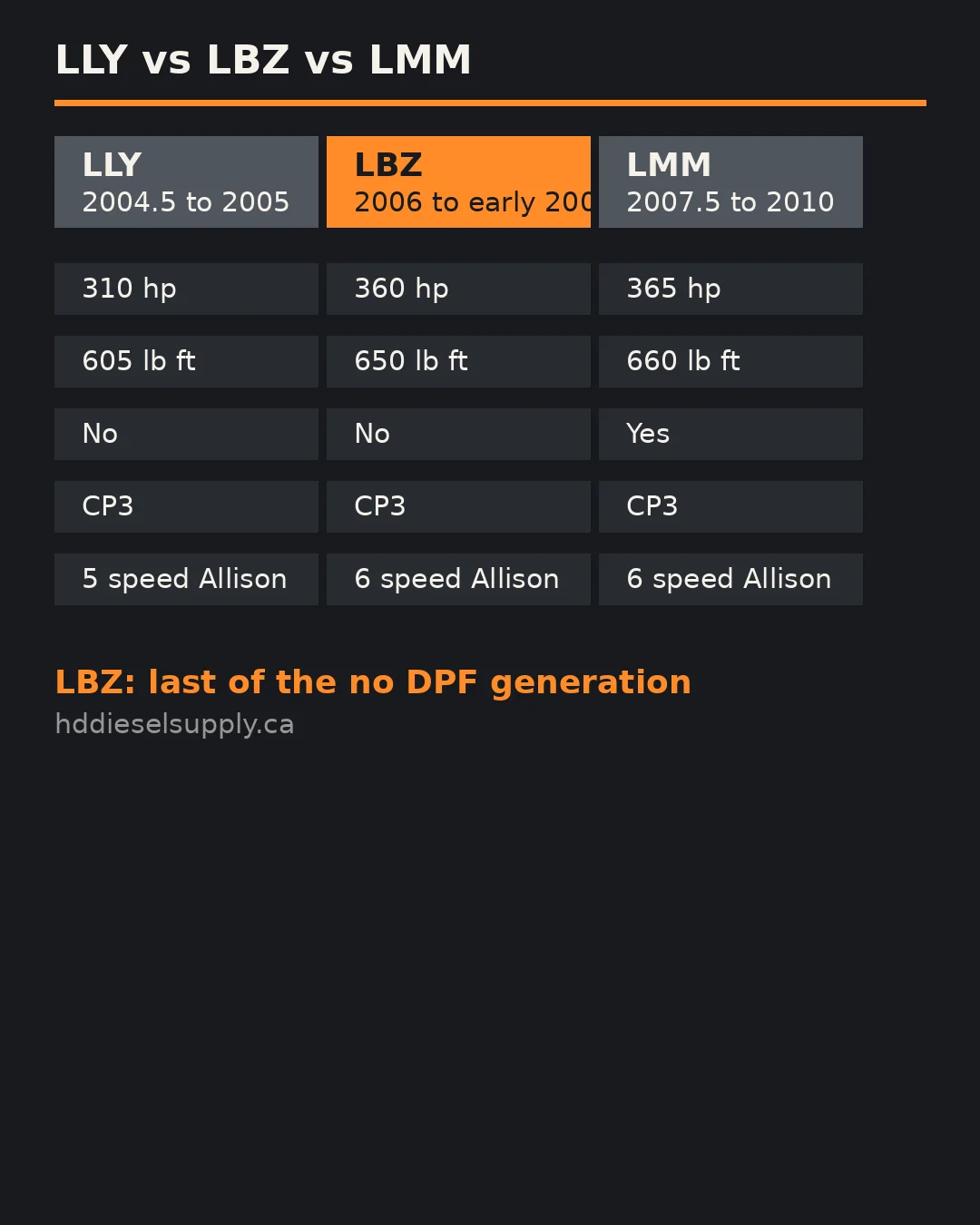
The LBZ is the 6.6 litre Duramax V8 built for the 2006 model year through early 2007, before the DPF arrived with the LMM. The factory ratings were 360 hp at 3,200 rpm and 650 lb ft at 1,600 rpm, a big jump from the LLY's 310 hp.
GM did not get there with just a new tune. The block got stronger webbing around the main bearings, 4 mm deeper cylinder bores, and tougher main caps. The connecting rods were upgraded to forged steel. The compression ratio dropped to 16.8 to 1, which takes stress off everything under load. The Bosch CP3 pump got bumped to 26,000 psi, feeding seven hole injectors that fire up to five times per cycle. A new 32 bit E35 computer replaced the old injector drive unit that used to live on the valve cover.
It was also the first Duramax paired with the six speed Allison 1000, and 2006 was the last year you could get a Duramax with a manual gearbox, the ZF650 six speed. Those manual trucks are unicorns now.
Why mechanics respect this engine
No DPF. This is the big one. The LBZ is the last Duramax with no diesel particulate filter. It has EGR and a diesel oxidation catalyst, which are far less trouble than a DPF and SCR system. No regen cycles, no DEF fluid, no plugged filters on a truck that does short trips in February. In Canada, where half the country spends winter doing exactly those short trips, that matters more than any spec sheet number.
The CP3 pump. My CP3 vs CP4 breakdown goes deep on this, but the short version is simple: the CP3 is forgiving and the CP4 is not. The LBZ runs a CP3. Change your fuel filters and it will run a long time without drama.
The block is built strong. Forged steel rods, strengthened mains, better pistons than what came before. I have seen LBZ trucks roll in with over 500,000 km on the original bottom end, still towing, still tight. The LB7 before it had injector issues. The LML after it had CP4 issues. The LBZ sits in the sweet spot between them.
Tuning headroom. Because the internals are strong and the emissions are simple, the LBZ takes a mild tune well. I am not telling you to hot rod a work truck. But a conservative tow tune on an LBZ is a very different animal than the same tune on an engine with a fragile fuel system. Emissions intact tuning exists and it is the smart way to wake one up.
The six speed Allison. The first six speed Allison changed the truck. Lower rpm on the highway, cooler running under load, better fuel economy than the old five speed. It is not indestructible behind huge power, but at stock to mild tune levels it is a great match.
The things that do break
Nobody should sell you an LBZ as problem free. Here is what I actually replace on these.
Glow plugs. The number one no start complaint I get on LBZ trucks, especially from November to March. The system has a controller that fails too. Budget for glow plug work on any LBZ you buy. My glow plug failure guide covers the symptoms.
Injector harness rub. The injector wiring harness chafes on the valve cover bracket on these trucks. The classic fix in the trade is called the ice pick fix, where you carefully adjust the connector. If your LBZ throws injector codes on the driver's side, this is the first thing to look at, not the injectors themselves.
EGR buildup. The LBZ does have EGR, and trucks that idle all day or never work hard will coke it up. A truck that tows regularly will have far fewer EGR problems than a grocery getter with a diesel badge. Watch for that when buying: low mileage plus heavy idle hours is not the gem it looks like.
Sticking VGT vanes. The Garrett variable geometry turbo can get soot buildup on the vanes, especially on trucks that never get driven hard. Symptoms feel like lost power and lazy boost. Regular highway driving with some load keeps the vanes exercised.
Head gaskets at big power. At stock power levels this is not a worry. Push one hard with an aggressive tune and big boost and the head gaskets become the limit, along with the cast pistons which can crack under very high cylinder pressure. The bottom end is strong, but strong does not mean unlimited.
Buying an LBZ in Canada today
The engine is the easy part. It is the truck around the engine that should make you nervous. An LBZ is now a 19 year old truck at the newest, and Canadian winters are brutal on bodies and frames.
My inspection list, from the shop:
- Frame and cab mounts for rust. Surface rust on the frame is normal here. Flaking, perforation, or soft cab mounts are walk away territory.
- Rocker panels, cab corners, and the bed above the rear wheels. If these are gone, price the truck accordingly, because proper rust repair is not cheap.
- Glow plug system function, not just the plugs. Test it on a cold morning if you can.
- Injector balance rates with a scan tool. My scan tool guide will get you sorted for under a couple hundred dollars.
- Transmission behaviour. The six speed Allison should shift cleanly with no flare between gears and no hard bang into reverse. If it has been tuned to big power, the transmission has lived a hard life.
- Maintenance records. An LBZ with records is worth real money over one without. Fuel filter changes on time tell you more about the truck's future than the odometer does.
- Check whether it is a real LBZ. On 2007 trucks, confirm the eighth digit of the VIN is a D for the LBZ, not the LMM. The switch happened during the 2007 model year.
Good LBZ trucks are not cheap anymore. The market knows what they are. I would rather pay strong money for a clean southern truck with records than get a deal on a rusted out northern work truck. The engine deserves a body worth keeping.
LBZ vs the other Duramax generations
The LB7 (2001 to 2004) is simpler, with no EGR, but the injectors are a known expensive job and it only had 300 hp. The LLY (2004.5 to 2005) fixed some of that but kept the five speed Allison. The LMM (2007.5 to 2010) kept the LBZ's strong bottom end but added the DPF and its whole bag of problems. The LML (2011 to 2016) brought power and the CP4 pump, which is the fuel system failure every mechanic dreads. The L5P (2017 and up) is the best modern Duramax, and I stand behind that in my L5P problems guide, but it is a complex modern diesel with complex modern maintenance.
The LBZ is the one that gives you the strong block and the CP3 with none of the DPF drama. That is why the reputation exists. It is not nostalgia. It is the spec sheet and the shop experience agreeing with each other for once.
The bottom line
If you want a Duramax that will tow, daily drive, and survive 400,000 plus km without needing a second mortgage for emissions repairs, the LBZ is the engine to find. Buy the cleanest truck you can, check the glow plugs and the frame, keep up with fuel filters, and drive it like it was built to be driven.
Twenty years from now mechanics will still be saying the same thing about this engine. Some trucks earn their reputation the hard way, one winter at a time. The LBZ is one of them.
Frequently asked questions
What years are the LBZ Duramax?
The LBZ ran from the 2006 model year through early 2007. The LMM with a DPF took over for the rest of 2007, so check the build date if you are shopping a 2007 truck.
Should I buy an LBZ Duramax in Canada?
If the truck is solid and the price is fair, yes. It is the most trouble free Duramax generation for high mileage use. Just inspect for rust, because an Ontario or Quebec truck can rot out long before the engine gives up.
What is the weak point of the LBZ?
The bottom end is strong. The common problems are glow plugs, the injector harness rubbing on the valve cover, EGR buildup, and sticking VGT turbo vanes on trucks that idle a lot. At very high power the cast pistons can crack.