

The 7.3 Powerstroke still matters because it is a simple, overbuilt V8 that predates every emissions system that gives modern diesel owners grief. It has no DPF, no DEF, and no EGR, and its cast iron block and HEUI injection system regularly carry trucks past 500,000 kilometres. The trade is real: it is loud, slow by modern standards, and the truck around it is now more than 20 years old, so you are buying condition and maintenance history, not just an engine badge.
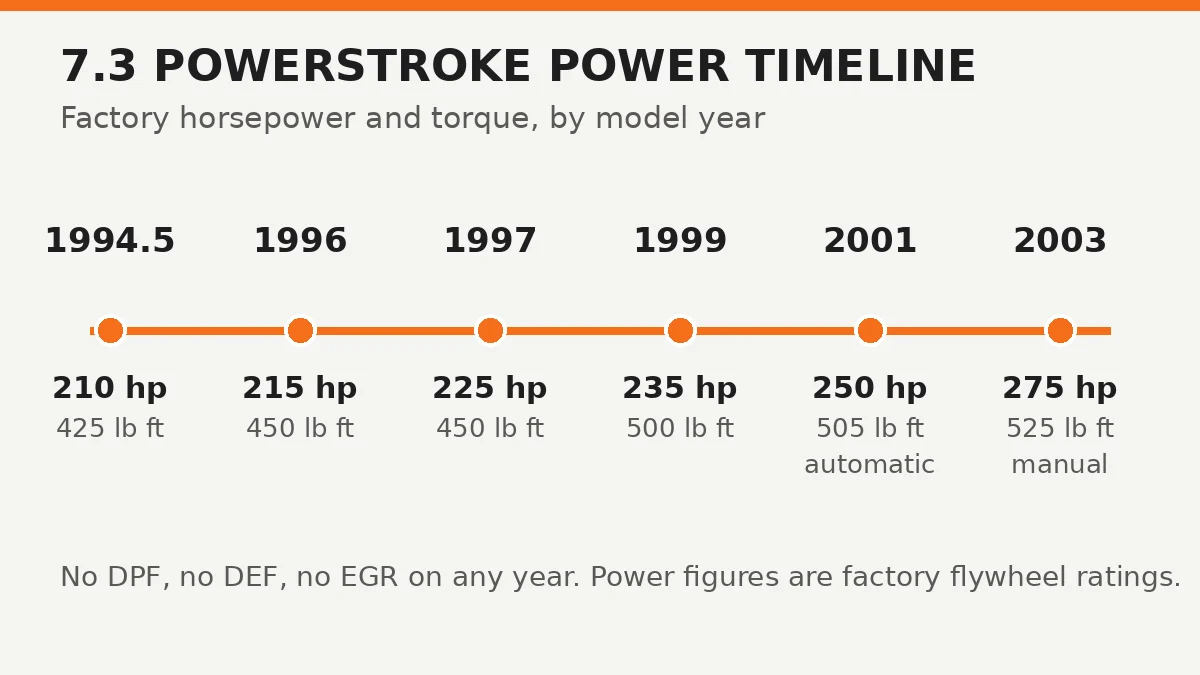
- Built by Navistar as the T444E from mid 1994 to mid 2003, with power rising from 210 hp to 275 hp over the run.
- No DPF, no DEF, and no EGR. That absence is the biggest reason owners still chase these trucks.
- Clean low mileage trucks are genuinely expensive now. Recent listings show US$26,000 to US$32,800 for well kept examples.
- The engine is the strong part. The cam sensor, glow plug relay, and 4R100 automatic are the parts that will actually strand you.
Yes, the legend is real, and it is not nostalgia doing the talking. The 7.3 Powerstroke went out of production in the middle of 2003, and more than two decades later clean trucks still change hands for money that would buy a decent new car. I have serviced these engines for most of my career, and I have watched the same pattern repeat at the shop counter: an owner brings in a truck older than his kids, and asks me if it is worth keeping. My answer is almost always yes, with conditions, and this article is those conditions.
1994 to 1997: the old body style years
Ford put the first Powerstroke in its trucks in mid 1994. Navistar built the engine, a 444 cubic inch V8 known on the Navistar side as the T444E, and Ford gave it the Power Stroke name. It replaced the old 7.3 IDI, and the jump was enormous. The new engine used HEUI injection, which means high pressure oil fires the injectors instead of a mechanical pump, and it made 210 hp with 425 lb ft of torque. Those numbers look modest today, and they were modest then too, but the engine was smooth, quiet for a diesel of its day, and built like a medium duty truck engine, because that is what it was.
Power crept up through the decade. 1996 brought 215 hp and 450 lb ft. 1997 brought 225 hp. The trucks from these years are the old body style Fords, and they have their own following now. Watch for the under valve cover harness on these early trucks. It carries power to the injectors and the glow plugs, and when its connectors loosen or melt, you get misfires and hard starts that look like a dying engine but cost a few hundred dollars to fix.
1999 to 2003: the Super Duty years
The 1999 Super Duty is the truck most people picture when they hear 7.3. Ford added an intercooler, a bigger Garrett turbo, and better injectors, and power jumped to 235 hp and 500 lb ft. In 2001 the calibration split by transmission: 250 hp and 505 lb ft with the 4R100 automatic, 275 hp and 525 lb ft with the ZF 6 speed manual. That 275 hp manual truck is the strongest factory 7.3 ever built, and buyers know it.
These are also the years that made the legend bulletproof in the public mind. The engine got stronger while the competition was still finding its feet. The 2001 Cummins made 505 lb ft. The first Duramax made 500. The 7.3 with a manual made 525, and it did it without a single emissions device bolted to the exhaust. No EGR valve to stick. No DPF to plug. No DEF tank to freeze in a Manitoba January. When people say they want a diesel without the emissions headaches, this is the engine they are picturing.
Why does a 275 hp engine still command these prices?
Because the market is not paying for horsepower. It is paying for the absence of things. A modern diesel owner budgets for DPF cleaning, DEF heaters, EGR coolers, and a fuel system that fails in expensive ways. I wrote about that last failure in my guide to what kills a CP4 pump, and the bill there starts where a 7.3 repair ends. The 7.3 owner budgets for oil, filters, and the occasional sensor. That difference in ownership cost is worth real money, and the market has priced it in.
The numbers prove it. A one owner 2001 F-350 Lariat 4x4 with 119,000 miles sold recently at US$26,000. A 2003 F-250 4x4 with 101,000 miles was listed at US$32,800. Those are prices for 20 plus year old trucks, and they are not asking prices from dreamers. Clean, documented, rust free trucks at that mileage actually sell in that range. Rough work trucks still start at a few thousand dollars, so the spread between a clean truck and a tired one is now wider than the price of a good used car. Condition is the whole ballgame.
What actually breaks on a 7.3?
The engine itself rarely fails in a catastrophic way. The parts around it fail, and most of them fail in ways that are cheap and well understood. Here is the honest list, in the order I see them at the shop.
The camshaft position sensor is the most famous failure on this engine. When it quits, the engine stalls or will not start, often with no warning and no code. A new Motorcraft sensor costs little, takes minutes to swap, and every experienced 7.3 owner carries a spare in the glovebox with a 10 mm wrench. If your truck ever dies and the tachometer does not move while you crank it, the cam sensor is your first suspect.
The glow plug relay is next, and it matters more in Canada than anywhere else. The relay switches big current to all eight glow plugs at once, and when it fails the truck cranks forever on a cold morning and blows white smoke when it finally catches. Test the relay before you blame the plugs. I see owners replace eight good glow plugs because nobody checked a relay that costs a fraction of the plugs.
The under valve cover harness and the injector O rings round out the electrical side. The harness connectors loosen with heat and age, and the O rings harden and let oil into the fuel or fuel into the oil. Both jobs are routine for a shop that knows these engines, and neither one means the engine is finished.
Then there is the transmission. The 4R100 automatic is the weakest link in the whole package, and it is the part that will actually end your ownership if you ignore it. It is fine behind a stock engine doing normal work. Add a tuner, tow heavy in the hills, or skip fluid changes, and it will slip, overheat, and fail. Budget for a rebuild if you are buying a high mileage automatic, and put a transmission temperature gauge on your list before you put a tuner on it. The ZF manual trucks do not have this problem, which is one more reason they command a premium.
In my bay last month, a customer brought in a 2002 F-350 that had died on the highway and would not restart. He was braced for an injector bill. It was the cam sensor. Twenty minutes and a part that cost less than a tank of diesel, and he drove it home. That is the whole appeal of this engine in one repair. The failures are small, known, and fixable at the side of the road.
Which year should you buy?
If you want the best truck, buy a 1999.5 to 2000 Super Duty. You get the intercooler and the stronger injectors, and you keep the forged connecting rods that Ford replaced with powdered metal rods in later 2001 trucks. If you want the most power, buy a 2001 to 2003 manual. If you want the cheapest way in, buy a 1994 to 1997 old body style and accept the smaller turbo and the older interior. Avoid paying a premium for a 2001 to 2003 automatic with no transmission history, because that is the combination most likely to hand you a rebuild bill in the first year.
Rust decides more than model year does. These trucks are old enough that the frame, the bed supports, the cab corners, and the oil pan can all be rotting at once. A clean southern truck with 300,000 kilometres on it is a better buy than a rusty Alberta truck with half the mileage. Check the oil pan with a flashlight, because a rusted pan leaks, and replacing it means lifting the engine.
Is a 7.3 still a smart buy in 2026?
For the right owner, yes, and I mean that without hedging. If you can turn a wrench, or you have a shop you trust, and you want a truck that you can keep running for a decade with parts that are cheap and available everywhere, a clean 7.3 is still one of the smartest diesel purchases you can make. It will never be fast, quiet, or modern. It will always be a little loud, a little slow off the line, and a little thirsty next to a new diesel. What it gives you back is a truck with no emissions equipment to fail, an engine that forgives neglected oil changes better than anything built since, and a repair bill that rarely reaches four figures unless the transmission is involved.
If you cannot do your own work and you need a truck that starts every morning in minus 30 without a second thought, buy newer and pay the emissions maintenance instead. The 7.3 rewards owners who look after it. It punishes owners who buy the cheapest one on the lot and hope for the best. That has been true since 1994, and it is still true today.
Frequently asked questions
Should I buy a 7.3 Powerstroke in 2026?
Buy one if you want a simple work truck you can fix yourself and you can find a clean, rust free example with records. Pay for a pre purchase inspection, check the frame and the oil pan for rust, and budget for the automatic transmission, because the 4R100 is the weakest link in the package. Walk away from a cheap truck with no history, because a 7.3 with deferred maintenance is still an old truck with old truck bills.
7.3 Powerstroke vs 6.7 Powerstroke: which one should I choose?
Choose the 7.3 if you want simplicity, cheap parts, and no emissions equipment to maintain, and you can live with 275 hp at best and a loud, old truck. Choose the 6.7 if you tow heavy, want modern power and comfort, and can afford the maintenance that comes with a DPF, DEF, and a high pressure fuel system. My full rundown of what goes wrong on the 6.7 is in my 6.7 Powerstroke problems guide, and the gap between the two trucks is bigger than the gap between their badges.
How many kilometres will a 7.3 Powerstroke last?
With regular oil changes and a cooling system that is actually maintained, 500,000 kilometres is a realistic expectation, and plenty of these engines have passed 800,000 kilometres in work service. The block, crank, and rods are not the limiting factor. What ends a 7.3 is usually rust in the frame and body, a tired automatic transmission, or an owner who stops spending money on the small things until the small things become one big bill.