

Yes, the 5.9 Cummins 12 valve earned its million kilometre reputation, because it is a mechanical engine with no computer controlling the fuel, no EGR, no DPF, and no DEF. The block, crank, and rods were built for medium duty truck service and they regularly outlast the Dodge Ram wrapped around them. Buy the 1994 to 1998 P7100 pump trucks if you can, budget for the transmission and the rust, and pay for a pre purchase inspection, because a 12 valve with a tired automatic and a rotten frame is still an old truck with old truck bills.
- Built from 1989 to early 1998 in the Dodge Ram 2500 and 3500, with 160 hp at first and 215 hp in the later manual trucks.
- The 1994 to 1998 trucks with the Bosch P7100 inline pump are the ones buyers chase, and the early 1998 trucks are the last of the breed.
- One real fault can kill the engine: the killer dowel pin in the timing case. A small tab fixes it for good.
- Verified 2026 listings show the spread clearly: US$12,000 for a 368,000 mile driver, and a dealer asking US$47,746 for a 120,000 mile Quad Cab.
Yes, the legend is real, and it is not nostalgia doing the talking. The 5.9 Cummins 12 valve went out of production in early 1998, and nearly three decades later clean trucks still change hands for money that would buy a decent new car. I have serviced these engines for most of my career, and the pattern at the shop counter never changes: an owner brings in a truck older than his kids and asks if it is worth keeping. My answer is almost always yes, with conditions, and this article is those conditions.
Should you buy a 12 valve Cummins in 2026?
Buy one if you want the simplest diesel truck still on the road in meaningful numbers. The 12 valve has no computer telling the injectors what to do. A mechanical pump meters the fuel, a cable opens the throttle, and the engine runs on physics and pressure. That is why these trucks still start on a cold Alberta morning with a dead battery replaced and a shot of ether nowhere in sight, and why a farmer with a toolbox can keep one running for decades.
The trade is real and you should price it in before you fall in love. The engine makes 215 hp at best, and the truck around it is now 28 years old at the newest. The steering wanders, the dash cracks, and the body rusts in places you cannot see until you are underneath with a flashlight. You are buying condition and maintenance history, not just an engine badge. A clean truck with records is a working asset. A cheap truck with a story is a project that will eat your weekends.
What makes the 12 valve different from every Cummins after it?
The difference is what is missing. Every Cummins that followed added electronics and emissions equipment, and each addition made the truck more powerful and harder to fix at home. The 12 valve has none of it. No EGR valve to stick. No DPF to plug. No DEF tank to freeze in a Manitoba January.
| 12 valve, 1989 to 1998 | 24 valve, 1998.5 to 2002 | Common rail, 2003 to 2007 | |
|---|---|---|---|
| Fuel system | Mechanical pump, no computer | VP44 electronic pump | Common rail, full computer control |
| Stock power | 160 to 215 hp | 215 to 245 hp | 235 to 325 hp |
| Emissions gear | None | None | Catalytic converter only |
| Main weakness | Killer dowel pin, automatic transmission | VP44 pump and lift pump | Injectors, then emissions on later years |
| Home repair | Wrench and gauge work | Scan tool helps | Scan tool required |
The table tells the story in one glance. Each generation gained power and lost simplicity, and the 12 valve sits at the simple end of that line. That is the whole appeal, and it is also the whole compromise.
Which years are which, and which one do you want?
The first trucks, 1989 to 1993, ran a Bosch VE rotary pump and made 160 hp with 400 lb ft of torque. They are the simplest of the simple, and they are getting hard to find in anything but project condition. The intercooler arrived in 1991, and that is a meaningful split, because the intercooled trucks run cooler under load.
The trucks most buyers want are the 1994 to early 1998 models with the Bosch P7100 inline pump. Power rose to 175 hp with the automatic and 215 hp with the manual in 1994 and 1995, then 180 hp with the automatic and 215 hp with the manual from 1996 to 1998. The P7100 is the pump that made the legend. It is overbuilt, it is adjustable with a fuel plate and a few turns of a screw, and it will feed enough fuel to double the stock power if you are willing to watch your exhaust temperatures. The manual trucks also got the NV4500 five speed, a transmission that regularly outlasts the truck, while the automatics got the 47RH and later the 47RE, which is the weakest link in the whole package and the first thing to budget for.
The killer dowel pin, and the other three things that actually fail
The engine itself has one fault that can kill it outright, and it has a name every Cummins owner learns: the killer dowel pin. A small steel pin locates the timing gear housing on the front of the block, and on some engines it works its way out, drops into the gears, and wrecks the timing case, the cam gear, and sometimes the whole front of the engine. The fix is a small tab that holds the pin in place, and it costs a few hundred dollars at a shop or an afternoon in your own garage. If you buy a 12 valve, ask whether the pin has been tabbed. If the seller stares at you blankly, budget for the job on day one.
The other three things that fail are less dramatic but far more common. The lift pump weakens with age and starves the injection pump, so check fuel pressure before you blame anything else. The overflow valve on the P7100 wears out and drops fuel pressure, which shows up as a hard start and a lazy throttle, and it is a forty dollar part. And the automatic transmission, the 47RE, slips, overheats, and gives up under a load it was never really built for. A rebuilt 47RE with a proper torque converter is a three to five thousand dollar job in Canada, and it is the single most common bill I write for these trucks.
What does a 12 valve cost in 2026?
The market has split into two very different trucks. A verified listing from March 2026 shows a 1998 Quad Cab 4x4 with 368,000 miles on it offered at US$12,000, which is honest money for an honest driver with high mileage. At the other end, a dealer is currently asking US$47,746 for a 1998 Laramie SLT Quad Cab 4x4 with 120,000 miles and the five speed manual, which is the rarest combination of the run. The spread between those two numbers is the whole market: condition, mileage, and transmission decide the price, not the badge on the fender.
Ten checks before you hand over cash
Walk around the truck with this list and do not skip a line. Start it cold, and I mean genuinely cold, because a warm engine hides a multitude of sins. Watch the exhaust on that first start. A puff of white smoke that clears in a minute is normal in winter. Blue smoke that hangs around is oil getting past tired seals, and black smoke under a light throttle means the pump has been turned up by someone who may not have watched the temperatures.
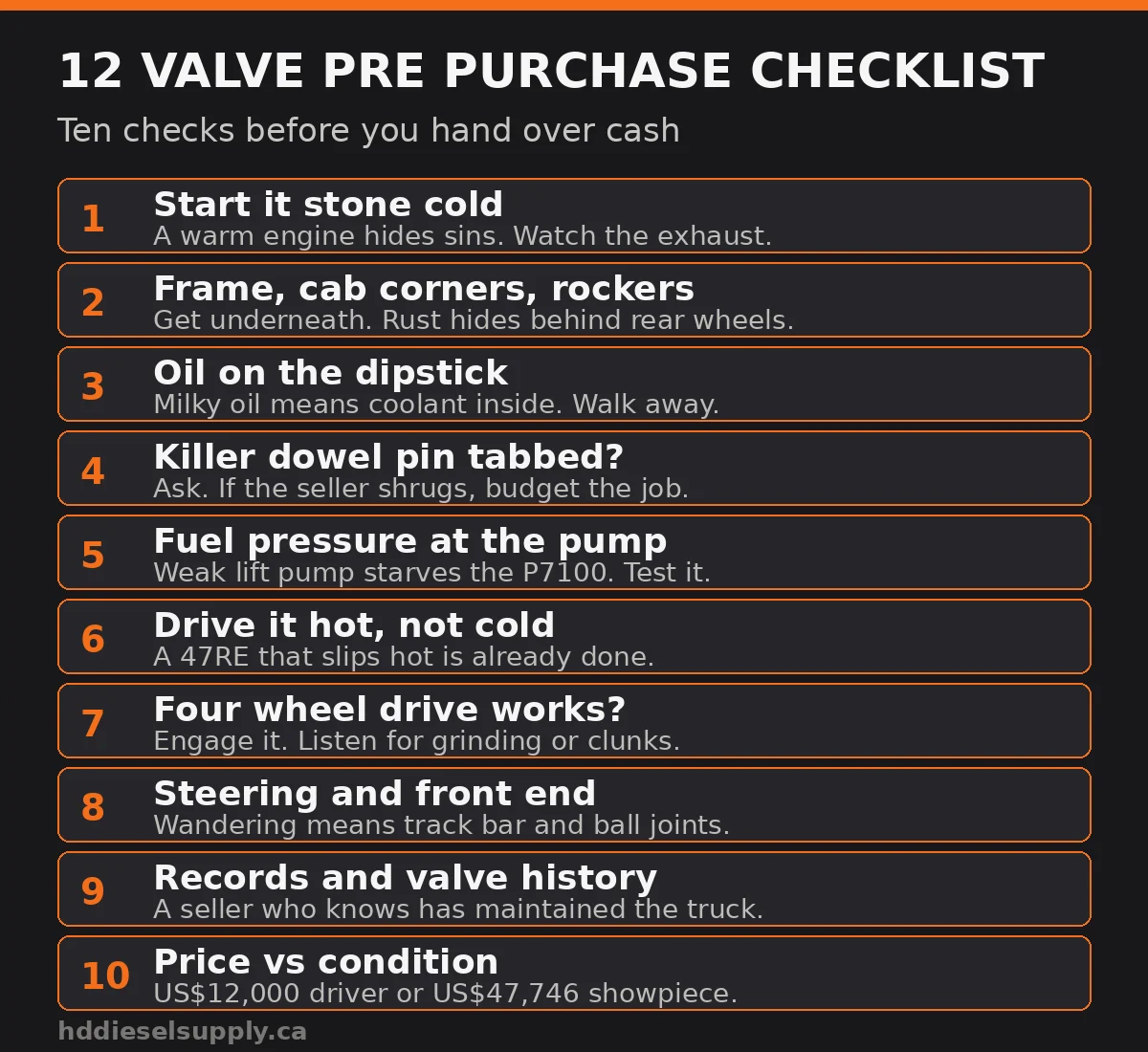
Check the frame rails, the cab corners, the rocker panels, and the bed supports for rust, and get underneath with a flashlight because the worst of it hides behind the rear wheels. Pull the dipstick and look at the oil. Milky oil means coolant is getting in, and that is a walk away problem. Drive it with the transmission hot, not cold, and feel for a flare or a slip between gears, because a 47RE that shifts fine cold and slips hot is already done. Test the four wheel drive, the brakes, and the steering, and listen for the front end clunks that mean ball joints and track bar work is due. Ask for the killer dowel pin tab, the lift pump age, and the last valve adjustment, because a seller who knows those answers has maintained the truck.
My call on the 12 valve
The 5.9 Cummins 12 valve is the engine I recommend when an owner asks me what old diesel to buy and actually means it. It is not the fastest, the quietest, or the most comfortable truck you can buy for the money, and a clean one costs real money now. But it is the last diesel you can keep alive with a toolbox, a pressure gauge, and a parts catalogue, and that is a freedom no new truck offers. Buy the cleanest P7100 truck you can afford, fix the dowel pin, budget for the transmission, and you will own a truck that outlives the payments on anything new.
Frequently asked questions
Should I buy a 12 valve Cummins in 2026?
Buy one if you want the simplest diesel you can still fix with hand tools, you tow or haul for work, and you can find a truck with a solid frame and honest records. Pay for a pre purchase inspection, check the frame, cab corners, and oil pan for rust, and budget for the transmission, because the 47RE automatic is the weakest part of the package. Walk away from a cheap truck with no history, because a 12 valve that was run hard and parked wet is still a 25 year old truck.
12 valve vs 24 valve Cummins: which one should I choose?
Choose the 12 valve if you want mechanical simplicity, no electronics in the fuel system, and an engine you can diagnose with a wrench and a pressure gauge. Choose the 24 valve if you want more stock power, a quieter truck, and you are comfortable with the VP44 injection pump and its lift pump problems. My full rundown of every Cummins generation, from the 12 valve to the 6.7, is in my Cummins generations guide, and the gap in complexity between the two is bigger than the gap in power.
How many kilometres will a 12 valve Cummins last?
With regular oil changes and a cooling system that is actually maintained, one million kilometres is a realistic expectation, and plenty of these engines have passed that mark in work service. The block, crank, and rods are not the limiting factor. What ends a 12 valve is usually rust in the frame and body, a tired automatic transmission, or an owner who stops spending money on the small things until the small things become one big bill.