
Your trailer already made this decision. If you tow a fifth wheel RV, buy a fifth wheel hitch, because the trailer has a kingpin and nothing else fits it properly. If you tow flatbeds, livestock trailers, or equipment haulers, buy a gooseneck, because those trailers come with a coupler tube made for a ball. If one truck has to tow both kinds of trailer, put a gooseneck base in the bed and drop a fifth wheel hitch into it when the RV hooks up.
- A fifth wheel RV takes a fifth wheel hitch. A flatbed or livestock trailer takes a gooseneck. The trailer decides, not the truck.
- A gooseneck hitch is rated higher on paper, 30,000 lb gross trailer weight against 20,000 lb for a common fifth wheel hitch, but your truck payload is the real ceiling on both.
- A gooseneck ball weighs about 10 lb and flips over to leave a flat bed. A fifth wheel hitch weighs 100 to 250 lb and needs two people or a hoist to lift out.
- Verified Canadian prices, November 2026: B&W Turnoverball gooseneck kit C$837.27, B&W Companion fifth wheel hitch $1,790.36, Companion slider $3,072.38.
Your trailer already made this decision, you just have to listen to it. If the trailer in your driveway is a fifth wheel RV, buy a fifth wheel hitch. If it is a flatbed, a livestock trailer, or an equipment hauler, buy a gooseneck. The only owners who need to think harder are the ones towing both kinds of trailer with one truck, and for them the answer is a gooseneck base in the bed with a fifth wheel hitch that drops into it when the RV hooks up. Everything below is the reasoning behind that verdict, plus the numbers that prove it.
What actually connects to what?
A fifth wheel hitch is a flat plate with a set of jaws that sits in the truck bed. The trailer carries a kingpin, a steel pin that hangs down from the front of the trailer, and when you back under it the pin slides into the jaws and locks. The plate carries the pin weight and the jaws carry the pull. It is the same idea as a semi truck, scaled down for a pickup.
A gooseneck hitch is a ball. A 2 5/16 inch steel ball mounts to the truck frame and sticks up through the bed floor, and the trailer carries a coupler tube that drops over the ball and latches around it. The whole connection is one ball and one socket, which is why gooseneck hardware is so simple and so strong.
Both systems put the trailer weight over the rear axle or just ahead of it, and that is the real reason both tow far steadier than a bumper pull hitch. The weight sits on the truck instead of hanging off the back of it, so the trailer pushes the truck around a lot less in wind and on rough roads.
How much weight can each one really pull?
On paper the gooseneck wins. A B&W Companion fifth wheel hitch is rated at 20,000 lb gross trailer weight with 5,000 lb of vertical load. A B&W Turnoverball gooseneck is rated at 30,000 lb gross trailer weight with 7,500 lb of vertical load. Those are hitch ratings, and the gap looks big.
In practice the gap matters less than it looks, because the truck caps the rig first. Chevrolet rates a 2026 Silverado 3500 HD dually with the Duramax and the Max Trailering Package at 32,000 lb with a fifth wheel hitch and 36,000 lb with a gooseneck. Same truck, same engine, same frame, and the gooseneck gains 4,000 lb. But almost nobody tows 32,000 lb behind a pickup, because payload runs out first.
That is the number to do properly. Pin weight on a fifth wheel is typically 20 to 25 percent of the loaded trailer weight. A 14,000 lb fifth wheel camper drops 2,800 to 3,500 lb onto the truck, and that weight counts against payload right alongside passengers, fuel, cargo, and the hitch itself. A one ton dually carries 5,500 to 7,500 lb of payload. A three quarter ton carries 3,500 to 4,500 lb. Run the math on your own door sticker before you trust any brochure number, because a hitch rated for 30,000 lb does not make a truck rated for 18,000 lb legal at 25,000 lb.
| Fifth wheel hitch | Gooseneck hitch | |
|---|---|---|
| Connection | Kingpin and jaws | Ball and coupler tube |
| Common max gross trailer weight | 20,000 to 25,000 lb | 30,000 to 36,000 lb |
| Common max vertical load | 5,000 to 6,250 lb | 7,500 to 8,000 lb |
| Typical pin weight | 20 to 25 percent of trailer | 15 to 25 percent of trailer |
| Hitch hardware weight | 100 to 250 lb | About 10 lb for the ball |
| Bed space when unhooked | Rails or pucks stay in the bed | Ball flips over, bed is flat |
What happens to your truck bed when you unhook?
This is where the gooseneck wins clearly, and it is the reason so many farm and work trucks run one. The ball weighs about 10 lb. Flip it over and the bed is flat. You can load pallets, slide in a toolbox, or haul a load of lumber five seconds after unhooking the trailer.
A fifth wheel hitch is a different job. The hitch itself weighs 100 to 250 lb, depending on the model, and it sits on rails or in the factory puck system. Lifting it out is a two person job or a hoist job, and the rails stay in the bed even when the hitch is out. If your truck is a work truck six days a week and a tow rig on the seventh, that matters. If the truck is a dedicated RV tow rig, it does not, because the hitch lives in the bed all season anyway.
The factory puck system softens this a lot. Ram, Ford, and GM all sell a factory fifth wheel and gooseneck prep package now, and with it both hitches drop in and lift out without rails bolted through the bed. If you are ordering a new truck and you plan to tow heavy, get the prep package from the factory. Retrofitting it later costs more and takes a full day in the shop.
Which one rides smoother behind the truck?
The fifth wheel, in most cases. The kingpin sits tight in the jaws with very little slack, so the trailer and the truck move as one unit. Owners who switch from a gooseneck to a fifth wheel usually notice the difference on the first rough stretch of highway: less fore and aft chucking, less banging over expansion joints, a quieter ride in the cab.
A gooseneck has more movement in the joint by design. The ball and socket can pivot and shift a little, and on a rough road that shows up as chucking, the trailer pushing and pulling against the truck in small jerks. It is not dangerous, and a good air ride pin box or an air ride coupler takes most of it out, but it is real, and it is one reason RV makers build fifth wheel campers instead of gooseneck campers.
Turning is the one place the gooseneck has the edge. The coupler sits further forward in the bed and the trailer nose is narrower, so a gooseneck turns tighter without the trailer threatening the cab. A fifth wheel on a short bed needs a slider hitch to do the same job, and the slider costs real money. My guide to tow haul mode covers what changes when you press the button, and it matters here too, because a heavy trailer on a grade wants tow haul on and the exhaust brake working with it, whichever hitch is in the bed.
What will it cost you in Canada?
I checked real Canadian prices on 14 November 2026, so these are not catalogue guesses. A B&W Turnoverball gooseneck kit, part number GNRK1400, lists at C$837.27 at Tdot Performance, a Canadian retailer. A B&W Companion fifth wheel hitch, part number RVK3500, lists at $1,790.36 at MyTruckPoint. A Companion slider for a short bed, part number RVK3670, lists at $3,072.38 at VMCustoms.
So the gooseneck costs about half the fifth wheel hitch, and a short bed fifth wheel setup with a slider costs nearly four times the gooseneck. Install is extra on both, and it varies by truck, but the pattern holds: the gooseneck is the cheaper hitch to buy and the cheaper hitch to live with. The fifth wheel costs more because it is a bigger piece of hardware with jaws, a plate, and a height adjustment mechanism, and the slider adds a whole second mechanism on top.
Three questions that settle it
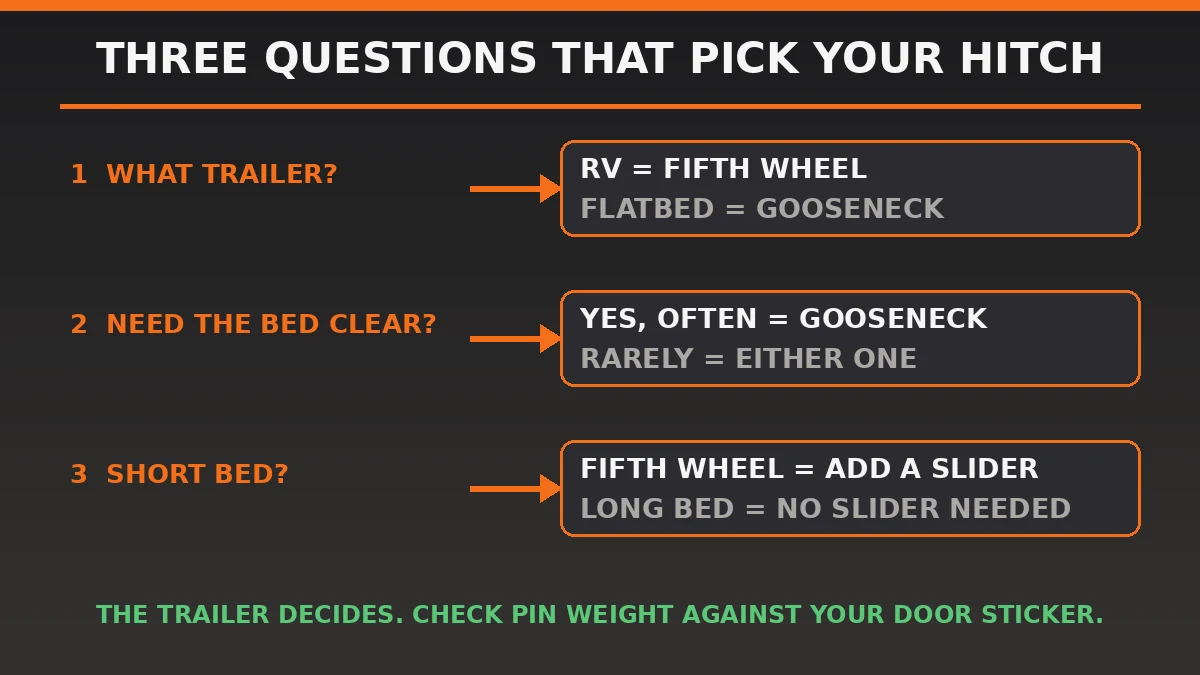
Answer these three in order and you will have your answer. First, what trailer are you towing? A fifth wheel RV takes a fifth wheel hitch, full stop, and a flatbed or livestock trailer takes a gooseneck. Second, how often do you need a flat bed for work? If the truck hauls cargo most days and tows on weekends, the gooseneck ball that flips out of the way wins. Third, is your bed short? A fifth wheel on a short bed needs a slider, which adds more than a thousand dollars to the bill, while a gooseneck bolts in and turns without one.
If the first question has two answers, because one truck tows an RV and a flatbed, then the answer is both hitches on one base. Put the Turnoverball in the bed, tow the flatbed off the ball, and drop a Companion fifth wheel hitch into the same base when the RV hooks up. It is the most common setup I see on trucks that do real work and real camping, and it costs less than buying two separate hitch systems.
Can one truck tow both kinds of trailer?
Yes, and there are two honest ways to do it. The first is the one above: a gooseneck base with a fifth wheel hitch that drops into it. The Companion was designed for exactly this, and swapping between the two takes a few minutes with no tools.
The second way is the Reese Goose Box, which replaces the pin box on a fifth wheel camper with a gooseneck coupler, so the camper hooks to a ball. This one carries Lippert approval, and that matters, because Lippert builds most RV frames and a frame warranty is worth protecting. A cheap adapter that clamps onto the existing pin box does not carry that approval, and it puts bending force into a pin box that was built to be pulled straight, not levered from the side. If your camper is under warranty, do not cheap out on the adapter.
Whichever route you take, the rule from the top of this page still holds. The trailer decides the hitch. Buy the hitch for the trailer you own, check the pin weight against your door sticker before you believe any tow rating, and if one truck has to do two jobs, spend the money once on a base that handles both instead of buying the wrong hitch twice.
Frequently asked questions
Should I put a gooseneck adapter on my fifth wheel camper?
Only if it is the right kind. The Reese Goose Box replaces the whole pin box and carries Lippert approval, which matters because Lippert builds most RV frames. A cheap adapter that clamps onto the existing pin box does not carry that approval, and it can void your frame warranty while putting bending force into a pin box that was never designed for it. If you want one truck to tow both, the cleaner route is a gooseneck base in the bed with a fifth wheel hitch that drops into it, so the camper keeps its proper kingpin.
Fifth wheel vs gooseneck: which one tows better?
Neither one tows better in a general sense, they tow differently. A fifth wheel rides smoother, because the kingpin sits tight in the hitch jaws with little slack, so you feel less fore and aft chucking on rough roads. A gooseneck carries a higher raw rating, 30,000 lb gross trailer weight against 20,000 lb for a common fifth wheel hitch, and it turns tighter. But both ratings sit far above what most trucks can legally pull, because payload and gross combined weight rating cap the rig long before the hitch rating does. Pick by the trailer you own, not by the bigger number on the box.
Do I need a slider hitch for a short bed fifth wheel?
On a short bed, yes, budget for one. A fifth wheel trailer swings its nose toward the cab in a tight turn, and on a 5.5 or 6.5 foot bed the nose can hit the back of the cab before you finish the turn. A slider moves the hitch back 10 or 12 inches while you manoeuvre, then slides it forward again for towing. On an 8 foot long bed you do not need one, the bed is long enough that the trailer clears the cab on its own. A gooseneck does not have this problem the same way, because the coupler sits further forward and the trailer nose is narrower.
Can I install a gooseneck hitch myself?
On many trucks, yes, if you are comfortable with a drill and a torque wrench. A B&W Turnoverball kit is a bolt on job that needs a 4 inch hole in the bed floor for the ball, and the frame brackets bolt to existing holes on most applications. The critical part is the torque spec on the frame bolts, so use a torque wrench, not a guess. If your truck has the factory puck system, it is even simpler: the gooseneck ball drops into the centre puck and locks in. If the idea of cutting a hole in your own truck bed makes you nervous, a shop does the whole job in a few hours.