
Tow haul mode changes how your automatic transmission behaves when you tow. It holds each gear longer, downshifts sooner when you lift off or touch the brakes, locks the torque converter sooner so it slips less and runs cooler, and on some trucks it keeps the top gear out until you are cruising steady. It adds no power and it is not a performance switch, it just stops the transmission from hunting between gears under load.
- Tow haul holds gears longer, downshifts earlier for engine braking, and locks the torque converter sooner, which keeps transmission fluid cooler under load.
- GM says it works best when truck and trailer together weigh at least 75 percent of the gross combined weight rating, and it gives no benefit on an empty truck.
- On a Ford 10 speed, owners report tow haul holds ninth gear until about 58 mph, where normal mode is already in tenth at 50 mph.
- Press it with the trailer on, leave it off empty, and use it with the exhaust brake on a long grade.
Press the tow haul button and four things change at once. The transmission holds each gear longer before shifting up. It downshifts sooner when you lift off the throttle or touch the brakes. The torque converter locks up sooner and stays locked. And on some trucks the top gear stays out until you settle into a steady cruise. Nothing under the hood gains power. The engine makes exactly what it made before. All the button does is tell the transmission to stop behaving like it is empty and start behaving like it is working.
That distinction matters because owners treat the button like a power switch. It is not. GM says so in plain words in its own service manual: the tow haul switch is not a performance switch. It is a shift strategy, and it earns its keep by keeping the transmission out of trouble.
What changes the moment you press the button?
First, the upshift points move. At light to mid throttle the transmission waits longer before shifting up, so the engine stays in its torque band instead of lugging in the next gear. On an older GM truck the minimum first to second shift moves out about 8 mph, second to third about 15 mph, and third to fourth about 30 mph. Modern 8 and 10 speed trucks do the same thing in smaller steps, and you feel it as the truck holding a gear through a hill instead of shifting up and straight back down.
Second, the downshift points move. Lift off the throttle on a grade and the transmission drops a gear instead of coasting up into overdrive. Touch the brakes and it drops another. That is engine braking, and it is the change you notice most on the way down a mountain, because the truck starts holding its own speed instead of gaining on the trailer.
Third, the torque converter locks up sooner and stays locked. In normal mode the converter slips to keep shifts smooth, and that slip makes heat. In tow haul the converter clutch applies from second gear and stays applied through the upper gears, and at closed throttle it stays applied at lower speeds than normal. A locked converter is a direct mechanical link, so less energy turns into heat in the fluid. GM's manual states the result plainly: significantly lower transmission sump temperature when towing heavy loads.
Fourth, the top gear gets picky. On a 2008 Ram, tow haul disables fifth gear and changes the second to third and third to fourth shift patterns, while still allowing overdrive during a steady cruise. On a 2023 and newer Super Duty with the 10 speed, owners report the same idea in modern form: in normal mode the truck is in tenth gear at 50 mph, while in tow haul it holds ninth until about 58 mph. The gear is not gone. The truck just refuses to use it until the load and the speed both say it is safe.
Normal vs tow haul on the same stretch of road
Picture the same truck pulling the same trailer up the same hill, once in each mode. The difference is not speed. It is how busy the transmission is.
| Normal mode | Tow haul mode | |
|---|---|---|
| Upshifts | Early, for fuel economy, then shifts back down on the hill | Delayed, engine stays in its torque band |
| Downshifts | Late, truck coasts and gains speed downhill | Early, on lift off and on braking, for engine braking |
| Torque converter | Slips for smooth shifts, unlocks often | Locks from second gear, stays locked, less heat |
| Top gear | Used as soon as speed allows | Held back until steady cruise |
| Shift count on a hilly road | Constant hunting between gears | Fewer shifts, each one firmer |
| Transmission temperature | Climbs under a heavy load | Lower sump temperature, per GM |
The hunting is the part that costs owners money. Every shift is clutch packs engaging and releasing, and a transmission that shifts forty times on a hilly stretch wears those packs and heats that fluid far faster than one that shifts ten times. Tow haul trades smooth for steady, and steady is what a loaded transmission wants.
When should you press it?
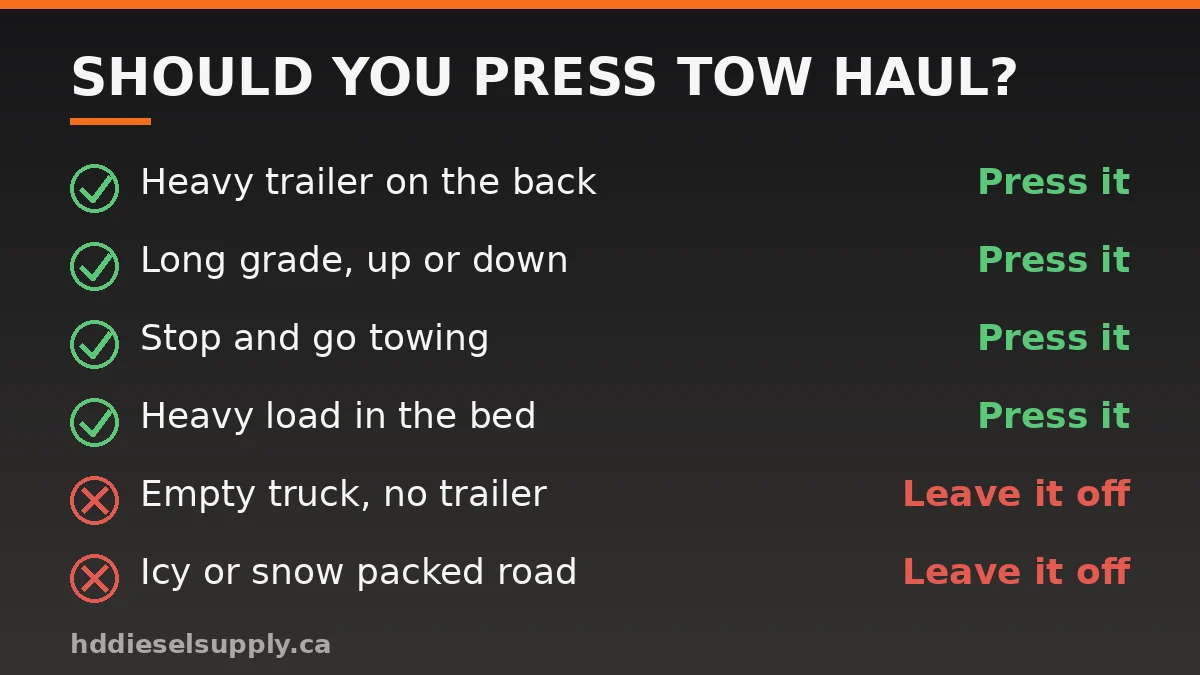
GM gives the clearest rule in the industry, and it is a good one to borrow whatever brand you drive. Tow haul is designed to be most effective when the vehicle and trailer combined weight is at least 75 percent of the gross combined weight rating. Below that weight the mode still works, but the benefit shrinks, and on an empty truck there is none at all.
In practice I tell owners to press it in four situations. A trailer that weighs enough to feel on a hill. A long grade in either direction, up or down. Stop and go towing, where the transmission would otherwise shift on every block. And a heavy load in the bed, like a slide in camper, because the truck cannot tell a bed load from a trailer.
One more detail from the owner's manual side: on many Rams the button resets every time you shut the truck off, so you press it again at every start. If the dash light is not on, the mode is not on, and a lot of owners who think they tow in tow haul have never actually turned it on.
When should you leave it off?
An empty truck is the main one. The higher revs and firmer shifts buy you nothing without a load, and you will burn a little more fuel for the privilege. GM says so directly: operation in a lightly loaded or non loaded vehicle will not cause damage, but there is no benefit, and the shifts will feel firm.
The second case is ice. Tow haul downshifts aggressively when you lift off, and engine braking only brakes the drive axle. On a slick road that can break traction at the rear wheels, so on snow packed pavement or ice, switch it off and let the service brakes, which work on all four corners, do the job. The same caution applies to the exhaust brake, and it is the reason my guide to the exhaust brake tells owners to switch that off on ice too.
Around town with an empty bed, tow haul also gets annoying. The firm shifts and the reluctance to upshift make stop and go driving feel jerky, and there is no trailer to justify it. Press it when the trailer is on, leave it off when it is not, and the button will never bother you.
Does tow haul mode damage your transmission?
I hear this one at the counter, usually from an owner who pressed the button once, felt the firm shift, and decided the truck was hurting itself. It is backwards. The firm shift is the protection. A slipping shift feels smooth and makes heat. A firm shift engages the clutch packs quickly, with less slip and less heat, and that is why the fluid stays cooler.
I have pulled the dipstick on a 68RFE that towed a 12,000 lb fifth wheel all summer in normal mode and found fluid the colour of strong tea with a burnt smell. The same truck a season later, tow haul on every trip, came back with fluid still red. One truck is not a study, but it matches what the service manual says about converter lockup and sump temperature, and it matches what I see on the lift. The owners who cook transmissions are the ones who tow heavy in normal mode, not the ones who press the button.
The real risk is the opposite mistake: leaving tow haul off because the shifts feel rough, then wondering why the transmission runs hot on a long pull. If your truck has a transmission temperature gauge, watch it once with the mode on and once with it off on the same hill. The numbers will settle the argument faster than I can.
Three tow haul myths that cost owners money
The first myth is that tow haul adds power. It does not. Your engine makes the same torque in either mode. What changes is where the engine runs, because holding a lower gear keeps the revs where the torque lives. A truck that feels stronger in tow haul is not making more power, it is finally using the power it already had.
The second myth is that tow haul locks out overdrive forever. It does not, at least not on most trucks. The Ram manual allows overdrive during steady cruise even in tow haul, and the Ford 10 speed will still reach tenth gear once you are fast enough and the load is steady. The mode delays the top gear, it does not delete it.
The third myth is that you should leave it on all the time, just in case. That costs fuel on an empty truck and makes every drive feel like you are towing a trailer that is not there. It is a towing tool, not a driving mode. Press it when the weight is on, switch it off when the weight comes off, and it will be there when the next trailer hooks up.
Press the button before the hill, not halfway up it. Let the transmission settle into the gear it wants, let the converter lock, and let the engine do the braking on the way down. A transmission that shifts ten times on a grade will outlive one that shifts forty times, and the only thing standing between those two numbers is a button on the end of your shifter.
Frequently asked questions
Should I use tow haul mode every time I tow?
Yes, whenever the trailer is heavy enough that you feel it. If the truck is hunting between gears on a hill, or the trailer pushes you on the way down, press it. GM puts a number on it: tow haul works best when truck and trailer together weigh at least 75 percent of the gross combined weight rating. A light utility trailer on flat ground gets little benefit, but pressing the button does it no harm either.
Tow haul vs exhaust brake: which one do I need?
They do different jobs, and on a grade you want both. Tow haul changes how the transmission shifts, holding gears and downshifting sooner. An exhaust brake chokes the exhaust to build backpressure and turn the engine into a brake. Tow haul gets the transmission into the right gear, and the exhaust brake does the slowing once it is there. My guide to the [exhaust brake](/posts/exhaust-brake-explained/) covers how the two work together on a long descent.
Does tow haul mode hurt fuel economy?
On an empty truck, yes, a little. It holds higher revs and delays upshifts, so the engine burns more fuel for the same speed, and GM is blunt that there is no benefit to running it unloaded. With a heavy trailer it can go the other way, because a transmission that stops hunting between gears wastes less energy than one that shifts every few seconds. The fuel saving comes from fewer shifts, not from the mode itself.
Can tow haul mode damage my transmission?
No, it protects it. The whole point is less slip and less heat. GM's own service manual says tow haul keeps the torque converter clutch applied from second gear up, which lowers transmission sump temperature when towing heavy loads. The firmer shifts feel harsher than normal mode, but a firm shift is not damage, it is the clutch packs engaging with less slip. What damages a transmission is towing heavy in normal mode while the converter slips and the fluid cooks.