
An exhaust brake slows your diesel pickup by partly closing off the exhaust, so the engine has to push against its own backpressure and the truck slows without touching the service brakes. Every current heavy duty diesel pickup has one from the factory, Ram since the 2007.5 6.7 Cummins and Ford and GM since 2011, and it works best on long grades with tow haul on and the transmission holding a lower gear. Use it on every tow and it also keeps the variable geometry turbo vanes moving, which stops soot from gluing them stuck.
- A factory exhaust brake on a 6.7 Cummins reads up to 150 braking horsepower on the cluster gauge, and Cummins rated the High Output version at 222 braking horsepower at the wheels.
- It is not a Jake brake. A Jake brake opens the exhaust valves to dump compression, while an exhaust brake chokes the exhaust to build backpressure.
- Switch it on before the grade, with tow haul on, and let the transmission downshift. It fades out near 1,200 rpm, so revs are what make it work.
- A Pacbrake PRXB kit for a 2007.5 to 2018 Ram 6.7 lists at $1,857 US, roughly $2,618 Canadian, before install.
I was halfway down the Coquihalla with a fifth wheel pushing me along and my foot nowhere near the brake pedal. That is the whole point of an exhaust brake. Flip the switch and the engine stops helping you go and starts helping you stop. It partly closes off the exhaust, the engine has to push against its own backpressure, and that resistance slows the truck. No extra parts, no machine gun rattle like a Jake brake on a highway tractor, just the engine working against itself.
I have watched owners tow for years without touching that switch, then wonder why their brake pads are gone at 60,000 km. The switch is free and already in your dash, and on a mountain grade it does more for your brakes than any pad upgrade ever will.
How does an exhaust brake slow a 15,000 pound truck down?
On a Ram 6.7 Cummins the answer lives inside the turbocharger. The Holset variable geometry turbo uses a sliding nozzle ring that changes the size of the exhaust path through the turbine. Under power the ring opens up to let exhaust flow. Switch the exhaust brake on, lift off the throttle, and the ring slides to its minimum area and nearly closes the path. Exhaust pressure builds behind it, the pistons have to shove against that pressure on every exhaust stroke, and the engine turns into an air compressor that drags the truck slower.
The numbers are bigger than most owners expect. The cluster gauge on a 2013.5 and newer Ram reads up to 150 braking horsepower in Full mode, and Cummins rated the High Output 6.7 exhaust brake at 222 braking horsepower at the wheels. That is retarding force, not engine power, and it is why a loaded Ram can hold speed down a 6 percent grade with the driver barely touching the pedal.
Two things have to be true for that force to reach the road. The transmission has to be locked in gear, because a slipping torque converter swallows engine braking before it reaches the wheels, which is why tow haul matters. And the engine has to be spinning fast enough, because the brake fades out near 1,200 rpm. Hold it above 2,000 rpm and you get real holdback. Let it lug at 1,400 rpm and you get almost nothing.
Exhaust brake vs Jake brake: what is the difference?
Owners mix these two up constantly, and the names do not help, because both are engine brakes in the broad sense. They slow a truck in opposite ways.
| Exhaust brake | Jake brake | |
|---|---|---|
| How it slows you | Chokes the exhaust path and builds backpressure | Opens the exhaust valves at the top of the compression stroke and dumps the squeezed air |
| Where you find it | Every current diesel pickup, standard | Class 8 highway tractors and some medium duty trucks |
| Noise | Quiet, just a deeper exhaust note | Loud machine gun rattle, banned in some towns |
| Retarding power | Up to 150 braking hp on a Ram 6.7 gauge | Much stronger than any pickup exhaust brake |
| Cost | Standard on new pickups | Factory option on highway tractors |
Which diesel pickups have a factory exhaust brake?
Ram got there first and Ford and GM followed in the same model year. If your truck is on this list, the brake is already in the dash.
| Truck | First year | How it works |
|---|---|---|
| Ram 6.7 Cummins | 2007.5 | VGT nozzle ring closes, up to 150 braking hp on the gauge, Auto and Full modes from 2013.5 |
| Ford 6.7 Powerstroke | 2011, proper VGT brake from 2015 | Integrated with tow haul from launch, weak on the early trucks, 2015 second generation 6.7 got a true VGT brake with its own dash button |
| GM 6.6 Duramax | 2011 LML | Smart exhaust brake working with the Allison, tied into tow haul and cruise control |
The older trucks have nothing from the factory. A 5.9 Cummins, a 6.0 or 6.4 Powerstroke, and any Duramax older than the 2011 LML need an aftermarket kit if the owner wants engine braking.
How do you use it properly on a long grade?
The mistake I see most is switching it on halfway down the hill, after the brakes are already hot. Switch it on before the crest, with tow haul on, and let the transmission drop a gear or two before the grade starts. Auto mode holds your speed and applies only as much braking as the truck needs, which suits a rolling grade. Full mode pulls the speed down and holds it down, which is what you want on a steep one.
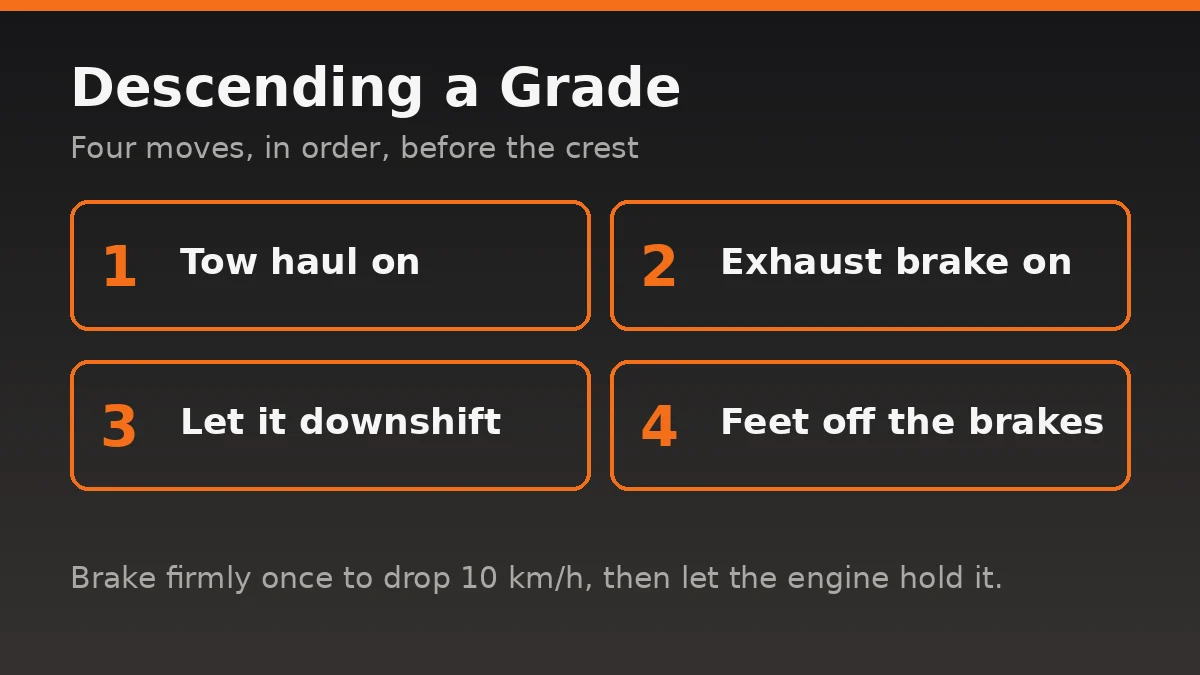
Keep your feet off the service brakes and let the engine do the work. If the speed still creeps up, brake firmly once to drop about 10 km/h, then get off the pedal and let the exhaust brake hold the new speed. Riding the pedal all the way down is how rotors warp and pads fade. Watch the tachometer, not the speedometer. If the revs fall toward 1,200 rpm the brake is fading and you need a lower gear, and tow haul will usually do the downshifting for you.
When should you leave it off?
An exhaust brake only brakes the drive axle, and on a slick road that matters. On ice or snow packed pavement the retarding force can break traction at the rear wheels and start the back end stepping out, so switch it off when the road is slick and use the service brakes, which work on all four corners. Around town with an empty truck, Full mode gets jerky, grabbing every time you lift off, and most owners switch it off until they hook up a trailer. The brake earns its keep on grades and with weight behind you, not in stop and go traffic. Switch it off when backing a trailer into a site, so the truck rolls freely at idle.
Why does my exhaust brake feel weak?
In my shop the most common exhaust brake complaint is not a dead brake. It is a 6.7 Cummins that towed all summer with the switch off, then the owner flips it on for the first mountain trip of the fall and nothing happens. Nine times out of ten the VGT nozzle ring is glued in place with soot. A hard working pull up a grade with the brake cycling will often free light soot. Heavy soot means the turbo comes off and gets cleaned, and my guide to how long diesel turbos last covers what kills them.
If the vanes move freely and the brake is still weak, work through the rest of the list. The electronic actuator on the Holset VGT is a known weak point, and if a scan tool shows the commanded vane position and the actual position disagreeing, the actuator is done. An exhaust leak upstream of the turbo bleeds off the backpressure the brake needs, so check the manifold and up pipe gaskets, and a boost leak costs braking the same way it costs power. Check the mode before you book the truck in. Auto mode on a gentle grade can feel like nothing because the truck does not need braking, and that is the system working, not a fault. Flip to Full, lift off the throttle at speed, and see if it pulls the truck down. One more cause hides in the transmission: if the torque converter is not locking up, the engine braking never reaches the wheels.
Should you add an aftermarket exhaust brake to an older truck?
If your truck never had one, a kit is the only way to get engine braking, and the two names that matter are Pacbrake and BD. A Pacbrake PRXB 4 inch inline kit for a 2007.5 to 2018 Ram 6.7 lists at $1,857 US on Pacbrake's own site, roughly $2,618 Canadian at the $1.41 exchange rate, before install. The 5 inch version lists at $1,980 US, roughly $2,791 Canadian. BD's inline electronic brake for a 2013 to 2024 Ram 6.7 is rated up to 150 retarding horsepower. Plan on a day in the shop for the install, plus wiring and a dash switch.
The owners who get their money back tow in the mountains with a 5.9 Cummins, a pre 2011 Duramax, or a truck that lost its factory brake to a non VGT turbo swap. If you tow twice a year on flat ground, the kit will never pay for itself. And if your turbo is tired, fix the turbo first.
The habit I teach every new tower
Leave the switch on, use Auto on rolling grades and Full on steep ones, switch it off on ice, and let the engine do the work your brake pads used to do. I have pulled brake pads off Rams with 100,000 km on them that still had life left, because the owner used the exhaust brake on every single tow. Learn it on a small hill first, with an empty trailer, and you will never tow a grade with your foot on the brake pedal again.
Frequently asked questions
Should I leave my exhaust brake on all the time?
Yes, on a Ram 6.7 Cummins I tell owners to leave it on. Every time you lift off the throttle the variable geometry turbo nozzle ring sweeps to its closed position, and that movement stops soot from gluing the ring stuck. Ram techs give the same advice for the same reason. The habit costs nothing and it is the cheapest turbo maintenance you will ever do. The one exception is an icy road, where any engine braking can break traction at the drive wheels, so switch it off when the road is slick.
Exhaust brake vs Jake brake: which one does my pickup have?
Your pickup has an exhaust brake. A Jake brake, properly a Jacobs compression release brake, opens the exhaust valves near the top of the compression stroke and dumps the air the piston just squeezed, and it lives on class 8 highway tractors. An exhaust brake does the opposite job in a quieter way: it chokes the exhaust path so backpressure builds and the engine has to fight itself. Pickups use the exhaust brake because it is simple, quiet, and strong enough for a truck that weighs a tenth of a loaded semi.
Why does my exhaust brake stop working on a cold morning?
The two usual causes are soot stuck turbo vanes and a dead actuator. Cold starts and short trips build soot, and the vanes stick in the open position, so the brake has nothing to close against. A hard working pull up a grade with the brake cycling often frees light soot. If a scan shows code P2262, or the commanded vane position and the actual position disagree, the actuator or the turbo needs hands on diagnosis. Forcing the switch will not fix either one.