
On a stock diesel pickup, a cold air intake is mostly a waste of money. The factory airbox on a modern 6.7 litre Cummins, Powerstroke, or Duramax already flows more air than the engine can use at stock power, and published dyno gains sit around 10 to 15 horsepower on a truck making close to 400. Buy one for the turbo sound and the look under the hood, or because you are building a tuned truck that needs more air. Buy one expecting a transformed truck and you will be disappointed.
- Published dyno gains for a bolt on intake on a stock 6.7 Cummins run about 11 to 18 horsepower, under 5 percent of stock output.
- A quality kit like the S&B lists at $379 US, roughly $535 Canadian, before shipping and tax.
- More airflow means a coarser filter. A stock paper element filters finer than an oiled cotton filter, which matters on dusty gravel roads.
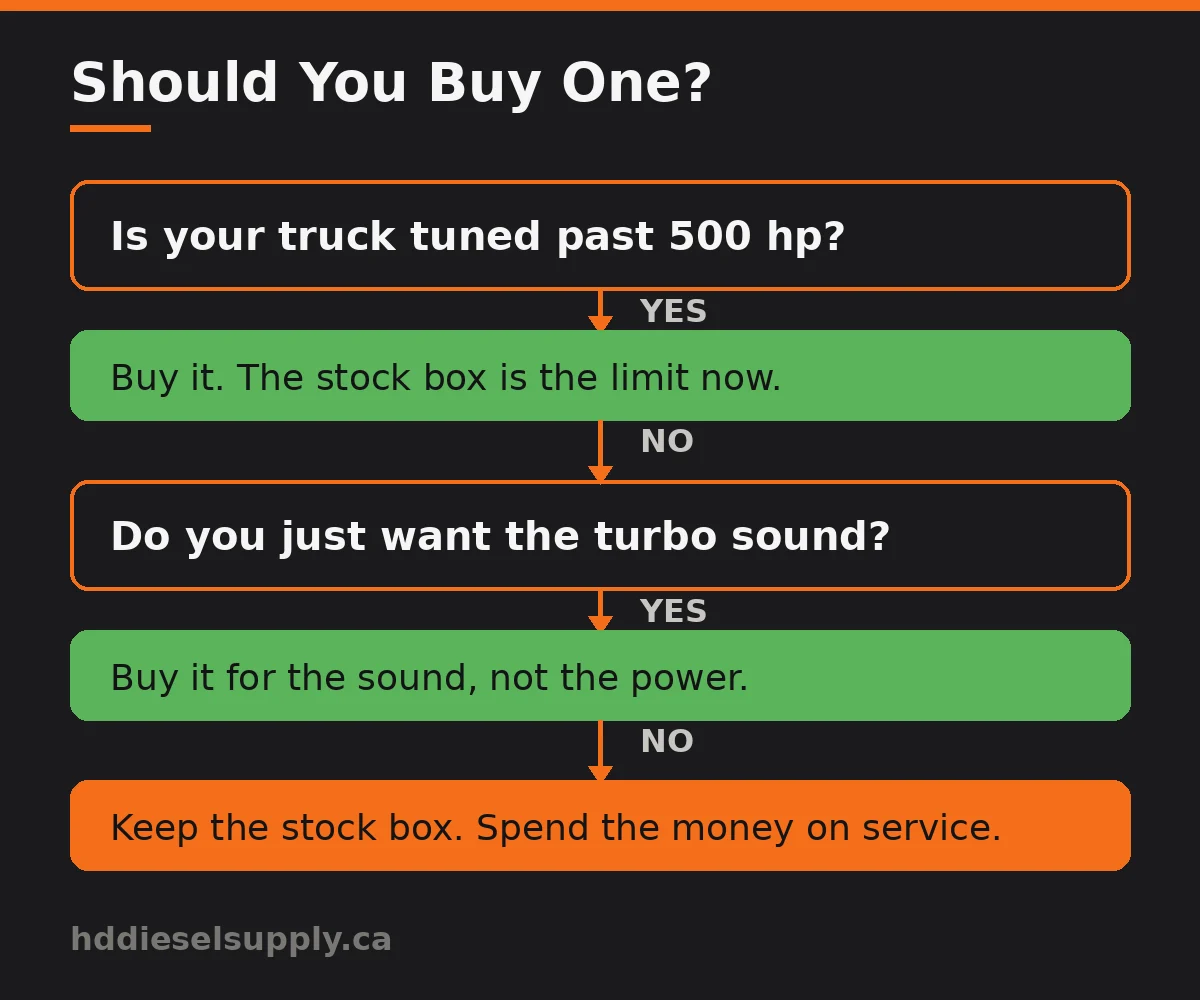
- The intake earns its money on a tuned truck making over 500 horsepower, or when you want the sound. On a stock daily driver, a fresh stock filter does more.
On a stock diesel pickup, a cold air intake is mostly a waste of money. The factory airbox on a modern 6.7 litre Cummins, Powerstroke, or Duramax already flows more air than the engine can use at stock power, and the dyno gains from a bolt on intake sit in the 10 to 15 horsepower range on a truck making close to 400. Buy one for the sound, or because you are building a tuned truck that needs more air, and it earns its keep. Buy one expecting a transformed truck and you will be disappointed.
I have fitted dozens of these kits in 14 years of turning wrenches in Alberta and Ontario, and I have taken just as many back off. The pattern never changes. The owner loves the sound for a month, then asks me why the truck does not feel any faster. The reason is simple: the stock intake was never the bottleneck.
What does a cold air intake actually change?
Three things, and only one of them matters on a diesel.
First, a bigger tube and a less restrictive filter let more air reach the turbocharger. Second, a sealed box that draws from the grille or fender pulls cooler air than an open filter sitting over a hot engine. Third, you hear everything. The turbo spool, the wastegate, the blow off between gears, all of it gets louder, and that noise is doing most of the work of convincing you the truck got faster.
Here is the part the box never mentions. A diesel does not breathe like a gas engine. The turbo compresses the intake air and heats it up, and then the intercooler cools it back down before it reaches the engine. A few degrees of cooler air at the filter disappears in that process. My guide to intercooler upgrades on a stock truck explains why the intercooler matters far more than the intake on a working diesel.
The factory box is a sealed, fender fed intake on most modern trucks, so it already draws cold air. The aftermarket kit mostly replaces a good cold air intake with a louder one.
What do the dyno numbers say?
Published dyno runs from the intake makers tell a consistent story, and it is a modest one.
| Kit, 6.7 Cummins | Claimed gain | Claimed airflow gain |
|---|---|---|
| S&B enclosed intake | 11 hp, 19 lb ft | 54.6 percent over stock |
| K&N 57 Series | 14.7 hp, 23.9 lb ft | Not published |
| Airaid MXP Series | 18 hp, 32 lb ft | Not published |
Eleven horsepower on a 385 horsepower truck is under 3 percent, and it shows up at peak revs, not in the midrange where you tow. The 54.6 percent airflow figure sounds enormous until you remember that airflow is not horsepower. An engine only uses the air it needs.
These are maker supplied or magazine dyno runs, done in ideal conditions. Your truck will not match them.
Stock box vs aftermarket intake
| Stock airbox | Aftermarket intake | |
|---|---|---|
| Cost | About $40 for a paper filter | $379 US, roughly $535 Canadian, plus shipping and tax |
| Power on a stock truck | Baseline | About 10 to 15 hp at peak |
| Filtration | Finest, paper element | Coarser, more flow means more fine dust passes |
| Sound | Quiet | Loud turbo spool and blow off |
| Service | New paper filter every 30,000 to 50,000 km | Wash and dry, or wash and reoil, on schedule |
| Warranty risk | None | Small, but real if a failure traces back to the filter |
The S&B kit for a 2013 to 2018 Ram 6.7 Cummins lists at $379 US, roughly $535 Canadian at the $1.41 exchange rate, before shipping and tax. That is real money for a part that adds less than 5 percent power.
The filter trade nobody talks about
Every filter is a compromise between flow and filtration, and you cannot improve one without giving up some of the other. A stock paper element is a fine filter. It traps the tiny dust that scores turbo compressor wheels and cylinder walls over time. An oiled cotton gauze filter flows more air because its pores are bigger, and bigger pores pass more fine dust. That is physics, not opinion.
S&B publishes 99.50 percent efficiency to the ISO 5011 test standard for its dry filter, which is a respectable number for an aftermarket filter, and still a step behind a fresh factory paper element. The gap is small on a highway truck. It gets bigger on a truck that works gravel roads, oilfield lease roads, or construction sites in Alberta, where the air is full of fine dust all day. I have pulled dusted turbos out of trucks running oiled filters on gravel. My article on how long diesel turbos last covers what kills them, and dust is on the list.
Over oil a filter after a cleaning and the excess oil migrates downstream, coating the mass airflow sensor on trucks that have one and throwing codes. A dry filter avoids all of that, which is why it is the only type I recommend if you do buy a kit.
When does an intake earn its money?
Three situations, and they are all specific.
A tuned truck making over 500 horsepower genuinely needs more air, and the stock box becomes a real restriction once the turbo is pushing far more boost than factory. A truck with a bigger aftermarket turbo needs the intake to match, and a truck towing heavy at altitude sees more benefit than one running empty at sea level.
The last reason is honest even if it is not about power: you want the sound. A diesel with an open intake sounds like a diesel should, and plenty of owners are happy to pay for that.
When should you leave the stock box alone?
A stock truck that tows on weekends and commutes during the week. A truck still under powertrain warranty. A work truck that lives on gravel. A truck with a boost leak or a tired turbo, where the money belongs in diagnosis first. In every one of those cases the stock box wins.
A fresh stock paper filter every 30,000 to 50,000 km does more for a stock truck than a $535 intake ever will. If your 6.7 Cummins is due for service, my guide to the best oil for the 6.7 Cummins is a better place to spend the afternoon.
What I would spend the money on instead
If your truck is stock and running well, put the $535 toward a transmission service, a set of gauges, or a fuel filter change. Those are the things that keep a diesel alive past 300,000 km. An intake is a finishing touch for a built truck, not a starting point for a stock one.
Frequently asked questions
Should I put a cold air intake on my stock diesel?
No, not for power. A stock 6.7 litre diesel already breathes well enough through the factory box, and the 10 to 15 horsepower an intake adds is not something you will feel in the seat. The one honest reason to buy one on a stock truck is the sound: you will hear the turbo spool and the blow off between gears far more clearly. If that sound is worth $535 Canadian to you, buy it with open eyes. If you want a faster truck, spend the money on maintenance first.
Cold air intake vs stock airbox: which one filters better?
The stock paper airbox filters better. It is a finer filter by design, and that is the trade you make for extra flow: bigger pores pass more air and more fine dust. S&B publishes 99.50 percent efficiency to the ISO 5011 test standard for its dry filter, which is good for an aftermarket filter, and still a step behind a fresh factory paper element. On a highway truck the difference is small. On a truck that works gravel roads in Alberta every day, it is the reason I tell owners to stay stock or pick a dry filter and service it on schedule.
Will a cold air intake void my diesel warranty?
An intake alone does not void a whole warranty, and in Canada a dealer has to show the part caused the failure before denying a claim. In practice the argument gets harder when the failure is connected to the intake. A turbo dusted out on a truck running an oiled filter gives a dealer something to point at, and that is a fight most owners lose. If the truck is still under powertrain warranty and you tow for a living, the safe play is to keep the stock box until the warranty ends.