

On a truly stock truck that runs cool, an intercooler upgrade is usually not worth the money. The stock unit was sized for stock boost and stock fueling. It becomes worth it when you tow heavy in heat and watch intake temperatures climb, when the truck is tuned and running more boost than stock, or when the factory core is damaged or leaking. Fix leaks and check your data before you buy parts.
- A stock daily driver with stable intake temperatures gains almost nothing from a bigger intercooler, so log your data first
- Towing trucks that heat soak on long grades can see 100 to 200 degrees lower exhaust gas temperatures with a good aftermarket core
- Cracked pipes, blown boots, and loose clamps are more common than a bad core, and a leak repair beats an upgrade every time
- Bigger is not automatically better: core size must balance cooling, airflow, fitment, and charge volume or you trade one problem for another
Every few months a customer asks me about an intercooler upgrade for a truck that is completely stock. The forums told them it is free horsepower. The parts store told them it is essential. So let me give you the answer I give them in the shop, which is: it depends on what the truck actually does, and most of the time the honest answer is to keep your money.
What the intercooler actually does
Your turbocharger compresses intake air, and compressing air heats it up. Hot air is less dense, which means less oxygen per gulp, which means the engine makes less power and runs hotter exhaust gas temperatures. The intercooler sits between the turbo and the intake and pulls that heat back out.
The factory sized your intercooler for factory boost and factory fueling. On a stock truck working a stock workload, that sizing is fine. The trouble starts when the workload grows past what the engineers planned for.
When the upgrade is worth it
There are three situations where I recommend one without hesitation.
First, towing heavy in heat. A truck pulling 14000 pounds up a long grade in July is asking the charge air system for everything it has. Intake temperatures climb, the core heat soaks, and power fades halfway up the hill while EGTs climb toward the danger zone. A quality aftermarket core with more thermal mass and better flow can drop exhaust gas temperatures by 100 to 200 degrees in exactly this scenario. That is not a marketing number. That is what the core is for.
Second, tuned trucks. The moment you add fuel and boost past stock levels, you have outgrown the stock core. More boost means more heat, and the factory unit was never asked to reject that much thermal energy. An intercooler upgrade belongs on the list right alongside the tuning, not as an afterthought two summers later when the truck starts pulling timing.
Third, a damaged stock core. Road debris, corrosion, and oil contamination kill factory intercoolers. If yours is compromised, replacing it with an upgraded unit instead of another stock one makes sense, since the labour is the same either way.
When it is a waste of money
A stock truck that commutes, runs errands, and tows a boat twice a summer does not need a bigger intercooler. If your intake temperatures stay within 15 to 20 degrees of ambient under your normal driving, the stock core is doing its job and a bigger one buys you nothing you can feel.
I will also be straight with you about the limits. In one published test on a tuned 6.4L Power Stroke, neither an aftermarket intercooler nor water injection made a measurable difference in an acceleration test with a 10000 pound trailer. Sometimes the rest of the system is the limit, not the core. Parts are not magic. Data tells you whether the core is actually the bottleneck, and guessing is how you spend 1500 dollars learning nothing.
Check the cheap stuff first
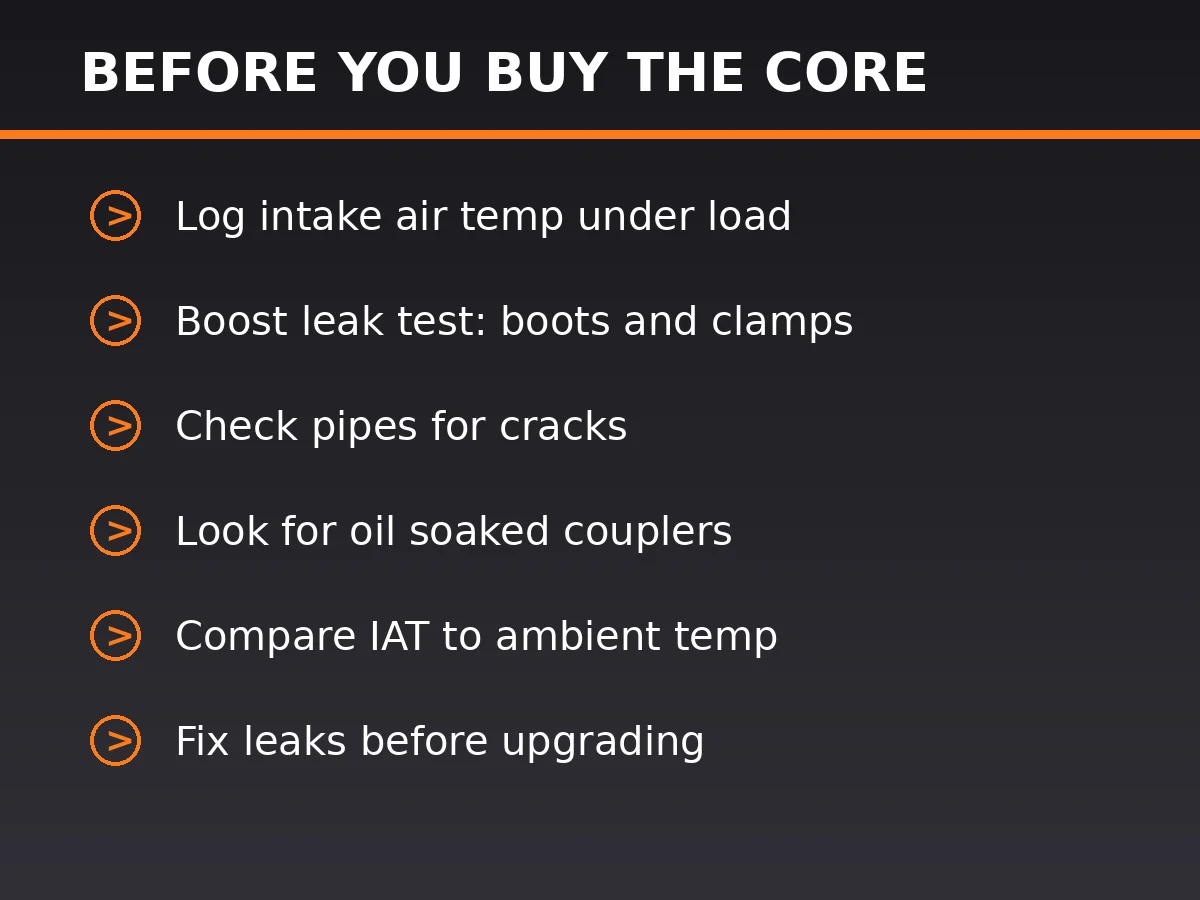
Before you blame the core, check the system around it. This is where I earn my keep, because the following are more common than a genuinely inadequate intercooler:
Boot blow off or split boots. The rubber couplers between pipes live a hard life with heat and pressure cycles. A torn boot leaks boost and mimics every symptom of a weak core.
Loose clamps. T bolt clamps loosen over time. A boost leak test finds these in minutes.
Cracked plastic end tanks or pipes. Some factory pipes are plastic, and plastic gets brittle. Hairline cracks open under boost and close at idle, which makes them fun to chase.
Oil soaked couplers. A little oil mist in the charge system is normal on a high mileage diesel, but soaked boots slip off under boost.
Fix all of that first. A twenty dollar clamp beats a fifteen hundred dollar core when the clamp is the problem. If you want to find leaks properly, read my guide on turbo boost leak symptoms and do the soapy water test before you order anything.
What to buy if you do upgrade
Not all aftermarket cores are equal. A proven bar and plate core from a reputable builder cools better and survives longer than a cheap tube and fin knockoff. Bar and plate is heavier and costs more, but it resists heat soak and handles pressure spikes without ballooning.
Size it for the truck. Bigger is not automatically better. An oversized core can block airflow to the radiator, which is the last thing you want when the cooling system is already working hard on a grade. It also adds charge volume, which softens throttle response a touch. Match the core to your power level and your use case, and make sure it actually fits without hacking up the truck.
And do the before and after logs. Intake air temperature, EGT, boost, ambient temperature, speed, and load. Same hill, same trailer, same weather if you can manage it. That log is the difference between knowing the upgrade worked and hoping it did.
The bottom line
An intercooler upgrade on a stock truck that runs cool is money spent on a problem you do not have. The same upgrade on a truck that tows heavy, runs a tune, or has a tired stock core is one of the most honest improvements you can bolt on. It will not transform the truck. It will let the truck do its job without fading, and for a working diesel, that is worth more than any peak number.
Log your temperatures, fix your leaks, and let the data make the decision. That is what I would do if it were my truck and my money.
Related reading
- Turbo Boost Leak Symptoms: Finding Leaks the Soapy Way
- What Kills the CP4 Pump (and How to Protect Yours)
- How to Inspect a Used Diesel Truck Before You Buy
- Best Used Diesel Trucks to Buy in Canada Right Now
Frequently asked questions
Should I upgrade the intercooler on my stock diesel truck?
Probably not, and I say that as someone who likes selling parts. If the truck is stock, runs normal intake air temperatures, and does not tow heavy in hot weather, the factory intercooler is doing its job. Spend the money on maintenance instead. The upgrade earns its keep on trucks that work hard: heavy towing, hot climates, long grades, or tuning that pushes boost past stock levels. Data decides. If your intake temperatures stay near ambient under load, you do not have a problem to solve.
Will an intercooler upgrade add horsepower?
Not peak horsepower on its own, and anyone promising big dyno gains from just a core swap is overselling. What a good intercooler does is protect the power you already have. Cooler, denser charge air means the engine holds timing and makes consistent power pull after pull instead of fading as heat builds. On a tuned truck running higher boost, that consistency is worth real performance. On a stock truck doing grocery runs, you will never feel it.
What are the signs my stock intercooler is not keeping up?
Watch intake air temperature above ambient under sustained load. If IAT climbs 40 or 50 degrees over ambient on a grade and stays there, the core is heat soaked. Oil in the charge pipes, whistling under boost, or visible damage to the core are physical signs. And check the simple stuff first: a blown boot or loose clamp mimics a weak intercooler perfectly, and I have seen trucks get full core replacements when a 20 dollar clamp was the actual problem.
Are there downsides to a bigger intercooler?
A few. A thicker core can block airflow to the radiator, which matters when you are already working the cooling system hard. A much larger core adds charge air volume, which can soften throttle response slightly. Fitment can fight you on some trucks, and cheap cores with poor internal flow can actually cool worse than the stock unit they replaced. Buy a proven bar and plate core from a reputable builder, not the cheapest aluminum box on the internet.