
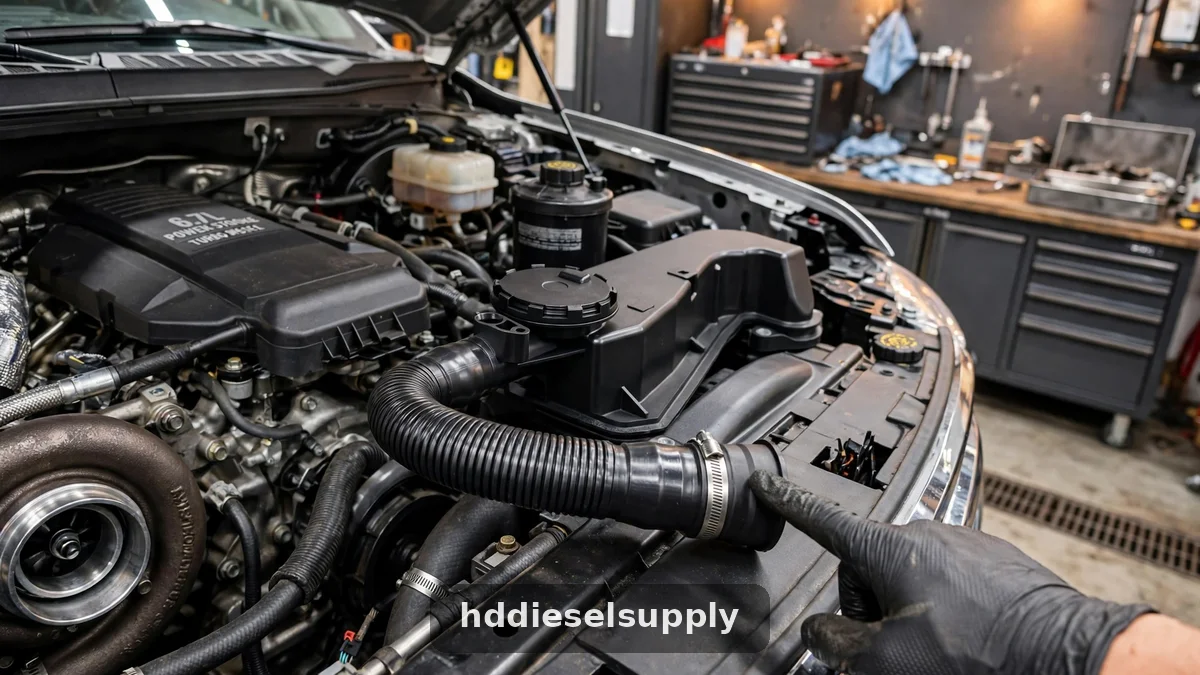
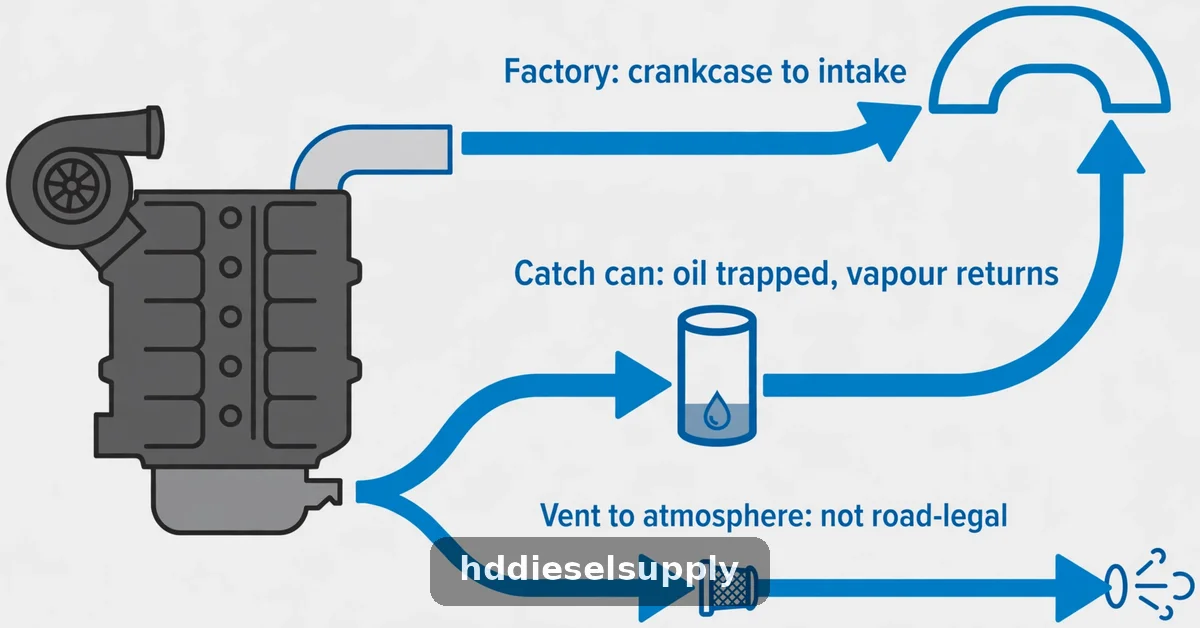
A 6.7 Powerstroke CCV delete reroutes crankcase vapour away from the intake instead of letting the factory system feed it back through the turbo. Owners do it because the oil mist in that vapour coats the intake, turbo, and intercooler over time. Venting blow-by to atmosphere is not road-legal, since crankcase ventilation is part of the emissions system, but a closed-loop catch can that keeps the loop intact gives you a cleaner intake without crossing that line.
- The factory CCV system routes blow-by gases and oil mist from the crankcase back into the intake, ahead of the turbo, so the engine re-burns them.
- Over time that oil mist coats the turbo compressor, charge pipes, intercooler boots, and intercooler. A light film is normal. Pooled oil or dripping boots is not.
- A catch can or separator traps the oil and sends the vapour back to the intake. A vent-to-atmosphere delete dumps the vapour outside, and that is not road-legal.
- A CCV reroute adds no real horsepower. Its only honest benefit is a cleaner intake tract over the long haul.
Pull the intake boot off a stock 6.7 Powerstroke with some miles on it and you will find the inside coated in a dark, oily film. Owners see that and start searching for a CCV delete before the boot is back on. I am a Red Seal heavy duty mechanic in Alberta and I have had this conversation in my shop plenty of times. Here is what I tell them, straight up.
What does the CCV system do on a 6.7 Powerstroke?
Every diesel pushes a little combustion gas past the piston rings. That is blow-by, and it carries oil mist, moisture, and unburned fuel with it. The crankcase has to breathe, and the factory CCV system handles that by routing the vapour from the valve cover back into the intake, upstream of the turbo. The engine re-burns the gases, and the crankcase stays at a controlled pressure.
On the 2011 to 2019 trucks that vapour passes through a replaceable filter element in the CCV housing. Later trucks moved to a sealed baffle box instead, so there is no filter element to swap. Either way the job is the same: separate out what oil it can, and send the rest back into the intake.
The system works fine when it is healthy. The trouble is that it works by putting oil mist exactly where you do not want it, mile after mile.
Why owners reroute it: oil in the intake and intercooler
The oil mist in the vapour does not just disappear. It condenses on the turbo compressor wheel, the charge pipes, the intercooler boots, and the intercooler itself. Owners call it boot soak or intercooler soak, and on a high-mileage truck that has spent its life towing, it is real. The film soaks the rubber boots, softens them, and over time that contributes to blow-offs and boost leaks under load.
Before you spend money on a kit, figure out how much oil you are actually looking at:
| What you see | What it usually means | First check |
|---|---|---|
| Light oily film inside the intake tube or charge pipe | Normal CCV oil mist built up over time | Clean it, drive the truck, and check again in a few weeks |
| Oily residue around charge pipe boots | Oil mist plus seepage under boost | Inspect the boots and clamps for looseness or wear |
| Oil pooling in the piping or dripping from a boot | Heavy blow-by, a turbo seal concern, or a restricted CCV path | Diagnose before buying anything |
That last row matters. A reroute kit hides the symptom. It does not fix worn rings or a failing turbo seal. If the truck is pushing real blow-by, test it first. Our guide on how to test for blow-by on a 7.3 Powerstroke walks through the same basic checks that apply to any diesel, and the principle is the same on the 6.7: confirm the engine is healthy before you start moving hoses around.
Catch can vs vent-to-atmosphere
This is where owners get confused, because the two options get sold under the same name. They are not the same thing.
| Setup | How it works | The catch |
|---|---|---|
| Closed-loop catch can | Vapour runs through a separator that traps the oil in a can you drain, then returns to the intake | You have to drain the can on schedule, and a frozen can in a cold Alberta winter is a real problem if you forget it |
| Vent-to-atmosphere delete | The factory path is blocked off and the crankcase vents straight outside, usually through a hose run down under the truck | It is not road-legal, it can smell, and it can drip oil on the driveway |
The closed-loop catch can is the one I recommend to owners who drive their truck on the street. It keeps the oil out of the intake, which is the whole point, and it keeps the vapour in the loop. The vent-to-atmosphere setup does the same job for the intake, but it trades a clean intercooler for an illegal truck and a smell you will notice every time you stand beside it at idle.
One more honest note. Neither setup adds horsepower. The forums sometimes sell a CCV delete like a performance mod. It is not one. The benefit is a cleaner intake tract over the long haul, and that is worth something, just not power.
Is a 6.7 Powerstroke CCV delete legal?
Here is the plain version. Crankcase ventilation is part of the emissions control system. Venting blow-by to atmosphere is tampering with that system, in the same category as other emissions deletes. It is not road-legal in Canada or the United States, and "I only drive it on the street sometimes" does not change that. A closed-loop catch can that keeps the vapour returning to the intake does not cross that line, because the loop stays intact.
I am not going to dress this up with numbers I cannot verify. The point is simple enough without them: if the vapour leaves the truck, the truck is not compliant. If it stays in the loop, it is.
What to do instead
If your intake is oily and you want to fix it without creating a new problem, work through it in this order.
First, check the engine. Pooled oil or heavy blow-by means something else is wrong, and a reroute kit will not fix it.
Second, check the CCV hardware itself. On the 2011 to 2019 trucks the filter element loads up with oil and soot over time, and a restricted filter pushes crankcase pressure up, which pushes oil past seals and into the boots. A fresh element is cheap maintenance compared to any kit. On the later trucks with the sealed baffle box, check the hoses and connections for cracks or blockage instead.
Third, if the engine is healthy and you still want the intake cleaner, fit a closed-loop catch can. Drain it on schedule, and drain it more often in winter. A full can that freezes is worse than no can at all.
If you are weighing this against the bigger delete question, read our 6.7 Powerstroke delete kit guide first. The same legal logic applies there, and the stakes are higher.
The bottom line
A 6.7 Powerstroke CCV delete is a simple answer to a real annoyance. The factory system really does coat your intake and intercooler in oil mist over time, and keeping that oil out is a reasonable thing to want. But the vent-to-atmosphere version makes your truck non-compliant, and it buys you nothing a closed-loop catch can does not already give you. Keep the engine healthy, keep the CCV hardware maintained, and if you want the intake cleaner, catch the oil and keep the vapour in the loop. That is the version of this job I would put on my own truck.
Frequently asked questions
Should I do a 6.7 Powerstroke CCV delete?
Not the vent-to-atmosphere kind, if the truck drives on public roads. Crankcase ventilation is part of the emissions system, so venting blow-by to atmosphere is tampering in the same way as other emissions deletes. A closed-loop catch can that keeps the vapour returning to the intake is the option that stays on the right side of that line.
Is oil in the intake normal on a 6.7 Powerstroke?
A light oily film inside the intake tube or charge pipes is normal on a stock truck. The factory CCV system sends oil mist through there by design. Pooled oil, oil dripping from an intercooler boot, or oil showing up alongside heavy blow-by is a different story and needs diagnosis first.
Does a CCV delete add horsepower?
No, not in any way you would feel. The benefit is intake cleanliness, not power. If a kit promises big horsepower gains, that is marketing, not mechanics.
What is the difference between a CCV reroute and a CCV delete?
A reroute moves the crankcase vapour out of the intake path, usually through a catch can or separator, and either returns it to the intake or vents it. A delete removes the factory ventilation path entirely and vents the crankcase straight to atmosphere. Only the closed-loop version, where vapour still returns to the intake, keeps the emissions loop intact.