

No, red diesel dye does not permanently stain your fuel system or wreck your engine. The dye colours the fuel itself, so it fades as clear fuel dilutes it, but it stains filter media, clings to lines and low spots, and can still show up on an inspector test long after the tank looks clear. Change the filters, run several tanks of clear fuel, and give yourself time before any inspection, especially if you used dyed fuel under the 2026 waiver.
- The dye is Solvent Red 164, dosed at 11.1 milligrams per litre, and it colours fuel rather than corroding metal.
- A metal tank is not permanently stained, but a fuel filter element stays pink until you change it.
- Test strips can pick up tiny traces, so a tank that looks clear to your eye can still test positive.
- Run the tank low, refill with clear fuel, change the filters, and repeat for several tanks before you assume you are clean.
No, red diesel dye will not permanently stain your fuel system. That is the short answer, and it is also the answer most pickup owners stop at, which is where the trouble starts. The dye does not corrode metal, it does not eat seals, and it does not leave a permanent red coating inside a steel or plastic tank. But it lingers in filter media, lines and low spots, and can still show up on a test weeks or months after you switched to clear fuel. That gap matters right now, with the 2026 waiver closing on December 31.
What the red dye actually is
The dye in United States dyed diesel is Solvent Red 164, dosed at a level spectrally equal to 3.9 pounds of the solid dye standard Solvent Red 26 per thousand barrels of fuel. In plain numbers that is 11.1 milligrams per litre. That sounds tiny, and it is, but it is deliberately strong enough to colour a whole tank a deep red, and strong enough to still show when dyed fuel is mixed into clear fuel.
Think of food colouring in water: a few drops turn the whole glass red, and one pour of clean water does not clear it. Diesel dye works the same way. It is a marker, not a corrosive.
Where the dye hides after you switch back
A bare metal or plastic tank does not hold dye like a sponge. Drain it, refill with clear fuel, and it is not permanently red. I have opened tanks that ran dyed fuel for years and found clean metal underneath. The tank is not your problem.
Your problem is everything the fuel touches on its way to the engine, starting with the fuel filter. Filter media is porous by design, and once it soaks up dyed fuel it stays pink until you throw it away. Cut one open and the element looks guilty even if the tank has been on clear fuel for a month.
Next are the lines and low spots. Fuel lines, the water separator bowl and return lines hold small amounts of dyed fuel after a switch, and unburned fuel returning to the tank mixes dye through the fresh fuel again. None of this is damage. All of it is dilution, and dilution takes time and volume.
How an inspector actually finds it
An inspector does not need to take your truck apart. The usual check is a dip of the tank and a look at the sample colour. If it is pink or red, the conversation is over. If it looks clear, some inspectors go further with a test strip that can pick up dye the eye cannot see. One commonly quoted field figure is as little as 1 gallon of dyed fuel in a 100 gallon tank, a 1 percent mix. Treat that as a warning, not a legal threshold, but the message is real: looking clear is not testing clear.
That is why a trucking warning quoted in October 2026 matters: it says dye can stay in a fuel system for up to six months unless flushed and cleaned, and a driver could face a citation after a relief period ends even if the fill happened while it was allowed. Six months is the cautious end of the range. A pickup that changes filters and runs clear fuel will clear far faster, but inspectors test the fuel in the tank on the day they test it, not your memory of when you bought it.
Do the dilution math before you panic
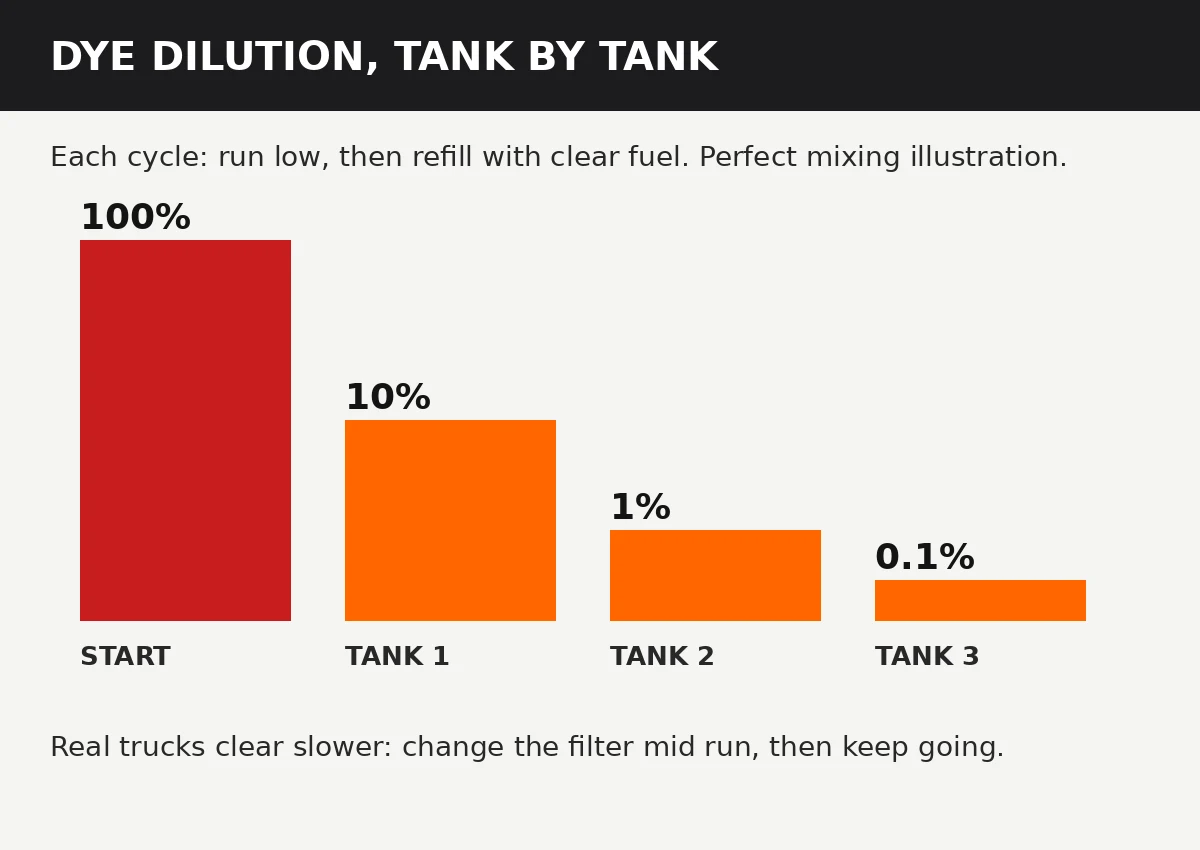
Here is the original number work for this article. Say you run a pickup tank down until only about a tenth of the fuel is left, then fill it with clear fuel. In a perfect mixing world, the dye concentration drops to a tenth of what it was. Do that again and it drops to a hundredth. A third cycle takes it to a thousandth. On paper, three good cycles take a full tank of dyed fuel below that 1 percent test strip figure above.
Real trucks are not perfect mixing worlds: the filter and separator bowl still hold dyed fuel, and dead legs do not flush on the first tank. So treat three cycles as the floor, and plan on four or five tanks of clear fuel, with a filter change in the middle, before you call the system clean.
The clean switch, step by step
- Run the dyed fuel down as low as you safely can before the first clear fill. Do not run the pump dry, but a low tank means less dyed fuel left to dilute the fresh fuel.
- Fill with clear fuel from a station you trust, and keep the receipt. That receipt is proof of when the switch happened.
- Drive a full tank, then change the fuel filters and drain the water separator bowl. This removes the pink filter media from the story.
- Run at least two more full tanks of clear fuel, then check the filter bowl. If the fuel there still shows a pink tint, change the filter again and keep going.
- Keep every fuel receipt from the switch onward, with filter change dates on the first one.
If you need the truck clean by the end of the 2026 waiver, work backwards from that date. A pickup burning a tank a week needs a month of clear fuel and a filter change. A parked truck needs draining, a clear refill, fresh filters, and a long enough run to circulate the fuel.
What not to do with dyed fuel
Do not try to strip dye out of fuel yourself. Online guides talk about bleach, acid and charcoal for turning red diesel clear. Ignore them. Stripping dye to dodge tax is fuel laundering, it is illegal, and those chemicals can wreck injectors, pumps and seals far faster than dye ever could.
Do not mix a little dyed fuel into clear fuel and hope nobody notices, and do not top a tank up daily after a dyed fill, because topping up never lets the concentration fall.
If you are thinking about using dyed fuel while the waiver lasts, read my breakdown of what the waiver covers and what it does not first. It pauses federal penalties in the United States until December 31, 2026, it does not make dyed fuel legal in Canada, and it does not forgive the federal tax.
My call for your truck
Red dye is not a death sentence for a fuel system. It is a stubborn marker that rewards patience and punishes shortcuts. Change the filters, run several tanks of clear fuel, and keep your receipts. If you drive a plated truck in Canada, the answer is simpler still, because Canada has no waiver. Clear fuel, fresh filters, and a drain of the fuel water separator now and then will keep your truck out of a conversation you do not want at the roadside.
Frequently asked questions
Should I change my fuel filters after running red diesel?
Yes, and do it once you are back on clear fuel, not while dyed fuel is still in the tank. A filter element holds dyed fuel in its media and will keep showing colour long after the tank has turned clear. Changing it removes the most visible trace in the whole system, and it is cheap insurance on any modern high pressure fuel system anyway. Keep the receipt and the date, because that paper trail is worth more than any explanation at the roadside.
Red diesel vs clear diesel: does the dye damage injectors or the DPF?
No. The dye itself does not damage injectors, pumps or a DPF. Modern dyed diesel is the same ultra low sulfur base fuel as clear diesel, so the dye adds no power and takes none away. What can hurt your truck is the tank the fuel came from. Old farm and jobsite tanks can carry water, rust and algae, and that contamination is a fuel quality problem, not a dye problem. If your truck ran rough on dyed fuel, suspect the fuel source, not the colour.
Should I buy a used truck that ran red diesel?
A history of dyed fuel use is not an automatic walk away, but it is a reason to ask questions. Ask when it last ran dyed fuel, whether the filters were changed after the switch, and whether the seller has fuel receipts. Then check the fuel filter yourself if you can, and look for pink staining in the filter bowl. If the truck runs clean, the filters are fresh, and the seller has paperwork, the dye history alone should not kill the deal. If the seller gets vague about fuel, walk away from the seller, not just the dye.