

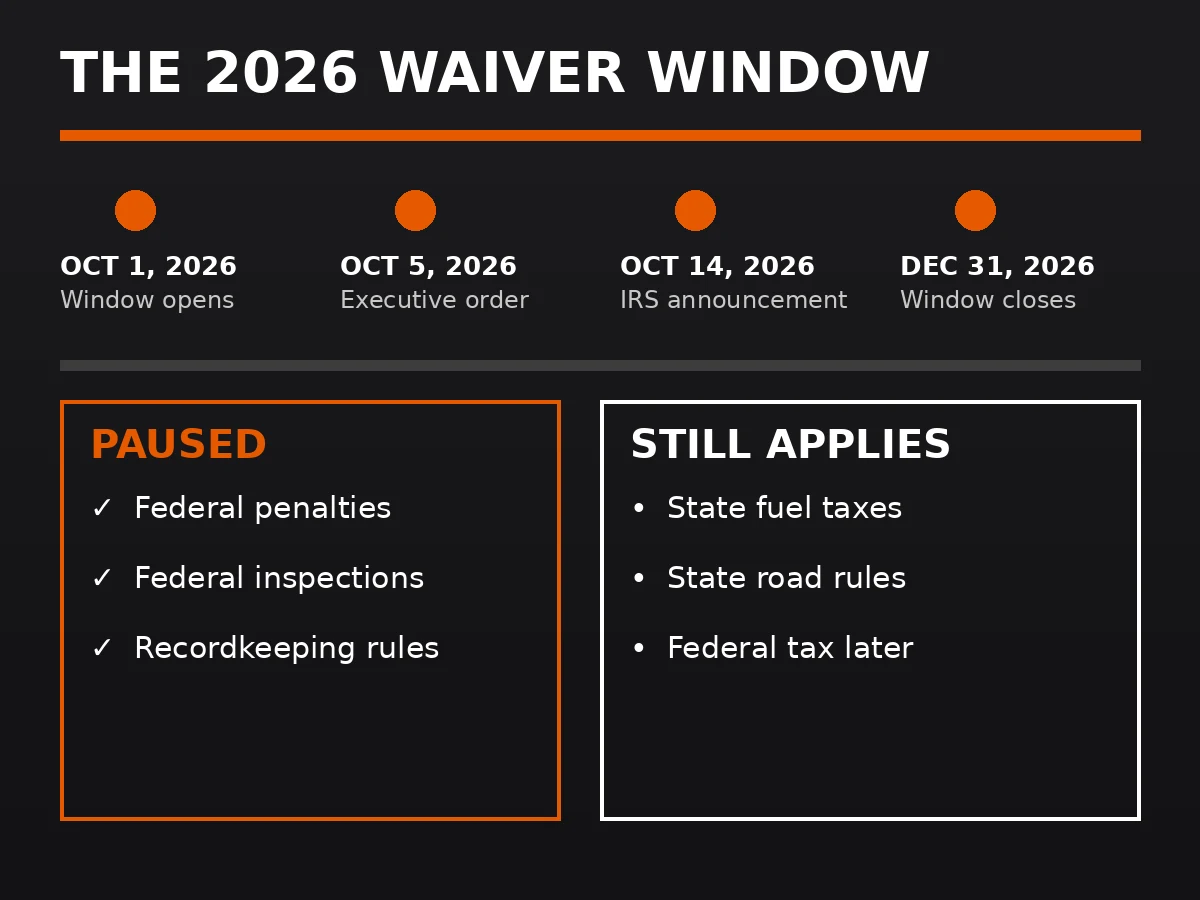
In the United States, the IRS will not impose federal penalties for selling or using dyed diesel on the highway from October 1 to December 31, 2026. That pause covers federal penalties only. State fuel taxes and state road rules still apply, and the federal tax itself is deferred, not forgiven, so the waiver is a short pause, not a free pass. In Canada, nothing changed at all, and marked fuel in a licensed pickup still draws provincial penalties.
- Federal penalties on dyed diesel for highway use are paused in the US from October 1 to December 31, 2026.
- The federal tax of 24.4 cents per gallon is deferred, not erased. It may still come due unless Congress acts.
- State rules still apply. A federal waiver cannot override a state fuel tax or a state road rule.
- Canada has no waiver. Marked fuel in a licensed pickup still brings provincial penalties, including 3 times the tax in Ontario on a first assessment.
Yes, for a short window in the United States, the federal penalty for running red dyed diesel on the highway is paused. The IRS announced on October 14, 2026 that it will not impose those penalties for highway use from October 1 to December 31, 2026, and the relief reaches back to October 1. That is the whole story in one paragraph, and it is also where most of the confusion starts, because a paused federal penalty is not the same thing as legal red diesel, and it is not the same thing as free fuel.
What is red dyed diesel, and why is it cheaper?
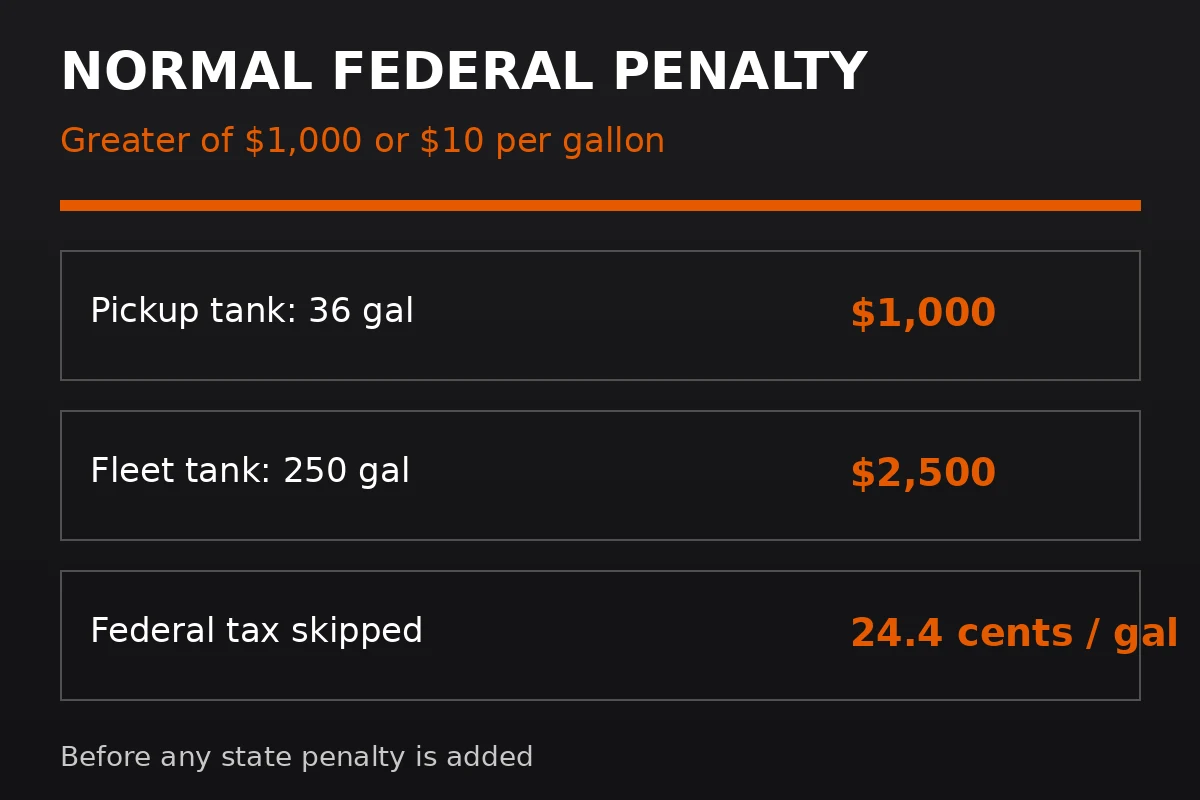
Red diesel is ordinary diesel with red dye added so inspectors can tell at a glance that it skipped highway tax. It is sold for machines that never touch a public road: farm tractors, construction equipment, generators. In the US, the federal highway tax it skips is 24.4 cents per gallon. That is the entire price gap the dye represents. It is not a cheaper grade of fuel, and it is not a secret performance blend. It is the same fuel minus the road tax, marked so it cannot quietly end up in a highway truck.
Under normal rules, using it on the highway is expensive trouble. The federal penalty is the greater of 1,000 dollars or 10 dollars per gallon of fuel involved. A 250 gallon fill therefore carries a 2,500 dollar federal penalty on its own, before any state penalty is added. Inspectors dip tanks at the roadside, and the dye is easy to find. That penalty is what the 2026 waiver pauses, and only that penalty.
What exactly did the 2026 waiver change?
The waiver came in two steps. An executive order signed on October 5, 2026 directed the Treasury to defer diesel tax payments and pause dyed fuel penalties where the law allows. The IRS then announced on October 14, 2026 that it will not impose penalties for selling dyed diesel for highway use, or for using it in a highway vehicle, during the October 1 to December 31, 2026 window. During that window the IRS also paused federal inspections of on road dyed fuel use, reassigned its fuel compliance officers, and suspended the recordkeeping and deposit rules tied to dyed fuel. Sellers do not have to investigate or document what a buyer plans to do with the fuel while the pause lasts.
That is a real change, and it is aimed at fleets and supply trucks, not at pickup owners hunting for a deal. A fleet filling 250 gallon saddle tanks defers 61 dollars of federal tax per fill, and across a fleet that adds up fast. A pickup owner with a 36 gallon tank defers about 9 dollars. Same rule, very different math, and the math is why I keep telling pickup owners to sit this one out.
Three myths I keep hearing in the shop
Myth one: the waiver made red diesel legal everywhere. It did not. The relief is federal only, and a federal order cannot override a state fuel tax or a state road rule. States are moving on their own timelines, and some have not moved at all. Iowa, for example, issued its own proclamation covering vehicles hauling listed farm products, and that state relief runs from October 5, 2026 to February 4, 2027, on its own terms. If your state has issued nothing, its rules still apply in full, and a federal waiver will not save you from a state fine.
Myth two: the tax is gone, so the saving is mine to keep. It is not. The order describes a deferral, and the IRS relief covers penalties, not forgiveness of the tax itself. Further guidance on how the deferred tax will be handled is still to come, and erasing the tax outright would take Congress. Until something changes that, treat every gallon of waived red diesel as a bill that may arrive later, not money in your pocket.
Myth three: the dye washes out, so I can switch back to clear fuel on January 1 with no trace. The dye is a marker, not a corrosive, so it does not permanently stain metal or wreck a fuel system. But traces of dyed fuel can linger in the tank, the lines, and the filters until enough clear fuel has run through. Inspectors test the fuel in the tank, not your explanation of when you bought it. If dyed fuel is still in a highway truck after the window closes, normal enforcement is back, and the waiver will not cover it. Anyone using the waiver needs a plan to be back on clear fuel before December 31, not after.
Does the waiver help a pickup owner in Canada?
No, and this is the part that matters most to my readers. Canada has no waiver. Marked fuel here is governed by provincial law, and the rules are strict. In Ontario, the penalty on a first assessment is 3 times the tax that would apply to clear fuel, and 10 times on a later assessment, plus the tax itself. In Alberta, a first offence can draw a fine of up to 10,000 dollars. Ontario also tells truckers to keep fuel receipts for 7 years, because an audit can reach back a long way.
Crossing the border does not change that. A US pickup that filled with dyed fuel under the waiver and then drives on a Canadian road is under Canadian rules the moment it is on that road. Provincial inspectors apply provincial law, and no US executive order reaches across the border. If you run a plated truck in Canada, the answer stays simple: clear fuel in the tank, receipts in the glovebox.
What I would do with my own truck
If I ran a US fleet, I would read my own state rules first, then decide, and I would schedule the switch back to clear fuel well before December 31 so no truck ends the year with dyed fuel in the tank. That is the disciplined way to use a temporary waiver: take the relief, respect the end date, and leave a paper trail even though the IRS paused the recordkeeping rule, because states and future audits have longer memories than a three month pause.
If I drove a pickup, I would skip it entirely. About 9 dollars of deferred tax is not worth dye traces in the tank, a possible state penalty, and a tax bill that may show up later. Fill with clear fuel, keep the receipt, and spend the worry on something that actually breaks trucks. If your fueling habits already feel complicated, my notes on diesel fuel additives and the winter diesel survival guide cover the fuel problems that genuinely cost pickup owners money, waiver or no waiver.
Frequently asked questions
Should I fill my pickup with red diesel while the waiver lasts?
For a pickup, I would not bother. A 36 gallon tank holds about 9 dollars of deferred federal tax, and deferred means you may still owe it later. Add the risk of a state penalty, plus dye traces left in your tank after the window closes, and the saving is not worth the headache. The waiver matters far more to fleets running 250 gallon saddle tanks than to a pickup owner.
Red diesel vs clear diesel: is the fuel itself different?
No. The red dye is a marker, nothing more. Modern dyed diesel is the same ultra low sulfur base fuel as clear diesel, so the dye itself adds no power, cleans no injectors, and harms no DPF on its own. What can hurt your truck is the tank the fuel came from. Old farm tanks can carry water and rust, and that is a fuel quality problem, not a dye problem.
Can I get fined in Canada for dyed fuel in my pickup?
Yes. Canada has no waiver, and provincial inspectors can dip the tank of a licensed vehicle. In Ontario the penalty on a first assessment is 3 times the tax that would apply to clear fuel, rising to 10 times on a later assessment. In Alberta a first offence can draw a fine of up to 10,000 dollars. Keep your fuel receipts, and keep clear fuel in a plated truck.