

300,000 km is not a red flag on the right diesel. The 5.9 Cummins, 7.3 Powerstroke, and LBZ Duramax regularly run far past that with basic maintenance. What matters more is service history, engine hours, cold start behavior, and frame rust, so price one major repair into your offer and buy the truck with records.
- 300,000 km is middle age for a maintained 5.9 Cummins, 7.3 Powerstroke, or LBZ Duramax
- Engine hours reveal idling wear the odometer hides, so ask to see the hour meter
- Injectors, turbos, the CP4 pump, and emissions systems all have a finite life, so budget for one major repair
- A stone cold start, a blowby check, and a rust inspection tell you more than any listing description
A gas truck with 300,000 km on it is near the end of its life. A diesel truck with the same mileage might be barely broken in, or it might be a polished up money pit. I have seen both roll through my bays over 14 years. The number on the odometer matters far less than most buyers think. Here is what 300,000 km really means, engine by engine, and how to tell a good one from a bad one.
Why diesels shrug at mileage that kills gas engines
Diesels are built to survive compression that would tear a gas engine apart. Heavier blocks, stronger internals, and power made at low rpm. That is why a 5.9 Cummins with 300,000 km can feel tighter than a gas half ton with half the mileage. Tough construction is not a free pass though. Heat cycles, skipped maintenance, and dirty fuel wear even the best engines down.
Not all kilometres are equal
Highway kilometres are the gentle kind. Steady speed, warm oil, complete combustion. City kilometres with cold starts, short trips, and long idling beat a truck up far faster. Two trucks can show the same odometer reading and be ten years apart in actual condition. A highway commuter from Saskatchewan is a different machine than a plow truck from Toronto that idled all winter. Always ask how the truck was used.
The engines that earn their miles
Some engines have earned a reputation for going the distance, and I have seen enough of them to believe it.
The 5.9 Cummins 12 valve and 24 valve are the legends. Simple, overbuilt, and the million kilometre stories are real when the maintenance is there.
The 7.3 Powerstroke is slow and loud and one of the most forgiving engines ever bolted into a pickup. I have watched 7.3 trucks with over 400,000 km still work for a living every day.
The LBZ Duramax, the 2006 and 2007 trucks, is the Duramax people pay extra for. Strong bottom end, no DPF to fight with, and better injectors than earlier models. For the deep version, read our LBZ Duramax breakdown.
The 6.7 Cummins has a strong bottom end too, but 2019 and newer trucks carry the hydraulic lifter issue, so a high mileage one deserves extra scrutiny on the valvetrain.
Now the risky ones. The 6.0 and 6.4 Powerstroke can be good trucks only with documented bulletproofing work and receipts to prove it. The 3.0 EcoDiesel at high mileage is a gamble I would not take with my own money. Our EcoDiesel reliability guide lays out why.
Engine hours matter more than the odometer
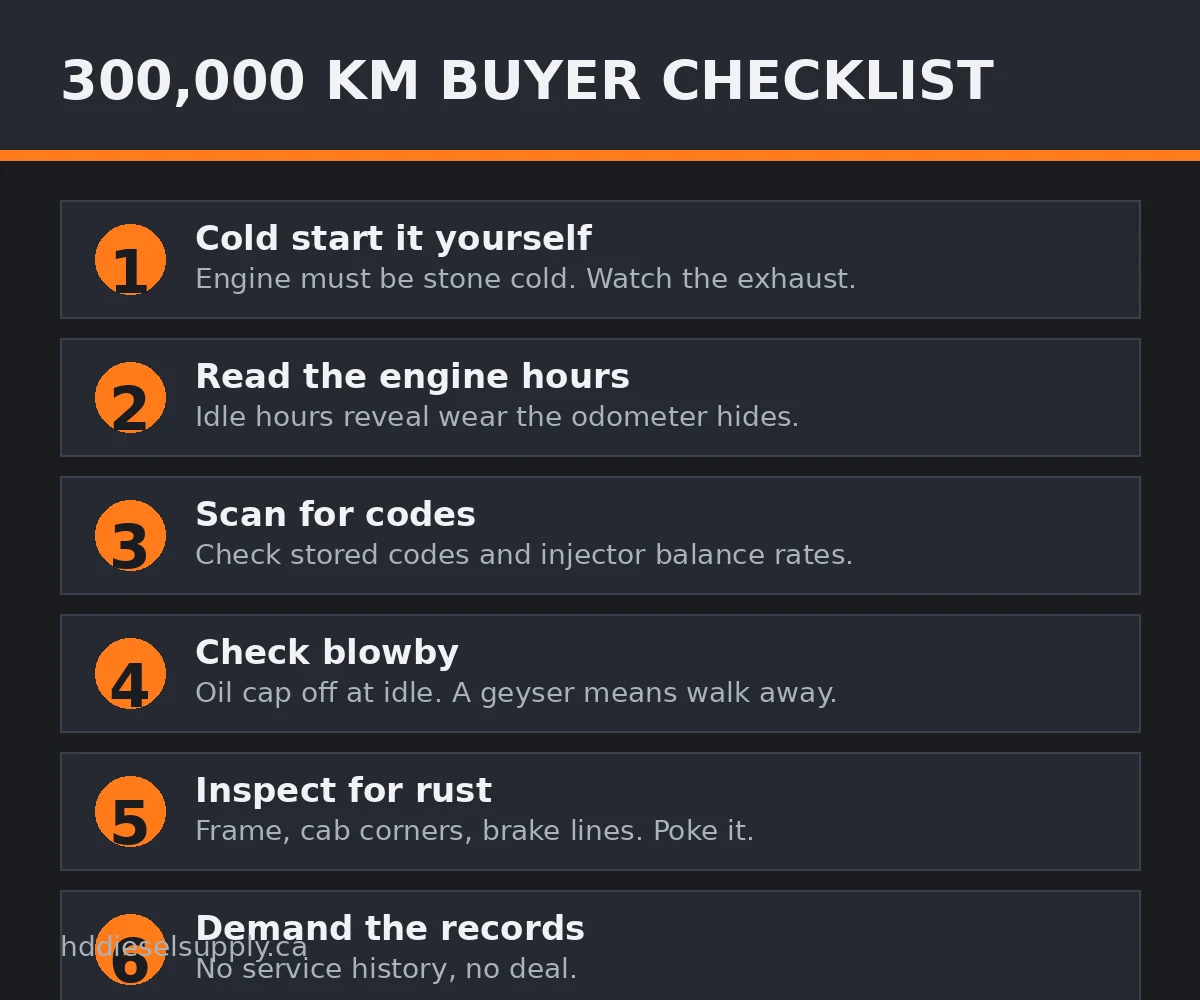
Ram, Ford, and GM trucks all track engine hours. That number includes every minute the engine ran while parked. A truck with 300,000 km and 12,000 idle hours lived a hard life the odometer never recorded. Ask the seller to show you the hour meter. As a rough rule, I count every idle hour as roughly 40 to 50 km of wear. If the seller stares at you blankly when you ask about engine hours, take that as information too.
What wears out no matter what badge is on the hood
The engine block might last forever, but the parts bolted to it have a clock on them.
Injectors wear. On common rail trucks, tired injectors show up as hard starts, rough idle, and balance rates drifting out of spec.
The turbo has a finite life, especially if oil changes were stretched. Listen for whine, siren noises, or boost that comes and goes. Our guide on how long diesel turbos last covers the warning signs.
On 2011 to 2016 Duramax and 2019 to 2020 Cummins trucks, the CP4 high pressure pump is the part that worries me most. A CP4 failure sends metal through the whole fuel system, and the repair bill can exceed the value of the truck. Read what kills the CP4 pump before you buy one of these.
Emissions era trucks add the DPF and EGR systems to the wear list. A truck that did short trips and never got hot enough to regen will have an ash loaded DPF waiting for your wallet. Front end parts and the transmission wear with mileage too. The 68RFE in Rams is the usual weak link there, as we covered in our 68RFE transmission guide.
Assume at least one of these is due. A high mileage truck is only a bargain if you subtract the coming repair from the asking price before you negotiate.
The cold start test drive
This is the test that matters most, and sellers hate it. Show up in the morning and insist the engine is stone cold. A warm engine hides sins.
Watch the exhaust on startup. A puff of white smoke that clears within a minute is normal, especially in cold weather. Blue smoke that hangs around means oil getting past the rings or valve seals. Black smoke under load points at turbo or injector trouble.
Pull the oil fill cap with the engine idling. A little vapor is fine. A steady blast of pressure, what mechanics call blowby, means combustion pressure is getting past the rings. Some is normal on a worn engine. A lot is a walk away signal.
Bring a scan tool and check for stored codes and injector balance rates. Our scan tool guide has picks that work on all three brands.
Rust is the real mileage killer
In Ontario and Quebec, rust kills more diesel trucks than engine wear ever will. Frame rot, cab corners, and brake lines do not care how strong the Cummins is. Get under the truck with a flashlight and poke the frame with a screwdriver. If it flakes, keep your money. The cleanest running 7.3 in the world is a parts truck with a rotten frame.
The bottom line
Buy the maintenance history, not the odometer reading. A 300,000 km diesel with full records, reasonable engine hours, a clean cold start, and a solid frame is a truck you can run for years. The same mileage with no records and a warm engine when you arrive is a gamble. Budget for one major repair, get an inspection from a diesel shop before you pay, and let the service records do the talking.
Frequently asked questions
Should I buy a diesel truck with 300,000 km?
Yes, if the right boxes are checked. Full service records, reasonable engine hours, a clean cold start, no serious blowby, and a rust free frame. Skip any truck where the seller warmed it up before you arrived or cannot produce records. At this mileage you are buying the previous owner's habits, not the truck.
How many kilometres is too many for a diesel truck?
There is no hard number. The engine family matters more than the odometer. Legendary engines like the 5.9 Cummins and 7.3 Powerstroke have documented million kilometre lives. Risky engines like the 6.4 Powerstroke can be trouble at half that. In Canada, rust, not mileage, is what sends most trucks to the scrapyard.
What is the first thing to check on a high mileage diesel?
Engine hours and a stone cold start. Hours tell you how much of the truck's life the odometer missed, and a cold start reveals injector, glow plug, and compression problems that a warm engine hides. Do those two checks before you fall in love with anything else about the truck.