
Yes. The Hamilton flat tappet conversion is the permanent fix for lifter failure on 2019 to 2024 Ram 2500 and 3500 trucks with the 6.7 Cummins. It replaces the factory hydraulic roller lifters and camshaft with a forged 178/208 cam, DLC coated steel tappets, upgraded pushrods and adjustable rockers. The kit lists at US$3,399 and a shop install typically lands between US$6,000 and US$9,000 all in. It runs on the factory calibration with no tune, keeps every emissions part in place, and ends the roller failure for good, at the cost of valve lash checks you will need to do yourself or pay for from now on.
- The kit costs US$3,399 and fits 2019 to 2024 Ram 2500, 3500, 4500 and 5500 trucks with the 6.7 Cummins.
- It replaces the whole roller valvetrain: forged cam, DLC coated tappets, pushrods and adjustable rockers, with no bearing left to fail.
- Installed cost runs US$6,000 to US$9,000, against US$4,000 to US$7,000 to refit factory lifters that can fail again.
- You trade a maintenance free valvetrain for valve lash checks, and you must run Hamilton approved oil or the kit warranty is void.
Yes, it is the permanent fix, and it is the fix I recommend to any owner who plans to keep a 2019 to 2024 Cummins for the long term. The Hamilton flat tappet conversion kit costs US$3,399, it replaces the failure prone hydraulic roller lifters with a flat tappet valvetrain that has no roller bearing to seize, and it keeps the truck emissions legal with no tune. A shop install typically lands between US$6,000 and US$9,000 all in. The catch is real but small: you go back to setting valve lash by hand, and Hamilton only warranties the kit if you run its approved oil. For a truck you intend to keep, that is a fair trade. For a truck you plan to sell next year, it is money you will never get back.
What is in the box for US$3,399?
Hamilton sells the kit as one complete package, and it covers 2019 to 2024 Ram 2500 and 3500 trucks, plus the 4500 and 5500 chassis cabs. I verified the price on the Hamilton Cams site on 18 November 2026, and it has held at US$3,399 across every retailer I checked. Inside the box you get a forged 178/208 camshaft, a full set of DLC coated steel tappets, upgraded pushrods, and adjustable rocker arms with DLC coated trunnions. Diamond like carbon is the coating that makes the flat tappet work without the high zinc oil the old Cummins engines needed. The tappets have no roller, no needle bearing, and no bushing axle, so the exact part that fails on the factory setup simply is not there any more.
Two details matter when you order. First, the kit is SEMA certified for street use in 49 states and Hamilton does not sell it in California, so Canadian buyers ordering from a US retailer should confirm the delivery address is outside California, which it is. Second, if your block or cylinder head has ever been surfaced, call Hamilton before you order, because the kit fitment changes and they want to verify it. A separate kit covers 2025 and 2026 trucks, and my lifter failure survival guide has the details on that version.
What does the job cost once a shop does it?
The kit is only part of the bill. The cam sits deep in the engine, and most shops pull the cab or use a magnetic cam removal tray to get it out without pulling the engine. Expect 12 to 20 hours of labour, and here is how the three honest options compare.
| Fix | Kit price | Shop bill | What you are left with |
|---|---|---|---|
| Factory lifters and cam again | Factory parts | US$4,000 to US$7,000 | The same roller design, so the failure can come back |
| Wagler spacer kit | US$1,400 | Kit plus 12 to 20 hours labour | Factory lifter body with solid spacers, hydraulic part removed |
| Hamilton flat tappet kit | US$3,399 | US$6,000 to US$9,000 | No roller at all, failure mode gone |
Forum owners who have had the Hamilton kit installed report totals in the US$6,000 to US$7,000 range when the shop already has the cab off for other work, and closer to US$9,000 when it is a standalone job at dealer labour rates. Either way, compare it with the alternative: a failed lifter that shatters inside the block can turn into a US$25,000 to US$27,000 engine replacement. The conversion is expensive. The failure is worse.
What happens on install day?
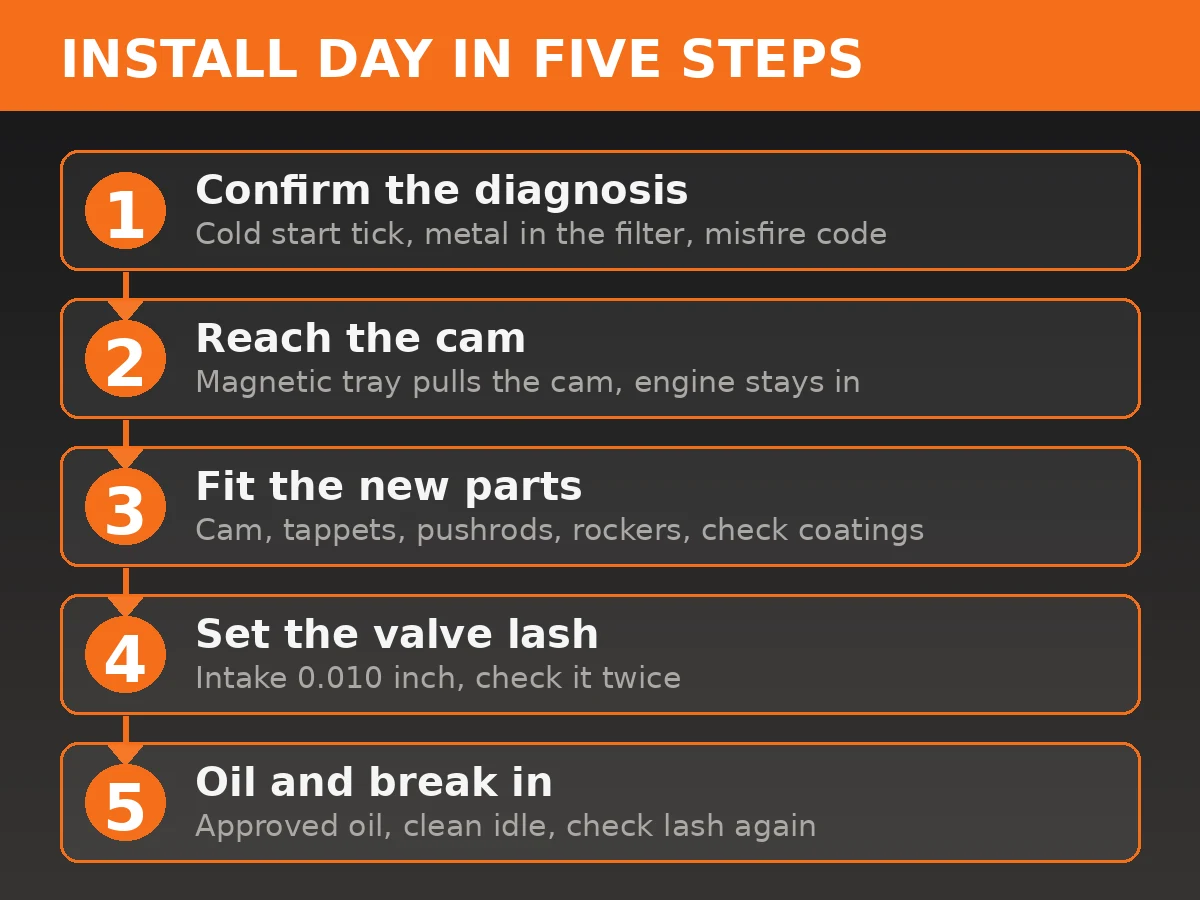
A good shop works through the job in this order. First, confirm the diagnosis: a cold start tick that tracks engine speed, metal in the cut open oil filter, or a misfire code on cylinder 1 or 6. There is no point converting an engine that has a different problem, and a shop that skips this step is guessing with your money. Second, drain the oil and pull the front of the engine apart to reach the cam, using a magnetic removal tray so the cam slides out without the engine coming out of the truck. Third, fit the new cam, tappets, pushrods and rockers, and check every lobe and tappet face for the coating Hamilton ships on them. Fourth, set the valve lash by hand to Hamilton's spec sheet, intake at 0.010 inch, and check it twice, because lash that is too loose hammers the coating and lash that is too tight starves the oil film. Fifth, fill with Hamilton approved oil, run the engine, listen for a clean idle, and check the lash again after the first heat cycle. The whole job is a full day in a well set up shop, sometimes two, and it is not a driveway job unless you have done a cam swap before and you own the tray and the measuring tools.
What changes for you after the swap?
Three things change, and you should know all three before you pay. First, valve lash is your job again. The factory hydraulic lifters adjusted themselves, and the flat tappets do not, so the lash needs checking on the schedule Hamilton sets out in the kit instructions, and it needs a mechanic who still knows how to do it by hand. Skip it and the coating takes the damage. Second, oil is not a free choice any more. Hamilton warranties the kit only on its approved oil list, and a claim needs the failed parts and an oil sample sent back, so keep the receipts and do not let a quick lube shop pour in whatever is on the shelf. My best oil guide for the 6.7 Cummins explains the factory oil rules, and the Hamilton list is stricter still. Third, the engine sounds a little different. A flat tappet valvetrain has a mechanical tick of its own at idle, quieter than a failing roller but not silent, and owners who expect the truck to sound exactly like it did from the factory are sometimes surprised. What does not change: power, fuel economy, towing, and the emissions system. The kit runs on the factory calibration, it keeps the DPF and the rest of the aftertreatment in place, and it stays under 4,000 rpm on factory valve springs, which covers every sane use of a work truck.
Who should buy it, and who should walk past it?
Buy it if the truck is out of warranty, you tow or haul for a living, and you plan to keep the Ram past 300,000 km. That is the owner the kit was built for: one conversion, one bill, and the lifter question is closed for the life of the truck. Buy it too if the lifters have already failed and you are paying for a cam job anyway, because refitting the same hydraulic lifters is paying twice for the same risk. Walk past it if the truck is still under the five year powertrain warranty, because Ram carries the risk until then, and spend the money on the right oil and a filter cut open at every service instead. Walk past it as well if you plan to sell within a year or two, because buyers rarely pay extra for a conversion they did not ask for, and you will not see US$6,000 back at sale time. The honest summary is simple: the Hamilton kit is the best fix for the 6.7 lifter problem, and it is also the most expensive one. For a keeper truck, it is worth every dollar. For a truck on its way out the door, it is not. My 6.7 Cummins reliability breakdown puts the lifter in context with the rest of the engine, if you are still weighing the truck as a whole.
Frequently asked questions
Should I convert my 6.7 Cummins to flat tappets before anything fails?
If your truck is out of warranty, you tow heavy, and you plan to keep it past 300,000 km, yes, and do it on your schedule instead of the failure's schedule. A planned conversion costs the same as a rushed one and you skip the tow bill, the rental, and the risk of metal in the oil. If the truck is still under the five year powertrain warranty, wait, let Ram carry the risk, and convert the day the warranty ends.
Hamilton vs Wagler: which lifter fix should I buy?
Buy Wagler if the truck is stock, lightly loaded, and you want the lowest bill: US$1,400 for the kit, and it keeps the factory lifter body with solid spacers. Buy Hamilton if you tow heavy, run the truck hard, or plan to keep it for the long term: US$3,399 replaces the cam, tappets, pushrods and rockers with parts that have no roller bearing to fail. Both need valve lash checks after the swap. Neither needs a tune.
Does the Hamilton conversion need a tune or delete?
No. The kit runs on the factory calibration and keeps the DPF, EGR and SCR systems in place. It is SEMA certified for street use in 49 states, and it is not for sale in California. That is the whole point for most owners: the fix is mechanical, not a software workaround, and the truck stays emissions legal where the kit is sold.
What oil does Hamilton require after the conversion?
Hamilton approved oil only, and the warranty depends on it. Use the wrong oil and Hamilton offers no warranty, and every warranty claim needs the failed parts plus an oil sample sent back. That is stricter than the factory rule, which already bans 15W40 in 2019 and newer trucks. Before you order, confirm the approved oil list with Hamilton or your installer, and keep every receipt.