
Yes, lifter failure is a real problem on 2019 and newer Ram 2500 and 3500 trucks with the 6.7 Cummins. The hydraulic roller lifters can seize, wipe out the camshaft, and send metal through the engine, and a late catch can mean a new engine at US$25,000 to US$27,000. Listen for a ticking sound on cold start, cut open the oil filter at every service, and run 10W30 oil, never 15W40. If the lifters are already failing, a Wagler spacer kit or a Hamilton flat tappet conversion fixes the design instead of repeating it.
- 2019 and newer 6.7 Cummins engines use hydraulic roller lifters with no needle bearings in the roller, and that roller can seize and eat the camshaft.
- The first warning is a typewriter tick on cold start. Metal in the oil filter means the damage has already started.
- Caught early, a cam and lifter job runs about US$3,000 to US$4,000. Caught late, a new engine runs US$25,000 to US$27,000 at a dealer.
- Two kits fix the design for good: the Wagler spacer kit at US$1,400 and the Hamilton flat tappet kit at US$3,399.
Yes, the lifter problem is real, and it is the first thing I warn every 2019 and newer Cummins owner about. The 6.7 earned its reputation on flat tappet engines that ran forever with a valve adjustment now and then. In 2019 Cummins switched to hydraulic roller lifters, a change that can quietly eat the camshaft and, if you miss it, the whole engine. Here is what fails, how to catch it, and the fixes that end it for good.
What changed in 2019, and why it matters
From 1989 to 2018 the Cummins ran solid flat tappets, loud and almost never failing, with periodic valve lash adjustments. For the fifth generation engine in 2019, Cummins switched to hydraulic roller lifters, also called Type III hydraulic valve lash adjusters, to cut noise and end manual adjustments, but the problem sits inside the roller itself.
The factory roller runs on a bushing style axle with no needle bearings, surviving only on a pressurised film of engine oil. On a cold start, thick oil is slow to reach the tight passages, so the roller starves, stops rolling, and skids across the cam lobe until it seizes and grinds the lobe down. A small steel dowel pin also keeps each lifter lined up with its cam lobe. If it backs out, the lifter rotates and can shatter inside the block, turning a cam job into an engine replacement.
Cummins blames early supplier quality problems, and the 2025 refresh improved upper valvetrain oiling, but the lifter bodies and rollers are the same parts as 2019 to 2024. Hamilton Cams now sells a separate flat tappet kit for 2025 to 2026 trucks. Most at risk are 2019 to 2024 Ram 2500 and 3500 models, most failures between roughly 100,000 and 240,000 km, some before 16,000 km.
How do you tell a lifter tick from normal diesel noise?
Start with a cold start listen. A failing lifter ticks rhythmically from the top of the engine, like an old typewriter, speeding up and slowing down exactly with engine speed. If the tick fades as the oil warms, the lifter is bleeding down and you caught it early. If it stays, the roller has likely seized and the cam is already taking damage.
Rule out the lookalikes: the DEF injector clicks near the exhaust without tracking RPM, and the CP4 pump on 2019 to 2020 trucks has its own noise at the front of the engine, covered in my guide to what kills the CP4 pump. A true lifter tick follows RPM exactly, from under the valve cover.
Then check the oil. Cut open the filter at every service and look for fine metallic glitter, the definitive sign the valvetrain is eating itself, showing up before the noise gets bad. A dull thump through the intake, called chuffing, means a valve is not closing right. Scan for codes too: the computer often catches it first, usually a misfire code on cylinder 1 or 6, then power loss under load.
What does it cost at each stage?
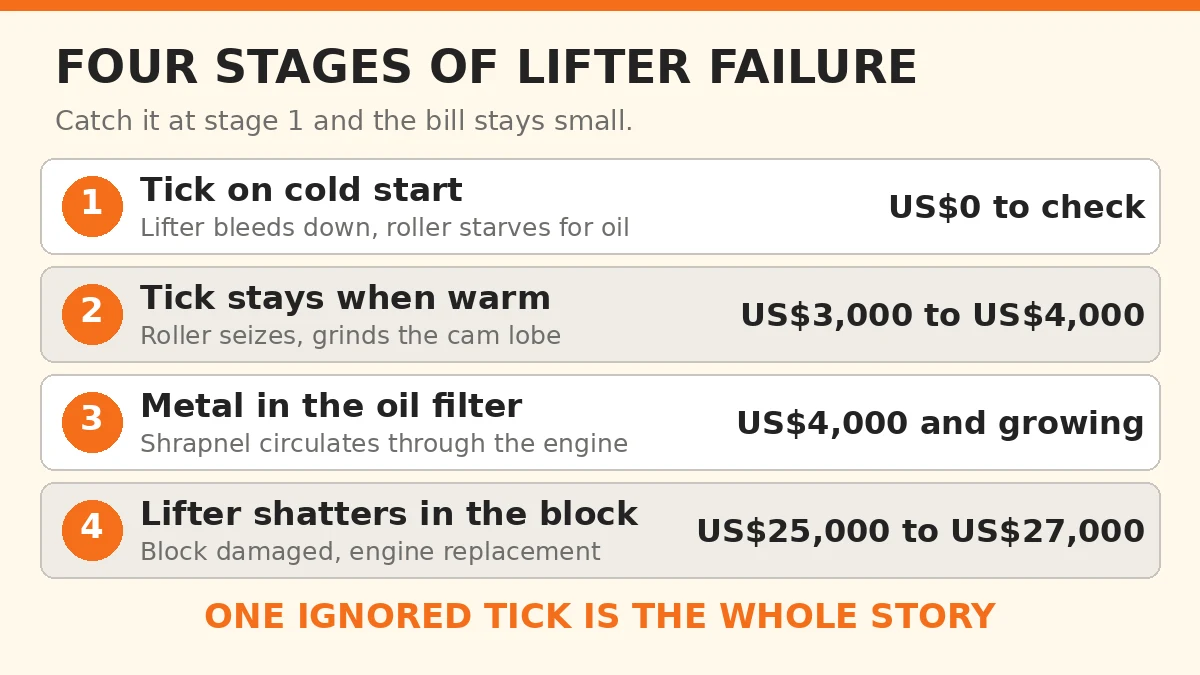
The bill depends entirely on when you catch it.
| Stage | What is happening | Typical bill |
|---|---|---|
| Tick on cold start, fades when warm | Lifter bleeding down, roller starving for oil | Diagnosis and an oil change |
| Tick stays when warm | Roller seized, cam lobe grinding down | About US$3,000 to US$4,000 for cam and lifters |
| Metal in the oil filter | Shrapnel circulating through the engine | More than US$4,000, and growing |
| Lifter shatters, block damaged | Anti rotation bore wrecked, engine out | US$25,000 to US$27,000 for a new engine at a dealer |
Ram covers these trucks under a five year, 100,000 mile diesel powertrain warranty while it lasts. Once it ends, the bill is yours, and there is no recall for the lifters, so do not wait for a letter that is never coming. The gap between stage one and stage four is one ignored tick.
Will the right oil keep your lifters alive?
Oil is the one thing you control, and on this engine it matters more than on any Cummins before it. The roller lives or dies on oil film, and 15W40 is too thick to reach the tight passages quickly on a cold start, when most wear happens. Ram put it in a technical service bulletin: 2019 and newer trucks get 10W30 above freezing and 5W40 synthetic below freezing, never 15W40. My best oil guide for the 6.7 Cummins covers the bulletin and the grades in detail, including the CES 20086 and API CK4 ratings to look for. Running the wrong oil can also void warranty coverage on the repair.
Good oil buys time. It does not fix a lifter that was built wrong, so change it on time, use the right grade, and cut the filter open at every service. If the tick is already there, no jug of oil will unseize a roller.
What is the permanent fix?
Two kits fix the design instead of repeating it.
The Wagler kit keeps the factory lifter body and adds solid spacers, pushrods, and OE adjustable rockers, listed at US$1,400, the value answer for a stock truck that tows on weekends. The Hamilton Cams flat tappet kit goes further: a forged 178/208 camshaft, DLC coated steel tappets, pushrods, and rockers, listed at US$3,399 for 2019 to 2024 trucks, SEMA certified for street use in 49 states, though not for sale in California. The 2025 to 2026 version lists at US$3,999 and is backordered to January 2027. Either kit takes 12 to 20 hours of labour, and a DNR Customs magnetic cam removal kit at US$499 lets a shop pull the cam without removing the engine.

If you are paying for a cam and lifter job anyway, convert instead of refitting the same hydraulic lifters. New factory lifters on a scored cam is a short term repair. A conversion kit on a fresh cam is the last time you pay for this job.
Should you still buy a 2019 to 2026 Cummins?
Yes, with your eyes open. The 6.7 Cummins is still strong in every other way, and my 6.7 Cummins reliability breakdown puts the lifter in context. A known problem with a known fix changes the buying math completely.
Before you pay, check the service records, listen to a cold start, and cut open the filter or ask for an oil sample. Check the powertrain warranty left, and if the truck is out of warranty, budget the conversion kit into your offer like you would budget tires. With fresh lifters and the right oil, you can keep it for a very long time. With a tick you chose to ignore, it will hand you a five figure bill on its own schedule.
Frequently asked questions
Should I buy a 2019 to 2024 Ram 2500 with the 6.7 Cummins?
Yes, if you buy it with your eyes open. Check the service records for 10W30 oil, listen for a cold start tick, and cut open the filter or ask for an oil sample before you pay. The engine is strong in every other way, and the lifter is a known problem with a known fix, not a mystery. If the seller cannot show oil change records, walk away or budget for the conversion kit in your offer.
Hamilton vs Wagler: which lifter fix is right for a daily driver?
Both fix the same weakness, and the difference is how far they go. Wagler keeps the factory lifter body and adds solid spacers, pushrods, and adjustable rockers, at US$1,400. Hamilton replaces the whole valvetrain with a forged cam, DLC coated tappets, pushrods, and rockers at US$3,399, and it is SEMA certified for street use in 49 states. For a stock daily driver the Wagler kit is the value answer. For a truck you plan to keep for 300,000 km or tow heavy with, the Hamilton kit is the once and done answer.
Can I keep driving with a lifter tick?
Only long enough to get it diagnosed. A tick that fades as the engine warms is an early warning, and a tick that stays when warm means the roller has already seized and is grinding the cam. Every kilometre you drive with a seized roller puts more metal in the oil. Park it, cut open the filter, and get the valve cover off before the cam damage spreads to the block.
Does 15W40 oil really cause lifter failure on a 2019 or newer Cummins?
It does not cause it on its own, but it makes it more likely. The roller survives on a thin film of oil, and thick 15W40 flows slowly to the tight lifter passages on a cold start, which is when most of the wear happens. Ram put it in writing in a technical service bulletin: 2019 and newer trucks get 10W30 above freezing and 5W40 synthetic below freezing, never 15W40. Running the wrong oil can also void warranty coverage on the repair, so the jug you buy matters as much as the interval.