

At $2.68 a litre, diesel in Canada costs more than $10 per US gallon, and a diesel pickup now costs more per kilometre in fuel than a gas half ton. That does not mean you should sell. Trading trucks costs you far more in depreciation, tax, and interest than you will ever save on fuel, unless you were buying new anyway. The smart move is to keep the truck, slow down, and cut the waste: idling, soft tires, and short cold trips.
- Diesel averaged $2.68 a litre nationally in October 2026, up from about $1.50 a year ago. That is over $10 a US gallon.
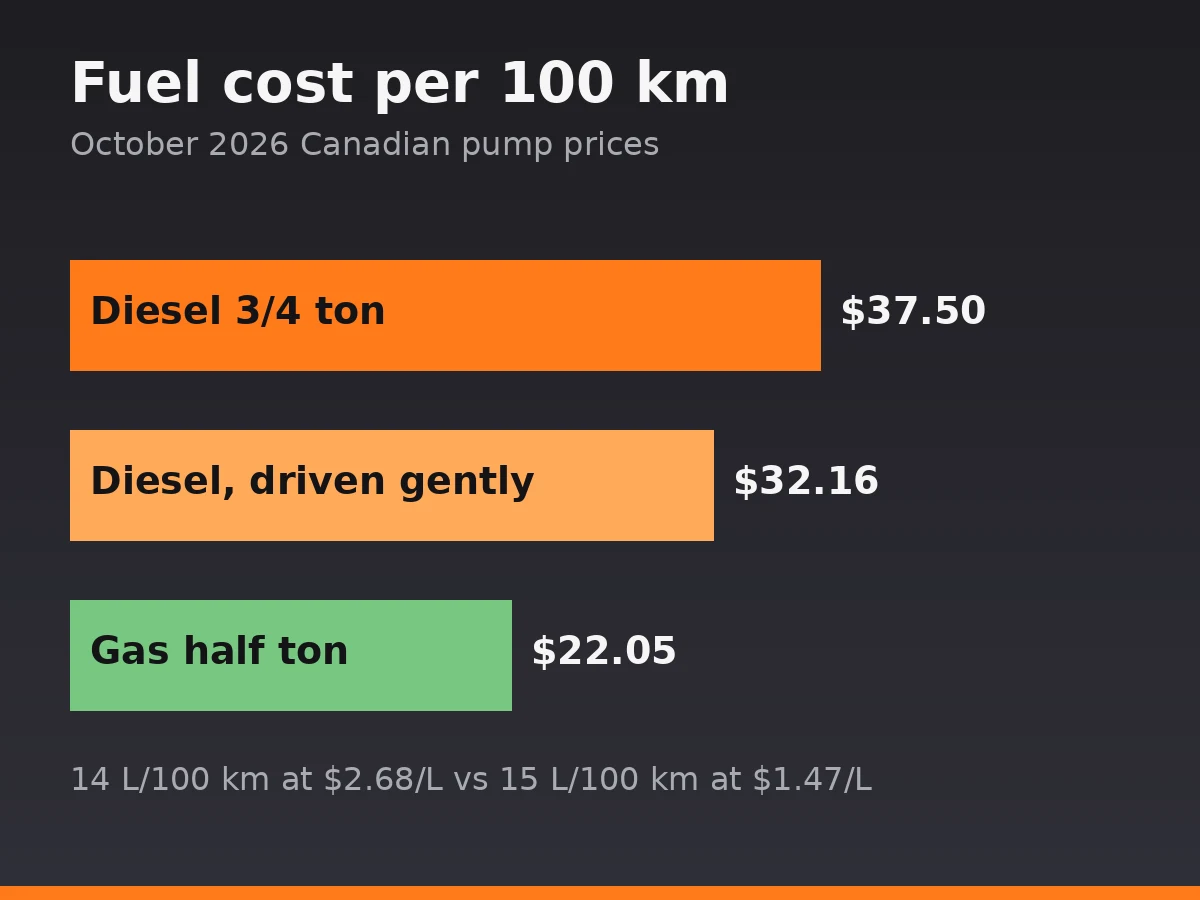
- A diesel 3/4 ton now burns about $37 in fuel per 100 km versus about $22 for a gas half ton. The fuel savings argument is dead for now.
- Trading your truck to chase cheaper fuel loses money. A $10,000 trade loss needs roughly 65,000 km of fuel savings to break even.
- The free fixes work: slow down 10 km/h on the highway, stop idling, keep tires pumped up, and give the truck real highway runs.
I filled up my own truck last week in Ontario and watched the pump climb past $2.65 a litre without blinking. A few years ago that number would have started a conversation at the coffee shop. Now everybody just sighs and pays it. Diesel averaged $2.68 a litre nationally in the third week of October, according to Natural Resources Canada, up from about $1.50 the same week last year. Out in BC and parts of Quebec and Saskatchewan it is pushing $2.90. Here is the number that stopped me cold: $2.68 a litre works out to more than $10 a US gallon. We are living the $9 a gallon question, just priced in litres.
So let me answer it straight, the way I would if you asked me in the shop: should you still drive your diesel truck?
Do the math before you panic
A diesel 3/4 ton driven normally uses around 14 litres per 100 km. At $2.68 a litre, that is about $37.50 in fuel every 100 km. A gas half ton uses around 15 litres per 100 km, and gasoline is sitting near $1.47 a litre, which works out to about $22 per 100 km. Read that again. Right now, the diesel costs roughly $15 more in fuel per 100 km than the gas truck. The fuel economy advantage that sold half the diesel pickups in this country has been wiped out by the price spread.
I am not going to soften that. If you bought your diesel mainly to save money on fuel, the math changed on you and nobody sent a memo. But before you list it for sale, keep reading, because the next number matters more.
When the diesel still earns its keep
Fuel per kilometre is only one line on the page. Here is what the diesel still does better.
Towing. Hook 10,000 pounds behind a gas half ton and watch it drink 25 litres per 100 km or more, screaming at 4,000 rpm the whole way. The diesel towing the same load sits around 16 to 18 litres per 100 km and barely notices. If you tow heavy regularly, the diesel still wins the real world fuel contest, because that is the contest that matters.
Longevity. A maintained diesel pickup will run 400,000 km without opening the engine. Gas trucks can get there, but it is rarer and the odds are worse. If you keep trucks a long time, the diesel spreads its purchase price over more years and more kilometres.
Work. If the truck earns money, fuel is a business cost, not a lifestyle cost. Farm Credit Canada reported this month that a 2,000 hectare canola farm in Saskatchewan is paying $68,000 to $106,000 more for fuel in 2026 than last year, and fuel surcharges now make up 45 percent of the cost of moving freight by truck. Those operators are not parking their equipment. They are passing the cost through and keeping the wheels turning, because a parked truck earns zero.
The cheap ways to burn less
You cannot control the pump price. You can control how much of it you burn. In order of payoff:
Slow down. This is the big one and it costs nothing. Dropping 10 km/h off your highway cruise can cut fuel use by roughly a tenth in a full size truck. At $2.68 a litre, that is real money by the end of the month.
Stop idling it to death. I see this every winter. A truck idling in the driveway for 20 minutes every morning, all winter long, burns fuel for exactly zero kilometres. Modern diesels warm up faster under light load than at idle. Start it, give it a minute for oil to circulate, and drive gently until the gauge moves. A block heater on a timer does the real work for a fraction of the cost.
Pump up the tires. Soft tires raise rolling resistance and the truck works harder every kilometre. Check pressures monthly, cold, against the door sticker, not the number molded on the sidewall. This one is free and most trucks I see are running low.
Empty the bed. Toolboxes full of tools you have not touched in a year, sandbags from February, the spare set of tires riding around since spring. Every hundred pounds costs fuel, all day, every day.
Give it real highway runs. Short cold trips are the worst thing for a modern diesel. The DPF never gets hot enough to finish regeneration, fuel dilutes the oil, and everything soots up. If your driving is all short hops, one proper highway run a week pays for itself in avoided repairs. Our winter diesel survival guide covers the cold weather routine in detail.
Should I park it and buy something cheaper?
This is the question behind the question, so let us do the trade math honestly. Say the fuel spread costs you an extra $0.15 per kilometre versus a gas truck, and you drive 20,000 km a year. That is $3,000 a year in extra fuel. Now price the trade: dealer spread on your used diesel, tax on the replacement, and interest if you are financing. A $10,000 all in cost to switch trucks is conservative, and at $3,000 a year in fuel savings you need more than three years and 65,000 km just to break even. And that assumes gas stays cheap relative to diesel, which nobody can promise.
There are two cases where switching makes sense. One, you were already buying: your truck is worn out, the frame is getting soft, the repair bills are stacking up. Then buy the vehicle that fits the fuel market as it is, not as it was. Two, the truck barely moves: if it sits parked 25 days a month and you are paying insurance and payments on it, the fuel price is not your problem, the ownership cost is. Sell it and rent a truck for the weekends you need one.
For everyone else, the cheapest truck is the one already in your driveway. Keep it, maintain it, slow down, and stop idling. That is the whole strategy, and it works at any pump price.
If you are shopping instead of keeping, read our guide to the best used diesel trucks in Canada before you buy, and our high mileage diesel buying guide if the budget is tight. The trucks have not changed. Only the pump has.
Frequently asked questions
Should I sell my diesel truck because fuel is so expensive?
Almost certainly not. Work out what the trade actually costs you: dealer spread, tax, and interest on the replacement. That number is almost always bigger than a year or two of extra fuel. The only time selling makes sense is if you were already planning to buy something, or the truck is sitting parked most of the month.
How much fuel does idling really waste?
A pickup diesel burns roughly a litre or two an hour just sitting there. That sounds small until you multiply it by a winter of 20 minute warmups every morning. Modern diesels warm up faster driving gently than they do idling, so start it, give it a minute, and go easy until the temp gauge moves.
Is premium diesel worth the extra money at these prices?
I have never seen it pay for itself in a stock pickup. Clean fuel from a busy station and a fuel filter changed on schedule do more for your injectors than any additive package at the premium pump. Save the price difference and put it toward maintenance.
Does driving slower really save that much fuel?
Yes, and it is the biggest free saving you have. Aerodynamic drag climbs fast with speed, so dropping from 120 to 110 on the highway can cut fuel use by roughly a tenth. In a truck shaped like a brick, speed is the throttle on your fuel bill.