
The best first mods for a diesel truck are a lift pump with proper filtration, a digital monitor, a cold air intake, a DPF back exhaust, and a deep transmission pan. All five leave the emissions system alone and need no tune, so none of them gives a dealer a reason to deny a warranty claim. The lift pump comes first because it protects the injection system, and the monitor comes second because it lets you see problems before they turn into repair bills.
- Start with protection, not power. A lift pump and a monitor do more for a stock truck than any tune.
- All five mods keep the DPF, EGR, and SCR in place and need no tune, so your warranty stays on solid ground.
- The five mods together cost about US$2,482 in list prices, roughly $3,400 to $3,500 Canadian at current exchange before tax and shipping.
- Skip tuners, deletes, and big injectors while the truck is under warranty. Those are the mods that start fights with dealers.
A new diesel truck owner walks into my shop with the same question at least once a week. He just bought the truck, he has about three grand to spend, and he wants to know what to do first. My answer never changes. Start with the parts that protect the truck and show you what is happening inside it. Power comes later, and it comes a lot cheaper when the engine is still healthy.
The five mods below are the ones I fit to my own trucks and recommend to customers who tow for a living. Every one of them leaves the emissions system alone. None of them needs a tune. None of them hands a dealer an excuse to deny a warranty claim. They are ranked in the order I would buy them, and the table at the end adds up the real cost.
What is the best first mod for a diesel truck?
A lift pump with proper filtration. It is the single best dollar you can spend on a stock diesel, because it protects the parts that cost the most to replace. The factory lift pump on most trucks is barely enough, and the factory filtration lets fine debris and water through. A good aftermarket lift pump filters fuel down to 2 microns, separates air and water out of it, and feeds the high pressure pump a steady supply at the right pressure. That is exactly what a CP4 needs to stay alive, and the CP4 is the pump that makes owners nervous on the 6.7 Powerstroke, the LML Duramax, and the 2019 and newer Cummins. Read our CP4 survival guide for the full story on why that pump fails.
The FASS Titanium Signature Series 100 GPH is the one I fit most often. It lists at US$714, which works out to roughly $1,000 Canadian once it lands here, before tax and install. AirDog makes a comparable kit at a similar price. Either one does the job. Fit the 100 GPH size on a stock truck. The bigger 165 and 250 GPH kits are for trucks making big power, and on a stock truck they just cost more and return more fuel to the tank. Budget two to three hours for the install if you do it yourself, and change the filters on the schedule in the box. A lift pump with a clogged filter is worse than no lift pump at all.
Can a monitor really save you money?
Yes, and it is the second mod on the list for that reason. A digital monitor plugs into the OBDII port and shows you what the factory gauges hide: exhaust gas temperature, transmission temperature, boost, fuel rail pressure, and whether the truck is in the middle of a DPF regen. The Edge Insight CTS3 is the one I see on the most dashboards. It lists at US$549.95, about $770 Canadian landed, and it takes ten minutes to install because there is nothing to install. Plug it in, stick the mount to the dash, pick your gauges.
The value is in the warnings. A transmission that runs 20 degrees hotter than normal on the same hill is telling you something weeks before it slips. An EGT that climbs past 1,200 degrees Fahrenheit on a long grade is telling you to back off before the turbo cooks. A truck that starts regens twice as often as it used to is telling you the DPF is loading up. Without a monitor you find all of that out from a warning light, and by then the bill has already arrived. The CTS3 also reads and clears codes, and it can trigger a manual regen on most trucks, which is handy when a truck has been idling around town all week.
Is a cold air intake worth it on a stock truck?
It is worth it, but keep your expectations honest. An intake does not turn a stock truck into a fast truck. What it does is let the turbo breathe easier, sharpen throttle response a little, and give you a reusable filter you clean instead of replacing. The S and B intake for a 6.7 Cummins lists at US$379 to US$399 depending on the year, and S and B rates the airflow gain at 40 to 55 percent over the stock box, depending on the generation. That sounds like a lot, and it is, but on a stock tune the seat of the pants difference is modest. The real payoff comes later, when you add power and the stock box becomes the restriction.
Pick the dry filter option if the kit offers one. Oiled filters work fine when they are oiled correctly, but over oiling is common and oil on the mass airflow sensor causes exactly the kind of running problem that is hard to chase down. We covered the full argument in our cold air intake guide, including when to leave the stock box alone.
What does a DPF back exhaust actually do?
It changes the sound, drops EGT a little, and gets rid of the most restrictive part of the factory exhaust, which is the muffler and the crimped tailpipe after the filter. The key words are DPF back. The system starts after the diesel particulate filter, so the emissions equipment stays exactly where the factory put it. That is what keeps it legal and warranty safe. A turbo back or delete pipe is a different conversation entirely, and not one for a truck under warranty.
The MBRP 5 inch T409 stainless DPF back system for a 2013 to 2026 Ram 6.7 Cummins lists at US$439.99, roughly $615 Canadian landed. MBRP claims up to 18 horsepower and a drop in EGT of up to 200 degrees Fahrenheit on the older trucks, and those numbers are plausible for a freer flowing tail section. On a stock truck I would call the power gain small and the sound and EGT drop the real benefit. Buy stainless if you drive through Ontario winters. Aluminized systems are cheaper and they rust out in three or four seasons of road salt.
Why would a deeper transmission pan matter?
Heat is what kills automatic transmissions, and towing is what makes heat. A deep cast aluminum pan adds fluid capacity, and more fluid means the same heat spreads across a bigger volume, so temperatures climb slower and peak lower. The Mishimoto pan for a 68RFE lists at US$378.95 and adds 2.6 quarts over stock. Mag Hytec and PML make comparable pans, some adding up to 5 quarts. The pan also has a drain plug, which the stock stamped steel pan does not, so fluid changes stop being a messy job and start happening on schedule.
This mod matters most on a Ram with the 68RFE, which runs hot when it tows heavy and has a well known appetite for rebuilds. Our 68RFE problems guide covers what fails and why. Pair the pan with a fluid and filter change, and do the cooler bypass valve at the same time if your truck has the failure prone plastic one. The pan alone will not save a transmission that is already slipping, but on a healthy one it buys margin on every long grade.
Will any of these mods void my warranty?
No, not the way most owners fear. A dealer cannot void your whole warranty because you fitted an intake or a lift pump. In Canada a dealer has to show the aftermarket part caused the failure before denying a claim, and in the United States the Magnuson Moss Warranty Act works the same way. The claim has to connect to the part. A lift pump cannot cause a window motor to fail, and no dealer will try to argue that it did.
Where owners get into trouble is the grey area. A turbo failure on a truck with an oiled intake filter gives the dealer an argument. A fuel system failure on a truck with a lift pump fitted wrong gives them one too. Keep your receipts, keep the stock parts, fit the mods properly or pay a shop that will, and the warranty argument stays on your side. What actually voids coverage is a tune that changes the engine calibration, or any delete that removes emissions equipment. Those two are the line, and this list stays well behind it.
What should you skip until the warranty ends?
Tuners, delete kits, bigger injectors, and bigger turbos. All of them make real power, and all of them change the conversation with the dealer completely. A tuner writes to the engine computer, and the dealer can see that it happened even after you flash it back to stock. A delete removes equipment the truck is legally required to have on public roads in Canada and the United States. Bigger injectors and turbos push the engine past what the factory internals were built for, and when something lets go the bill lands on you.
None of that means those mods are wrong. It means they belong on a truck you own outright, out of warranty, with a budget for what comes next. Do the five mods on this list first, drive the truck for a season, and you will know exactly what it needs next, because the monitor will have told you.
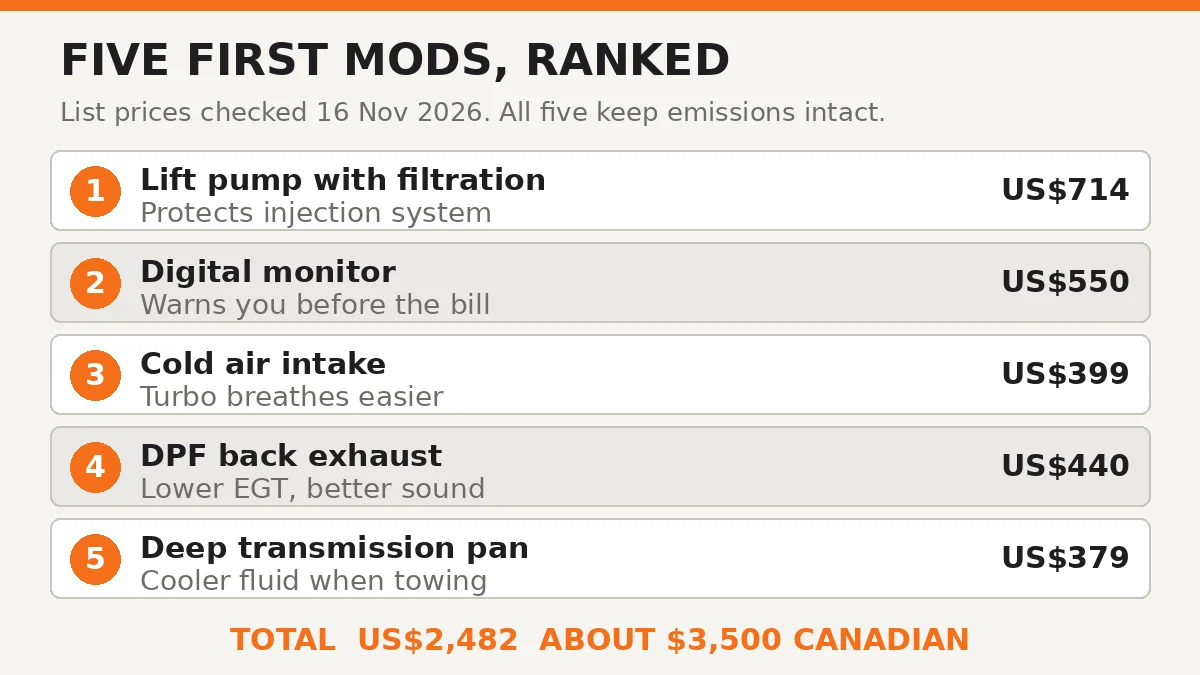
The five mods and what they cost
| Rank | Mod | What it protects | List price US |
|---|---|---|---|
| 1 | Lift pump with filtration | Injection pump and injectors | $714 |
| 2 | Digital monitor | Early warning on heat and regens | $550 |
| 3 | Cold air intake | Turbo airflow and throttle response | $399 |
| 4 | DPF back exhaust | EGT and exhaust flow | $440 |
| 5 | Deep transmission pan | Transmission heat when towing | $379 |
The total is about US$2,482 in list prices, checked 16 November 2026. At current exchange that is roughly $3,400 to $3,500 Canadian before tax, shipping, and install. That is real money, but compare it against one fuel system repair or one transmission rebuild and the math is easy. Do them in order, one at a time, and the truck gets better protected with every step. That is how you spend three grand on a diesel and end up with a truck that lasts longer, not just a truck that sounds faster.
Frequently asked questions
Should I buy a lift pump or a monitor first?
Buy the lift pump first if you can only afford one. It filters fuel down to 2 microns, strips air and water out of it, and feeds the injection pump steady pressure, which is what keeps a CP4 alive. The monitor is second because it shows you EGT, transmission temperature, and regen status, so you can catch a problem early. If the truck already has a lift pump, the monitor is the obvious next buy.
Lift pump vs cold air intake: which one helps a stock truck more?
The lift pump helps more, and it is not close. A lift pump protects the most expensive parts on the truck, the high pressure pump and the injectors. An intake adds airflow and a bit of throttle response, and on a stock truck the power gain is small. Do the lift pump first, the intake second, and think of the intake as a supporting mod for later power work rather than a power mod on its own.
Will a cold air intake void my diesel warranty?
An intake alone does not void a whole warranty. In Canada a dealer has to show the part caused the failure before denying a claim, and the same idea holds in the United States under the Magnuson Moss Warranty Act. The risk is narrow but real: if a turbo fails and the truck is running an oiled filter that let dust through, the dealer has something to point at. Keep the filter clean, use the dry filter option if the kit offers one, and keep the stock airbox in the garage so you can refit it if a claim ever comes up.
Do I need a tune for any of these mods?
No. Every mod on this list works with the factory tune. The lift pump, the monitor, the intake, the DPF back exhaust, and the deep pan all bolt on without touching the engine computer. That is the whole point of the list. The day you add a tune, the warranty conversation changes completely, so do these five first and enjoy a truck that is better protected and easier to watch.