

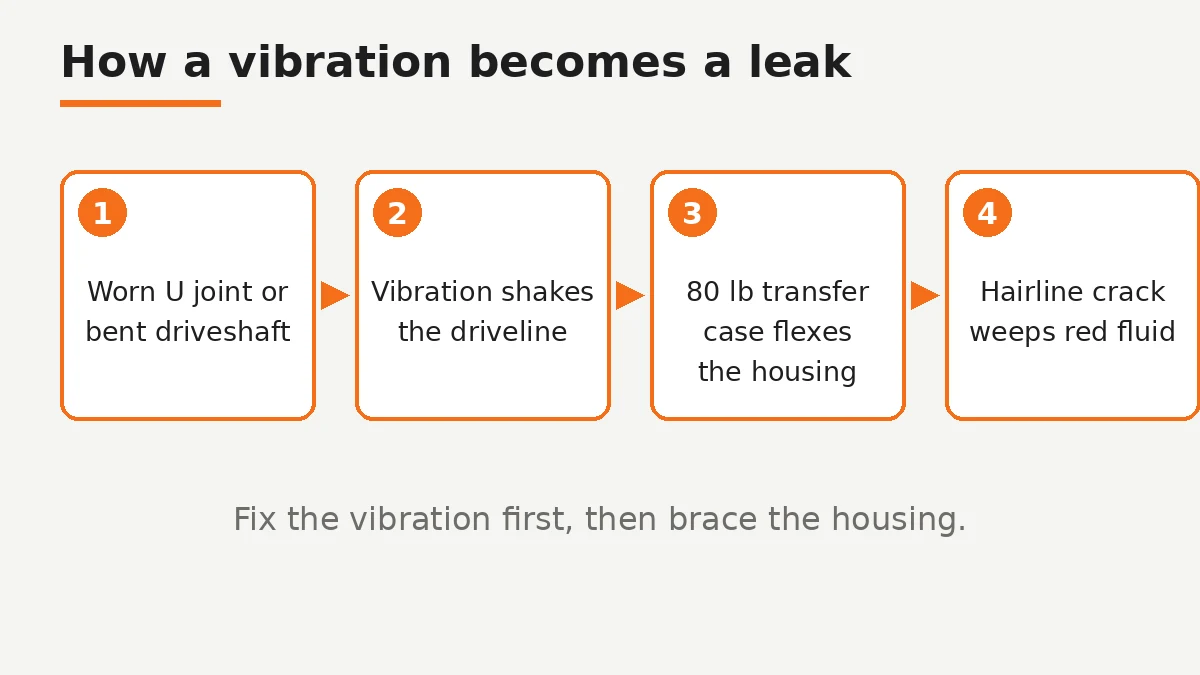
On a 4WD Duramax, an Allison case crack is almost always in the rear extension housing, the casting that joins the transmission to the transfer case. The transfer case weighs about 80 pounds and hangs off the back of the transmission with no support of its own, so every vibration from a worn U joint or a bent driveshaft flexes that housing until a hairline crack opens and red fluid starts to weep out. The crack itself is a design weakness, but the vibration is what finishes it, which is why fixing the driveline and fitting a support brace matters more than the crack alone.
- The crack is almost always in the rear extension housing on 2001 to 2019 4WD Allison 1000 trucks, not inside the transmission.
- An 80 pound transfer case hangs off the back of the transmission with no support, so driveline vibration flexes the housing until it cracks.
- A worn U joint or bent driveshaft can crack the housing in a few miles, so fix vibration the day you feel it.
- A rear housing repair runs around $1,000, while a full installed replacement transmission runs $2,400 to $6,500, so a brace is cheap insurance.
If you found red fluid weeping from the back of your Allison, the answer is short. The crack is in the rear extension housing, the casting that joins the transmission to the transfer case on your 4WD truck. It is a known weak spot on 2001 to 2019 Duramax trucks, and it happens because an 80 pound transfer case hangs off the back of the transmission with nothing holding it up except that housing. Add a worn U joint or a bent driveshaft and the vibration does the rest.
Where does an Allison case actually crack?
There are three places a crack shows up, and they are very different jobs.
The rear extension housing is the one you will see most. It is also called the adapter housing, and it bolts to the back of the transmission while the transfer case bolts to it. Cracks here start as hairlines you can barely see, usually along the bolt flange or the lower edge, and they weep red fluid down the back of the case. Because the crack sits behind the transmission and above the crossmember, it hides under road grime for months before anyone spots it.
The input housing at the front can crack too, but it takes abuse to do it. Builders report it cracking under extreme shock load, like an aggressive launch in 4WD on dry pavement with a tuned truck. Billet input housings exist for exactly this reason.
The third spot is the bellhousing, where cracked torque converter bolt pads leak fluid at the front of the case. Transmission diagnosticians flag this one often, and it is easy to mistake for a front seal leak until the case is clean and you watch where the fluid actually starts.
Why does the rear housing crack?
The short version is that the design asks one casting to do two jobs. The rear housing carries the weight of the transfer case and takes every vibration the driveline makes, and it does both with no support of its own. Merchant Automotive, who build a brace for this exact problem, put the transfer case weight at a stout 80 pounds, and even normal towing and heavy acceleration strain the housing.
Then vibration gets added on top. A failing U joint lets the driveshaft move outside its tolerance, and that shake travels straight into the housing. A bent or damaged driveshaft does the same thing, and a driveshaft spins thousands of times a minute, so even a small imbalance becomes a constant hammering on the casting. Tuning and hard launches make it worse, but you do not need a tuned truck for this failure. One owner reported that a U joint vibration lasting only a few miles cracked his rear housing. That is how little warning you get.
Two wheel drive trucks mostly escape this one. With no transfer case hanging off the back, there is no 80 pound weight levering on the housing, and the same vibration has nowhere near as much to work against.
How do you know the case is cracked?
A cracked rear housing does not announce itself with shifting problems. The transmission keeps shifting fine while the fluid slowly leaves. The first sign is usually a red weep at the seam where the transfer case meets the transmission, or a slow drop in fluid level with no obvious leak on the ground.
Finding it takes ten minutes and a can of brake cleaner. Wash the back of the transmission and the seam clean, drive the truck for twenty minutes, then get under it with a good light and look again. A hairline crack shows as a fresh red line on clean metal. A truck that keeps losing fluid with no puddle under it is losing it somewhere unseen, and the rear housing seam is the first place to check.
Do not confuse it with the two leaks that look similar. A pan gasket leak drips from the bottom of the transmission, further forward. A cooler line leak runs down from the front and the lines themselves. A rear housing leak starts right at the seam between the transmission and the transfer case, and it weeps down the back face of the housing.
What does a cracked Allison case cost to fix?
The bill depends on which crack you have and how far you let it go.
A support brace is the prevention, not the repair. It bolts between the transmission and the transfer case and takes the weight and the vibration off the housing, and it installs in a driveway with basic hand tools. PPE makes a transfer case brace for 2001 to 2007 trucks, and Merchant Automotive makes a rear housing support for 2007.5 to 2010 and 2011 to 2019 trucks, backed by a limited lifetime warranty. If your housing is still sound, a brace costs a fraction of the repair it prevents.
Replacing a cracked rear housing is the real fix once the crack is there. The transmission and the transfer case both have to come out, so labour is the big number. Merchant Automotive puts this repair at around $1,000.
Welding the crack is possible on cast aluminum, but it is rarely the smart call. The case has to come out and be spotlessly clean, and a weld beside a stress point often cracks again next to the repair. Most shops will quote a replacement housing instead.
If the crack has damaged the transmission itself, the numbers jump. Used Allison 1000 units start around $623, an installed replacement runs about $2,400 to $6,500 depending on whether you buy used, remanufactured, or built, and one owner was quoted around $7,000 for an Allison reman unit. That is the bill a five dollar U joint can turn into if the vibration goes ignored.
How do you stop it happening again?
Fix the vibration first, then brace the housing. That order matters. A brace on a truck with a dying U joint just moves the shake somewhere else, so check the U joints and the driveshaft balance every time the truck is on a lift for an oil change. Any new vibration under load gets looked at the same day, not next month, because the housing does not care how short the drive was.
Fit the brace that matches your year. The 2001 to 2007 trucks take the PPE brace, and the 2007.5 to 2019 trucks take the Merchant Automotive support, with separate versions for the 2007.5 to 2010 and 2011 to 2019 trucks. It is a bolt on job, and it is the cheapest insurance you will ever buy for an Allison.
Then keep an eye on the seam. A quick look at the back of the transmission at every service catches a weep while it is still a weep, and a weep caught early is a brace and a gasket instead of a transmission out job.
For the full picture on the newer transmission, read Allison 10 Speed Reliability: The Honest Report. If the bill has already grown past a housing, see Allison Transmission Rebuild Cost before you approve anything.
Frequently asked questions
Should I buy a Duramax with a cracked Allison case?
Only if the price reflects a transmission out repair and you know exactly where the crack is. A rear housing crack is a known fix, but a bellhousing crack or a crack near the pump can mean a full case or a full transmission, and that changes the bill by thousands. Get the truck on a lift, clean the case, find the leak, and get a written quote before you sign anything.
Allison 1000 vs 10 speed: which one cracks its case more?
The 1000, by a wide margin, and it is a design issue, not a strength issue. The six speed Allison 1000 in 2001 to 2019 4WD trucks carries an 80 pound transfer case on an unsupported rear housing. The 10 speed in 2020 and newer trucks is a GM built unit with a different rear case design, and case cracking is not one of its known trouble spots. Its problems sit inside the valve body instead.
Can I drive with a cracked transmission case?
A short drive to a shop with the fluid topped up is usually fine. A long drive or a tow is not. A hairline crack weeps slowly at first, but fluid loss starves the clutches and a transmission that runs dry dies fast. Check the level, top it up with the right fluid, and do not tow anything until the case is fixed.