
The Allison 10 speed, code name 10L1000, is a strong modern transmission rated to 1,000 lb ft, but GM builds it, not Allison, and it is not as proven as the old six speed. The main trouble spots are the valve body, which can wear and cause harsh shifts, and the E clutch, which wears early on trucks that tow heavy or run tunes. Keep the fluid fresh, keep the software current, and do not tune the engine without supporting the transmission.
- GM builds the 10L1000. Allison only licensed the badge and helped validate the design
- Valve body wear is the headline issue: harsh shifts, rare wheel lockup risk, multiple recalls
- E clutch wears early under heavy towing or tuning, and converter shudder is common
- Fresh Dexron ULV fluid, current TCM software, and trans upgrades if you tune the engine
Every week somebody asks me if the 10 speed in the newer Duramax trucks is a real Allison. I give them the short answer first: the badge says Allison, the build sheet says GM, and the reliability story is more complicated than either one. Fourteen years in Alberta and Ontario shops, and I have watched this transmission go from launch hype to recall headlines. Here is the honest report.
The badge is not the builder
Here is the fact most salesmen will not tell you: the 10 speed in your Silverado HD was not built by Allison. GM designs it, GM builds it, and GM stands behind it. Allison approved the design, helped with validation testing during development, and licensed the name. That is a very different thing from building the transmission.
The distinction got loud enough that Allison moved to pull the branding rights off the unit entirely. The two companies reached an agreement and the badge stayed on the 2026 HD trucks, but GM has confirmed some of those trucks may ship without the Allison badge at all. Same ten speed underneath. A badge that can be negotiated on and off in a contract is a marketing asset, not a birth certificate.
For contrast, look at GM medium duty trucks, the 4500, 5500, and 6500. Those still run genuine Allison built transmissions. Allison never stopped building transmissions for GM. It stopped building the one in your pickup.
What this transmission actually is
The 10L1000 arrived for the 2020 model year behind the 6.6 litre Duramax L5P in the Silverado and Sierra 2500HD and 3500HD, replacing the six speed Allison 1000. My L5P problems guide covers the engine side. GM and Ford developed the ten speed family jointly, and each company built its own heavy duty version. It sits behind a modern diesel with DPF and SCR emissions, so budget for that maintenance separately.
On paper it is a serious upgrade. The factory rating is 1,000 lb ft of torque. You get shift by wire, adaptive learning that adjusts to your driving, torque converter lockup in first gear, triple overdrive for low highway rpm, and grade braking that actually holds speed on long descents. Specialists have called it the best engineered transmission ever fitted behind a Duramax, and I will not argue with the hardware. The design is clever.
But clever and proven are not the same thing. The old six speed ran for nineteen years. Every failure mode was known, every fix was documented, and any diesel shop in the country could rebuild one for known money. The ten speed is still writing that history, and some of the early chapters are ugly.
The valve body problem, explained plainly
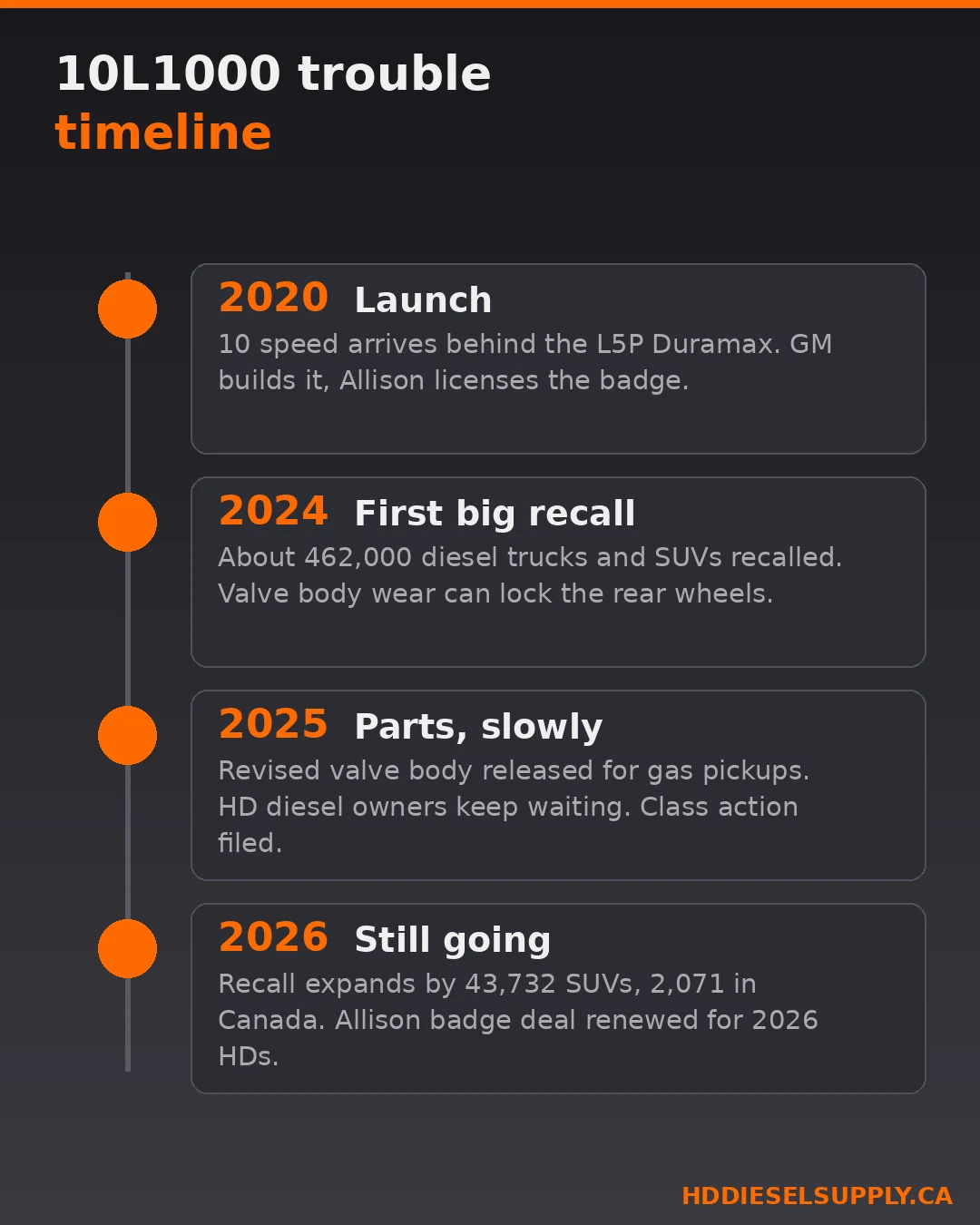
This is the headline issue and the one behind the recalls. Inside the transmission sits the valve body, the hydraulic brain that routes fluid to engage each clutch pack. In the 10L1000 the control valve can wear prematurely. When it wears, fluid pressure drops, shifts turn harsh, and in rare cases the rear wheels can lock during a downshift from eighth gear. That last part is what got the attention of regulators.
GM has recalled hundreds of thousands of trucks and SUVs over this, starting with close to 462,000 diesel pickups and SUVs and later adding tens of thousands more full size SUVs, including just over 2,000 in Canada. Here is the part owners need to understand: the recall remedy is a software update, not new parts. The updated transmission control module watches valve wear and warns you roughly 10,000 miles before a lockup becomes likely. If it sees critical wear, it limits the transmission to fifth gear until the next key cycle. That prevents the dangerous failure, but it does not fix the worn valve.
GM did release a revised valve body and a new repair procedure, but so far that relief has gone to gas powered pickups. Heavy duty diesel owners were still waiting for their version at last check, and back orders for replacement valve bodies have left trucks parked for weeks. A software patch that buys time is not the same as a part that fixes the cause. There is also a federal class action in California alleging violent shifting, hesitation, and wheel lockup, which tells you how frustrated some owners are.
The E clutch and the tuned truck trap
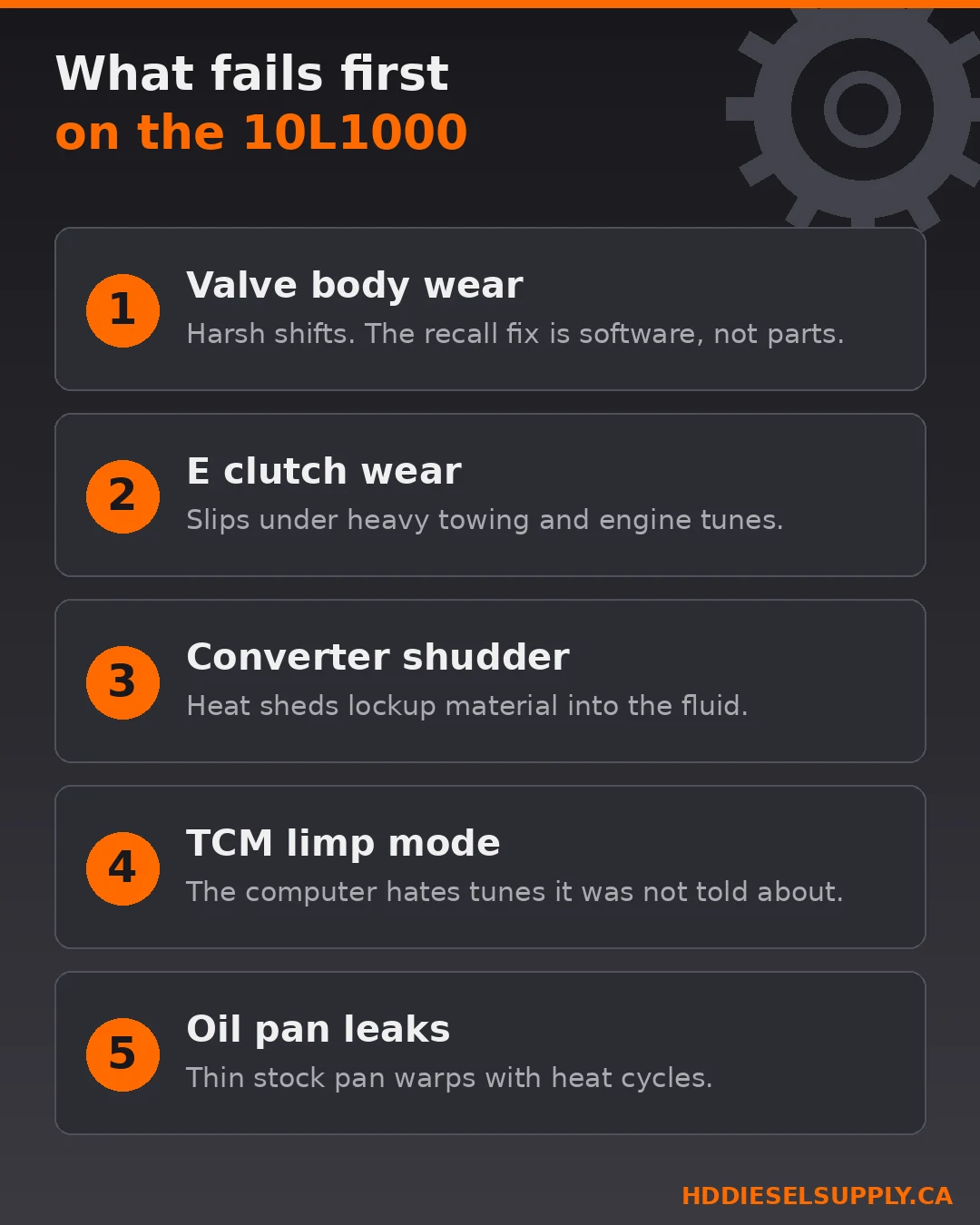
The second pattern I see is E clutch wear. The E clutch handles the higher gear shifts, and on trucks that tow heavy every day or run engine tunes, it wears early. The symptoms creep up: a flare between gears, a shudder under load, power delivery that feels inconsistent. It does not announce itself with a bang. It fades.
Tuning deserves its own warning. The 10L1000 watches torque output aggressively, and a tuned Duramax making an extra 100 lb ft over stock asks the stock clutches to absorb that extra energy on every single shift. Tuned trucks also trip the computer into limp mode when torque readings stop adding up, which feels like the truck giving up halfway up a grade.
The aftermarket has answers: upgraded clutch packs from SunCoast and BD Diesel, billet torque converters, reworked valve bodies, and transmission tuning from DuramaxTuner, PPEI, or Banks that matches the trans to the engine. My Allison rebuild cost guide has the real numbers. My rule is simple: if you tune the engine, budget for the transmission in the same conversation.
The smaller complaints worth knowing
Beyond the two big ones, here is what else comes through my bay.
Torque converter shudder. The lockup material sheds under heat, which puts debris in the fluid and gives you a shudder that feels like driving over rumble strips at cruising speed. A quality billet converter solves it, and it is the first upgrade I suggest to anyone towing heavy.
Oil pan leaks. The stock pan is thin and heat cycles warp it. A deeper cast aluminum pan adds fluid capacity and ends the seep for good, usually for a few hundred dollars.
Early truck teething issues. The 2020 and 2021 trucks had oil pump noise, harsh 3 to 4 shifts, and converter complaints that mostly got sorted with software updates. If you are shopping one of the early ones, make sure every update was actually performed. A surprising number of used trucks never got them.
Buying one used in Canada
The ten speed does not scare me on a used truck, but it changes what I check.
Get the VIN run at a GM dealer and confirm every transmission software update and recall is done. This is free and it takes ten minutes.
Drive it long enough to get fully warm, then feel the 3 to 4 and 4 to 5 shifts under light and medium throttle. Any flare, bang, or shudder is a negotiating point at best and a walk away at worst.
Ask about transmission service history. Fresh Dexron ULV fluid on schedule matters more on this unit than on the old six speed, because heat and dirty fluid wear the valve body and the clutches faster than mileage does. Heat is the enemy here, as I explain in my transmission overheating guide.
Be honest about tuning. A stock truck with clean fluid is a solid buy. A tuned truck with a stock transmission and no receipts is a gamble, and the price should reflect that.
On a 2020, check the build date. The earliest trucks had the most teething trouble.
Ten speed vs the old six speed, honestly
On capability, the ten speed wins. Higher torque rating, better grade braking, lower rpm on the highway, smarter shifting. Towing a heavy fifth wheel through the mountains, you feel the difference.
On proven reliability, the six speed wins and it is not close. Nineteen years of production meant every weakness was found and fixed, parts were everywhere, and any shop could rebuild one. The ten speed is a better transmission on paper with a thinner track record in the real world. The LBZ era trucks with the six speed are still the ones old timers chase, and this is a big reason why.
Here is my honest summary: the ten speed is a good transmission with a known weak spot and a corporate parent that has handled the fallout with software instead of parts. If you maintain it, keep it cool, and respect its limits, it will do the job for a long time. If you need the legend, buy the legend. That truck is now close to twenty years old and priced accordingly.
The bottom line
Would I buy a Duramax with the ten speed? Yes, and I would buy it with my eyes open. Budget for fluid services, get the software current, and if you tow heavy or tune, put transmission upgrades in the plan from day one. The badge on the side is marketing. The maintenance schedule is what actually decides how long it lives.
Frequently asked questions
Is the Allison 10 speed a real Allison transmission?
No. GM designs and builds the 10L1000. Allison approved the design, helped with validation testing, and licensed the name. GM medium duty trucks still use genuine Allison built transmissions, but the 10 speed in your Silverado or Sierra HD is a GM unit wearing a licensed badge.
Should I buy a used Duramax with the 10 speed?
Yes, with homework. Confirm all recall software updates are done, ask for transmission service records, and test the 3 to 4 and 4 to 5 shifts on a long warm drive. A stock truck with clean fluid is a solid buy. A tuned truck with no transmission upgrades is a gamble.
What maintenance matters most for the 10 speed?
Fresh Dexron ULV fluid on schedule and the latest transmission software from the dealer. Heat and dirty fluid wear the valve body and clutches faster than mileage does, so an auxiliary cooler is cheap insurance if you tow heavy.