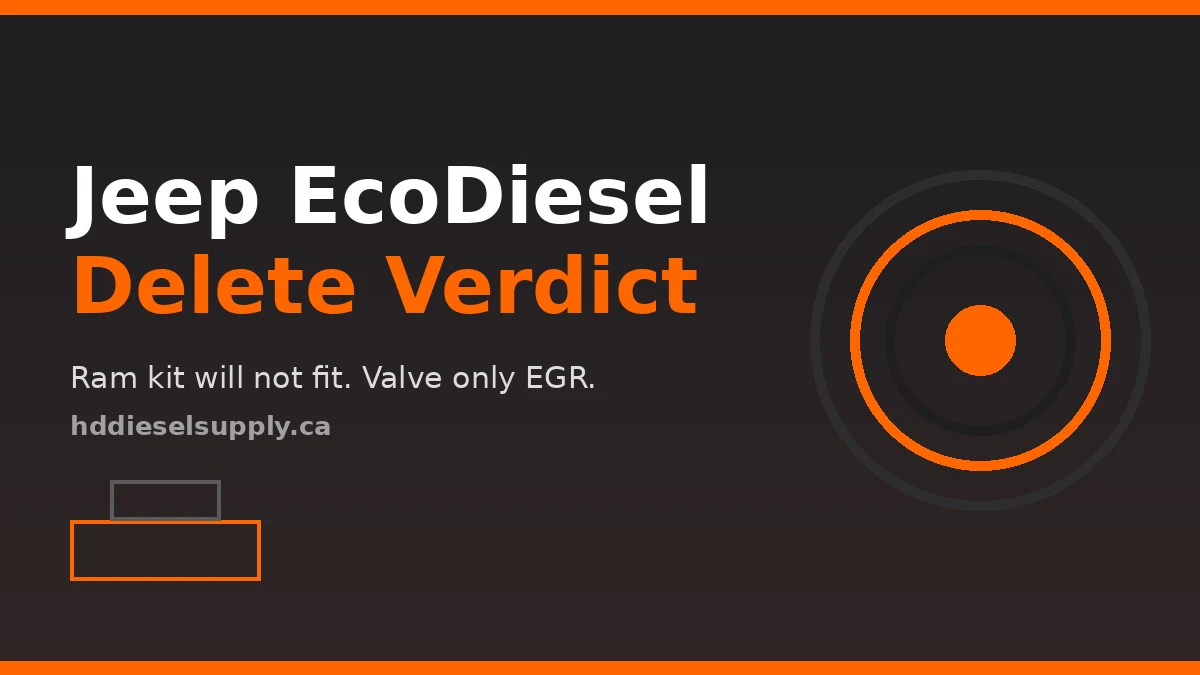
No, not for a Jeep you drive on public roads. A delete kit removes the DPF, EGR and DEF hardware and retunes the computer to ignore the missing parts, and sellers label those kits for off road use only for a reason. On a 2014 to 2018 Grand Cherokee the kit also differs from the Ram kit in ways that catch buyers out: the exhaust pipe is a Jeep specific part, and the Jeep EGR kit deletes the valve only, not the cooler. Check your recalls and your province rules first, because a legal repair plus emissions intact tuning usually solves the same complaints for less risk.
- A Jeep EcoDiesel delete kit is a Jeep specific kit. A Ram 1500 pipe will not fit, and the Jeep EGR kit deletes the valve only, not the cooler.
- One Canadian seller lists the full bundle at 2,809 dollars, built from a 299 dollar EGR kit, a 709 dollar exhaust and a 999 dollar tune.
- Sellers label these kits for off road use only. That label does not make a road driven Jeep legal in Canada.
- The 2014 to 2016 emissions settlement payout window closed in 2021, so do not buy a kit expecting settlement money to pay for it.
- Fix the recalls first, then look at emissions intact tuning and proper DPF care before you remove anything.
No, not for a Jeep you drive on public roads. Owners usually land here because a warning light is on, a dealer quote hurt, and a forum thread promised that a delete kit ends the whole mess for less money. I understand the temptation, and I am still going to talk you out of it, because on this specific Jeep a Ram kit does not fit, the Jeep EGR kit does not remove what many buyers think it removes, and the old settlement money is long gone.
What does a Jeep EcoDiesel delete kit actually remove?
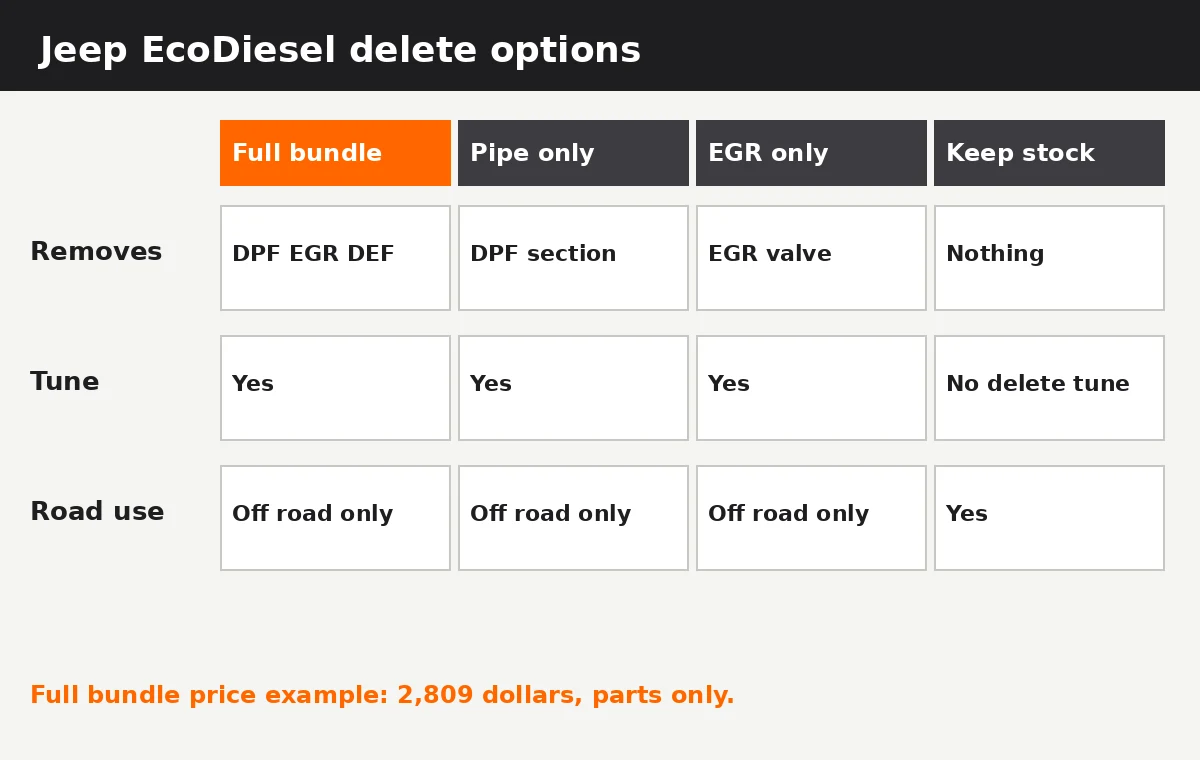
A full kit targets three systems. The DPF traps soot and burns it off in regeneration cycles. The EGR system routes exhaust gas back into the intake to cut nitrogen oxide output. The DEF and SCR system injects diesel exhaust fluid to convert nitrogen oxide into nitrogen and water vapour. A full delete replaces the DPF section with a straight pipe, blocks the EGR valve, and stops DEF dosing, then a tune rewrites the computer so it stops looking for the missing hardware.
That last part matters more than the pipe. A pipe on its own, with no matching tune, will set codes and can push the Jeep into reduced power mode. The parts and the tune have to match each other, and they have to match the Jeep, not a Ram. My guide to what a DPF delete is covers the basics without the sales talk.
Why a Ram EcoDiesel kit will not fit your Jeep
This is the expensive mistake. The Grand Cherokee and the Ram 1500 share the 3.0 litre EcoDiesel engine, and that shared engine fools people into thinking the kits are shared too. They are not. The Grand Cherokee packages the DEF tank and the DPF in different places, so the Jeep delete pipe is its own part. Order a Ram pipe and you will find out on the hoist, after the old exhaust is already off, that it does not line up.
The EGR difference is sneakier. On the Ram, an EGR kit can remove the valve and the cooler. On the Grand Cherokee, the kit deletes the valve only, not the cooler, because of how the cooler sits in the Jeep chassis. Read the parts list line by line before you pay. If the list says valve only, believe it.
Do not carry the parts list from my 2014 Ram EcoDiesel delete kit guide across to the Jeep. Same engine, different vehicle, different kit.
What does it cost, in real listed prices?
Forget round numbers from forums. Here is one real Canadian catalogue, checked this week. The EGR kit is listed at 299 dollars, the DPF and catalytic converter delete exhaust at 709 dollars, and an EZ Lynk delete tune at 999 dollars. Bought as a bundle, the same seller lists the full package at 2,809 dollars. Bench flash tuning is listed at 999 to 1,249 dollars on the same catalogue.
Two warnings sit on top of those numbers. They are parts prices only, with labour, taxes and shipping extra. Sellers often quote fuel economy gains, one bundle listing claims about 5 miles per gallon on average, and that is a seller claim, not a measured result on your Jeep. Short trips, winter idling and towing will eat most of any gain. Keep every original part if you ever go down this road, because buying a used DPF, SCR unit and sensors second hand is a miserable way to spend money.
Is it legal on a road driven Jeep in Canada?
Sellers label these kits for off road use only, and that label does not turn a road driven Jeep legal. Once a vehicle is sold, provinces regulate vehicles in use, and tampering rules treat disabling emissions equipment as a problem, with enforcement varying by province. Ontario stopped emissions testing light duty vehicles years ago, which confuses owners into thinking nobody checks anymore. No test to pass is not permission. A roadside inspection can still find missing hardware, and a missing DPF under a Jeep is not subtle.
Resale is where most owners feel it first. A deleted Jeep appeals to fewer buyers, and careful ones will ask for the original parts and tune. If you cannot provide them, expect a lower offer or none. Insurance is the second quiet risk: an adjuster who finds undeclared modified hardware has a reason to argue a claim. Get your insurer and province position in writing before you buy, not from a seller who profits from the sale.
What should you fix or check before you delete?
First, the recalls. About 30,000 Grand Cherokees from 2014 to 2020 were covered by a 2022 recall for a high pressure fuel pump that could fail and starve the engine of fuel, causing power loss while driving. Check your VIN with a dealer first. A free recall repair beats a 2,809 dollar kit every time.
Second, the old settlement. The 2014 to 2016 Grand Cherokee EcoDiesel, about 25,542 vehicles, was part of the FCA emissions settlement that paid eligible US owners up to 3,075 dollars. That claim window closed on February 3, 2021, and the warranty clock has run out for most of these Jeeps by age alone. Do not buy a kit expecting settlement money. It is not coming.
Third, the actual fault. EGR cooler trouble is real on this engine family, as my EcoDiesel reliability notes show. But a cooler problem, a sensor problem and a clogged DPF feel similar from the driver's seat and cost very different amounts to fix. Get a proper diagnosis, with codes and live data, before you let a kit be the diagnosis.
What works instead, without removing anything?
Fix what is broken, then tune around the emissions system instead of removing it. Emissions intact tuning keeps the DPF, EGR and DEF hardware in place while improving drivability, and it keeps the Jeep sellable and inspectable. Pair it with highway runs long enough for a full regeneration, the correct low ash oil, and professional DPF cleaning when soot load climbs. My notes on emissions intact tuning explain that route in full.
That combination gives you a Jeep you can sell in any province and take to any dealer without an awkward conversation. For a family SUV that also tows, that trade beats a claimed fuel economy gain.
Five checks before you spend a dollar
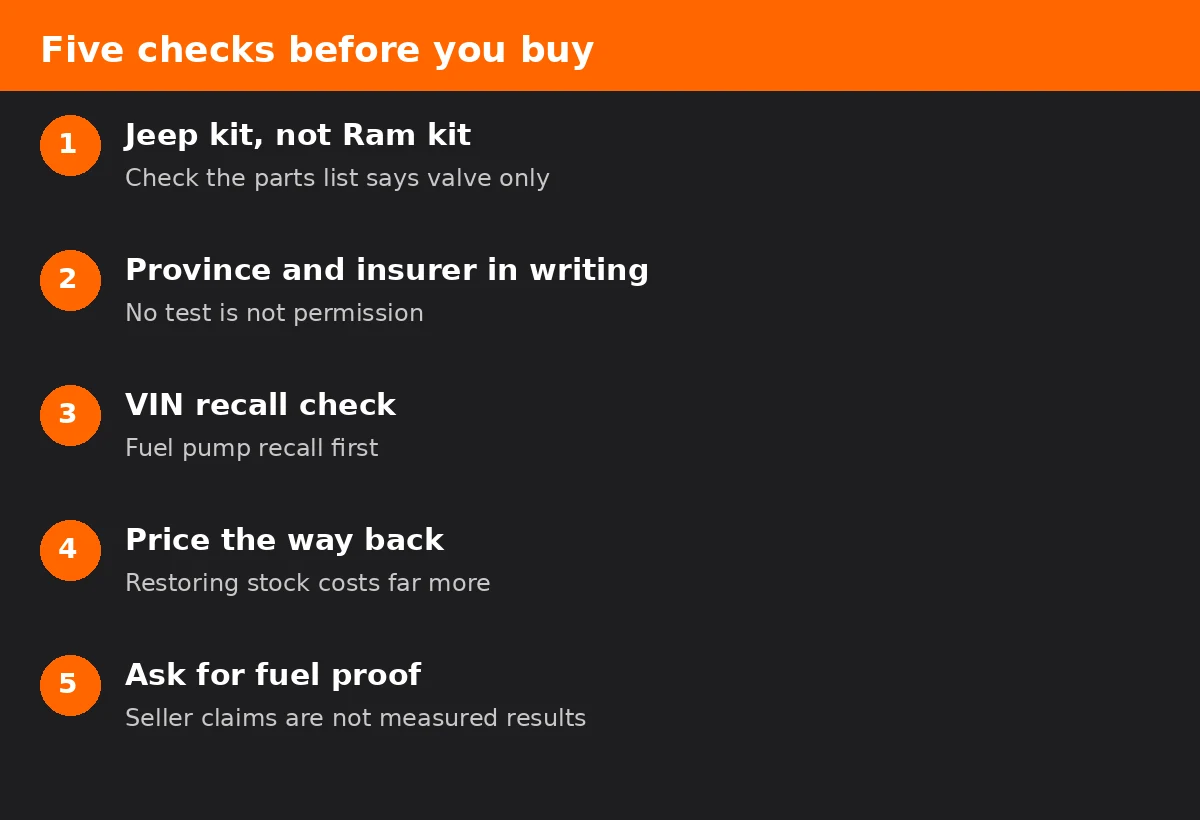
- Confirm the kit is listed for your exact Jeep year, not a Ram, and that the EGR list says valve only.
- Get your province rules and insurer position in writing.
- Check your VIN for the fuel pump recall and open EGR cooler work.
- Price the way back: what would restoring the original DPF, SCR hardware and tune cost?
- If a seller promises a fuel economy number, ask what driving cycle produced it.
If all five checks point the same way and the Jeep is genuinely a dedicated off road vehicle, then a Jeep specific kit with a matching tune is at least an informed choice. If any check fails, fix the fault, keep the emissions system intact, and spend the kit money on maintenance instead.
Frequently asked questions
Should I delete my 2014 Jeep Grand Cherokee EcoDiesel?
Not if you drive it on public roads. The kit is straightforward hardware, but once it is fitted the Jeep no longer matches the emissions standard it was sold to meet, and that hurts resale, insurance and inspection outcomes in provinces that check. If your Jeep is a dedicated off road or competition vehicle that never sees a public road, that is a different conversation, and you still need a tune that matches the exact hardware you fitted.
2014 Jeep Grand Cherokee EcoDiesel vs Ram 1500 EcoDiesel: is the delete kit the same?
No. Both use the 3.0 litre VM Motori EcoDiesel, but the Grand Cherokee packages the DEF tank and the DPF in different places, so the DPF and catalytic converter delete pipe is a distinct Jeep part. The EGR side differs too: on the Jeep the kit deletes the valve only, not the cooler, because of chassis packaging. Buying a Ram kit for a Jeep, or assuming a Jeep kit removes the cooler, are the two mistakes I see most often with this vehicle.
What does a Jeep EcoDiesel delete kit cost in Canada?
As a real listed example, one Canadian seller prices the EGR kit at 299 dollars, the DPF and catalytic converter delete exhaust at 709 dollars, and an EZ Lynk delete tune at 999 dollars, with the full bundle listed at 2,809 dollars. Bench flash tuning is listed at 999 to 1,249 dollars on the same catalogue. Those are parts prices only. Shop labour, taxes, shipping and the cost of putting everything back later are on top, and a deleted Jeep usually sells for less, not more.
Will a deleted Jeep Grand Cherokee pass inspection in Canada?
That depends on your province, and you need the answer in writing before you buy, not after. Ontario no longer emissions tests light duty vehicles, but that does not make a delete legal, and roadside enforcement can still apply. Other provinces test or inspect differently, and a missing DPF or DEF system is easy for an inspector to spot. If a seller tells you no province ever checks, ask them to put that in writing. They will not.