
A delete kit removes the DPF, EGR, and DEF systems from a 2014 Ram EcoDiesel and retunes the computer to ignore them. It is illegal on any truck driven on public roads in Canada, even though Ontario no longer tests light duty trucks for emissions. Most 2014 owners consider a delete after an EGR cooler failure, but the cooler was covered by a recall and a settlement, so the legal fix costs less than the delete and keeps the truck sellable.
- A delete kit removes the DPF, EGR cooler, EGR valve, and DEF/SCR hardware, plus a tune that blinds the computer to the missing parts
- It is illegal under federal Canadian law on any road driven truck, and Ontario can still fine you at a roadside inspection
- Ontario scrapped light duty emissions testing in 2019, so a deleted 2014 Ram 1500 will never be called in for a test, but it is still not legal
- The 2014 EcoDiesel EGR cooler had a recall and a class action settlement, so check your coverage before paying for anything
- Emissions intact tuning plus proper DPF care gives you most of the drivability gain with none of the legal risk
Somebody asks me about deleting a 2014 Ram EcoDiesel about once a month. It is almost always the same story. The truck threw an EGR code, the dealer quoted a repair that made their eyes water, and somebody on a forum told them a delete kit fixes everything for less money. I get why the idea is tempting. I am going to talk you out of it anyway, and then I am going to show you what actually works on this truck.
Why the 2014 EcoDiesel ends up in this conversation
The 2014 was the first model year of the Ram 1500 EcoDiesel, and it carries the Gen 2 version of the 3.0L VM Motori engine. I have written before about how rough those early years were, and the short version is this: the EGR cooler on the 2014 to 2019 trucks can leak coolant internally, and Ram recalled a large number of them after some caught fire. There was also a class action settlement. If you own a 2014 and the EGR recall was never done, that is your first job, before anything else.
So when a 2014 owner starts pricing delete kits, it is rarely about chasing power. It is about a truck that keeps throwing EGR codes, going into limp mode, or drinking coolant, and a repair quote that feels like too much for a twelve year old truck. I understand the math they are doing. The problem is the math leaves out the parts that bite later.
What a delete kit actually does
A delete kit for the EcoDiesel is a bundle of hardware plus a tune. The hardware removes the diesel particulate filter, the EGR cooler and valve, and the DEF/SCR components. The tune, usually loaded through a handheld tuner, reprograms the engine computer so it stops looking for the missing equipment and stops throwing codes for it. Straight pipes replace the DPF and SCR sections of the exhaust.
The appeal is real and I will not pretend otherwise. The truck stops doing regens, stops using DEF, and stops throwing EGR codes because there is no EGR left to throw codes about. Throttle response sharpens up. But every one of those gains comes from removing equipment the truck is legally required to have. There is no version of this that keeps the truck compliant. Anyone selling you a delete kit with a wink and an off road use only disclaimer knows exactly what the kit is for.
The law in Canada, plainly stated
Under federal law, the Canadian Environmental Protection Act and the On Road Vehicle and Engine Emission Regulations, it is illegal to tamper with or remove emissions equipment on a road vehicle. Canada takes this seriously at the corporate level: Volkswagen paid 196.5 million dollars in Canada over its diesel emissions cheating, the largest environmental fine in the country's history. That was a manufacturer, not an owner, but it shows the direction of enforcement.
What confuses Ontario owners is testing. Ontario ended its Drive Clean light duty emissions testing program in April 2019. Under the current DriveON system, emissions tests apply only to heavy duty diesel commercial vehicles with a registered gross weight over 4500 kilograms. A Ram 1500 is a light duty truck, so it is never called in for an emissions test. Some owners read that as permission. It is not. Ontario's own guidance says every vehicle on its roads is subject to the province's emissions standards, and a vehicle found in contravention can face enforcement action including fines. A deleted truck can be caught at a roadside inspection, and unlike a test failure, that conversation starts with an officer who already knows what a straight pipe looks like.
What a delete does to the truck's value
This is the part the forums skip. A 2014 Ram 1500 is twelve years old. Whatever you do to it now, you will eventually sell it, trade it, or hand it to a family member.
Dealers in my area will not take a deleted truck on trade. The ones who will, price it like a problem. Private buyers are split: some specifically hunt deleted trucks, but they expect a discount for the risk they are taking on, and the pool of buyers who want a clean truck, which is most buyers, disappears entirely. Insurance is another quiet risk. If the truck is in a serious collision and the adjuster finds the emissions equipment removed, you have given the insurer a reason to argue about the claim. I have not seen it happen to one of my customers, and I do not want to be the mechanic who finds out how it goes.
Then there is the cost of undoing it. Returning a deleted EcoDiesel to stock means sourcing a DPF, SCR hardware, an EGR cooler and valve, and the factory tune, plus the labour. On a twelve year old truck, some of those parts are getting hard to find new. The delete is easy to install and expensive to reverse.
What to do instead
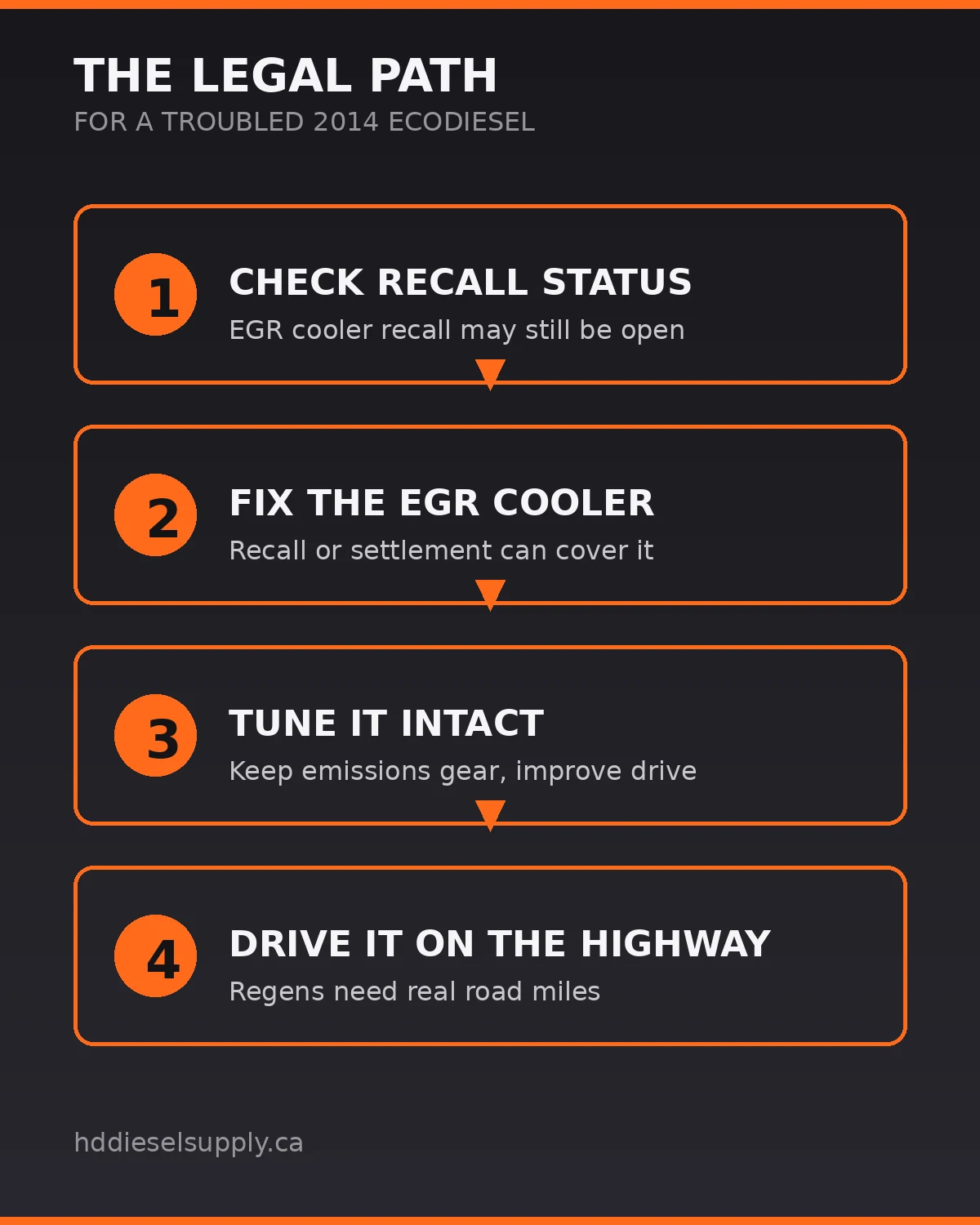
Start with the recall and the settlement. Read our breakdown of the EcoDiesel EGR cooler settlement and check whether your truck is covered. This is the single highest value step a 2014 owner can take, and it costs a phone call.
Next, look at emissions intact tuning. This is the legal middle ground the forums rarely mention: a tune that keeps every piece of emissions hardware in place and working, while improving how the truck drives. It does not delete anything, so the truck stays compliant.
Then maintain the system you kept. The Gen 2 EcoDiesel punishes short trips and neglected oil more than any diesel I work on. Regular highway miles let the DPF complete its regeneration cycles, correct low ash oil keeps the DPF from clogging with ash, and fixing fault codes early keeps small problems small. When the DPF does get loaded up, professional cleaning costs a fraction of replacement. Our 3.0 EcoDiesel reliability guide covers the full maintenance routine.
The delete promises to make the truck simpler. What it actually does is trade a fixable mechanical problem for a permanent legal one. Fix the cooler, keep the equipment, tune it intact, and drive it. That is the whole playbook, and it works.
Frequently asked questions
Should I buy a delete kit for my 2014 Ram EcoDiesel?
No, not for a truck you drive on public roads. The kit is simple hardware, but the moment it goes on, the truck no longer complies with Canadian emissions law. The 2014 has known EGR cooler problems that were covered by a recall and a settlement, so get the legal repair first and look at emissions intact tuning if you want better drivability.
Will a deleted 2014 EcoDiesel pass an emissions test in Ontario?
Ontario does not emissions test light duty trucks at all since the Drive Clean program ended in 2019, so there is no test to pass or fail. That does not make the delete legal. Federal law still prohibits tampering, and Ontario can take enforcement action, including fines, if a roadside inspection finds the equipment missing.
What usually pushes 2014 EcoDiesel owners toward a delete?
The EGR cooler. On the 2014 to 2019 Gen 2 engine it can leak coolant internally, and in the worst cases it caused fires. There was a recall and a class action settlement covering many of these trucks. Owners hit with a big cooler replacement quote start shopping for delete kits. Check your recall and settlement coverage first, because the repair may cost you little or nothing.
What is the legal alternative to deleting a 2014 EcoDiesel?
Fix what is broken, then tune around the emissions system instead of removing it. Emissions intact tuning keeps the DPF, EGR, and DEF hardware in place and working while improving drivability. Pair it with regular highway driving, correct low ash oil, and professional DPF cleaning when needed. That combination solves nearly every complaint that sends owners toward a delete.