

Fleets are not quitting cherry diesel because it is bad fuel. They are keeping it away from road trucks because the tax saving is small, the fine for one wrong fill is large, and a single misfuel can poison an audit trail for a whole yard. Modern dyed diesel is the same low sulfur base fuel as clear diesel, so the issue is paperwork and enforcement, not engine damage.
- Cherry diesel is red dyed diesel, the tax exempt fuel for off road equipment, and it is legal in tractors, loaders and generators.
- One wrong fill in a road truck draws a federal penalty of the greater of $1,000 or $10 per gallon in the United States, plus back tax.
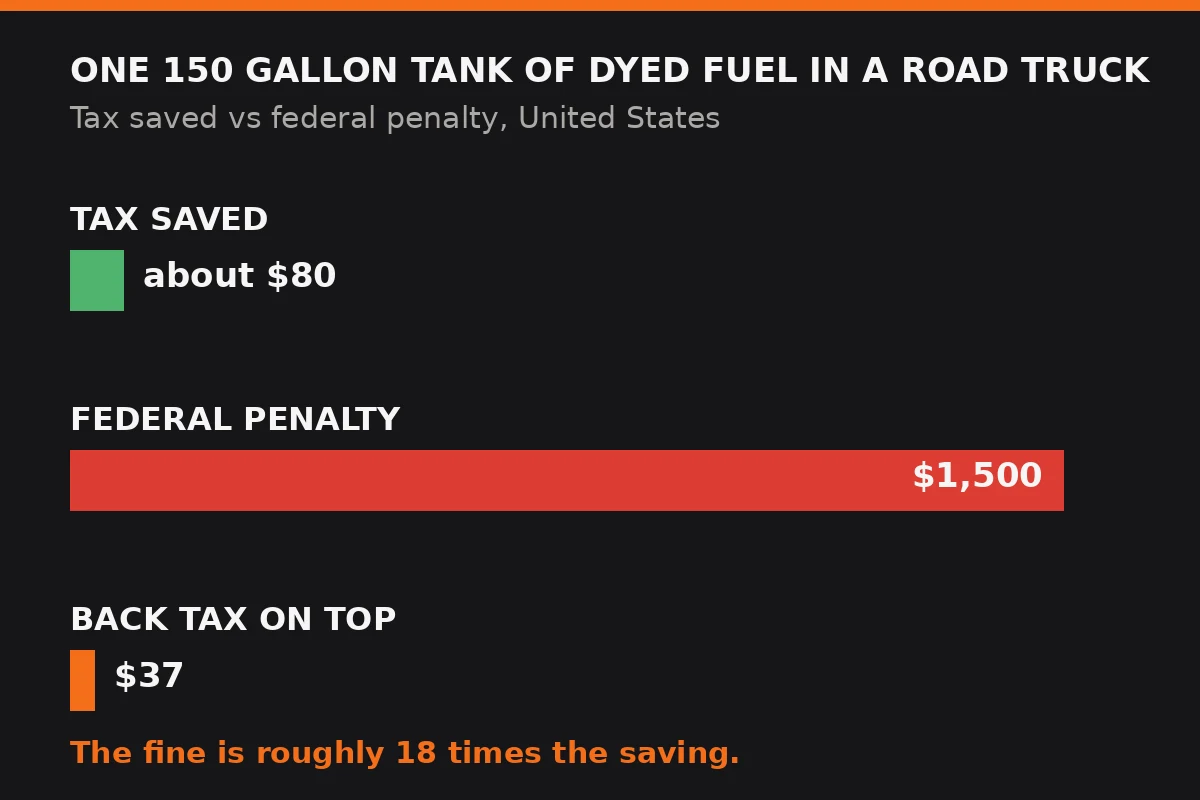
- The tax saved on a full 150 gallon tank is roughly $80, while the penalty on that same tank is $1,500. That is the whole argument in one line.
- Mixed fleets that keep dyed fuel on site use separate tanks, labelled nozzles and separate paperwork, or they wet hose equipment and keep cherry diesel out of the yard altogether.
Fleet managers are not arguing about cherry diesel at the fuel island anymore. They are quietly making a policy decision in the office: does dyed fuel get a tank in our yard at all? More and more of them are answering no, and it is not because the fuel is bad. It is because the math, the enforcement and the paperwork all point the same way. The fleets that get burned are almost never the ones trying to cheat. They are the ones with one tank, two kinds of trucks and a driver in a hurry.
Cherry diesel is red dyed diesel, also called cherry juice in some shops. The dye is Solvent Red 164 in the United States, and the fuel underneath it is the same ultra low sulfur diesel as clear fuel. The colour exists for one reason: to mark fuel that has not paid road tax. That makes it legal in tractors, loaders, generators and other equipment that never drives on a public road, and illegal in anything with plates that does.
Myth: cherry diesel is cheaper fuel, so a fleet saves real money
Fact: the only saving is the tax you did not pay, and it is smaller than most people think. In the United States the federal excise tax on diesel is 24.4 cents per gallon, plus whatever the state charges. In Alberta, marked fuel carries a tax rate of about 4 cents per litre against about 13 cents for clear fuel, a gap of roughly 9 cents a litre.
But here is the number work I run for fleet owners, using one tank as the unit. Fill a 150 gallon saddle tank with dyed fuel instead of clear fuel and you have dodged roughly $80 in combined tax. Get caught with that same tank on the road and the federal penalty under 26 U.S.C. section 6715 is the greater of $1,000 or $10 per gallon, which on 150 gallons is $1,500, plus a backup tax of 24.4 cents per gallon on top. The fine is roughly eighteen times the saving, and that is before any state penalty, back taxes or audit costs. One bad fill erases years of careful savings.
Myth: inspectors need a lot of dye to write a ticket
Fact: there is no safe trace amount. Inspectors dip the tank at weigh stations and roadside stops, and a sample that shows red is enough to start the process. Test strips can pick up dye the eye cannot see, and the law treats any dyed fuel in a road vehicle tank as a violation. Repeat offences get worse in a way that surprises owners: the $1,000 floor climbs by $1,000 for each prior penalty, so a second offence starts at $2,000 and a third at $3,000, always compared against the $10 per gallon figure.
A fleet does not need a dishonest driver to get fined. It needs one tired driver, one unlabelled nozzle and one truck that was supposed to take clear fuel. I have seen a yard where the dyed tank and the clear tank sat side by side with faded labels, and the owner only found out there was a problem when a truck came back from a scale with a citation. The driver swore he filled from the right tank. Nobody could prove otherwise, because the paperwork did not separate the two fuels either.
Myth: dyed fuel wrecks modern engines and DPF systems
Fact: modern dyed diesel does not damage a DPF or an EGR system, because it is the same 15 parts per million sulfur base fuel as clear diesel. The dye itself adds no power and takes none away. The confusion comes from two real risks that get blamed on the dye. First, old farm and jobsite tanks carry water, rust and algae, and that contamination hurts injectors and filters no matter what colour the fuel is. Second, heating oil is also dyed, and heating oil is not held to the ultra low sulfur standard, so it genuinely can poison catalysts and load a DPF with sulfates. If a truck ran rough on dyed fuel, suspect the tank it came from, not the colour.
Myth: one tank for everything is simpler if drivers are careful
Fact: careful drivers are not a fuel system. Every fleet that runs dyed fuel safely does the same boring things, and fleets that skip them are the ones that get caught. Separate tanks for each product, with different nozzles that are clearly labelled. Separate delivery tickets and invoices showing product and gallons for each fuel. And a real rule, written down, that dyed fuel never touches a road vehicle tank, with no exceptions for a quick top up.
Some yards go further and skip the second tank entirely. Mobile fueling, often called wet hosing, fills road trucks with clear diesel straight into their tanks and fuels equipment where it sits. Both approaches exist for the same reason: removing the dyed tank removes the mistake. When I talk to a fleet owner who is on the fence, I ask one question. Can you prove, from paper, which fuel went into which truck on any given day last month? If the answer is a pause, that fleet should not have a dyed tank.
Myth: Canada is looser about this than the United States
Fact: Canada enforces marked fuel its own way, and the penalties are not small. In Alberta, possessing marked fuel in contravention of the Fuel Tax Act can draw a fine of up to $10,000 for a first offence and up to $25,000 for a subsequent offence, alongside possible imprisonment. In British Columbia, the penalty for unauthorized purchase or use of coloured fuel is the greater of three times the tax that would have been payable or up to $1,000 as set by regulation. There is also no Canadian version of the United States 2026 dyed diesel waiver, so a Canadian road truck on dyed fuel has no relief period to hide behind at all.
A yard policy that holds up
If your fleet runs equipment that qualifies for dyed fuel, the saving is legitimate and you should take it, but only inside a policy that survives a bad day. Label every tank and nozzle so a new hire cannot get it wrong. Keep delivery tickets by product, not in one pile. Drain and clean any tank you convert from dyed to clear before the first clear fill, because leftover dye shows up in the next load.
If you cannot do all of that, the honest fleet answer is the one more managers are choosing. Run clear fuel in everything, claim the off road tax back where your jurisdiction allows it, and sleep through the scale visit. The tax saving on dyed fuel was never the profit centre of a fleet. It was a discount with a tripwire attached, and the fleets saying no to cherry diesel have simply decided the discount is not worth the tripwire anymore.
Frequently asked questions
Should I run cherry diesel in a farm truck that sometimes drives on the road?
No. The moment that truck touches a public road with dyed fuel in the tank, the farm exemption does not cover it. If the truck ever leaves the property, fill it with clear fuel and keep the receipt. Plenty of farm trucks live a double life, and that double life is exactly what inspectors look for. Run clear fuel in anything with plates and save the dyed fuel for equipment that never leaves the yard.
Cherry diesel vs clear diesel: which one belongs in a mixed fleet yard?
Clear diesel belongs in every road truck, full stop. Cherry diesel belongs only in equipment with its own tank that never touches a public road, and only if your yard can keep the two fuels physically apart. If you cannot guarantee separate tanks, separate nozzles and separate delivery tickets, the safer fleet policy is clear fuel for everything and a tax rebate claim on the off road use, where your jurisdiction allows one. The tax saving is real but it is not worth an audit.
What happens if an inspector finds dye in a truck after a waiver period ends?
The waiver ending does not reset your tank. Inspectors test the fuel that is in the tank on the day they test it, and dye can linger in filters and low spots long after you switch back to clear fuel. That is why I tell owners to change fuel filters, run several tanks of clear fuel and keep every receipt from the switch onward. A clean paper trail is the only defence that actually works at the roadside, and you can read the full clean switch process in my guide to whether red diesel dye stains your fuel system.