

Diesel trucks idle so much because drivers are warming the cab, cooling the turbo after hard work, keeping the engine ready in cold weather, or just following an old habit from the days when a cold diesel was hard to restart. A pickup diesel burns about 1 to 2 litres of fuel an hour at idle, and an hour of idling wears the engine about as much as 25 to 30 miles of driving. A minute or two is harmless, but hours of idling every day loads the DPF with soot, dilutes the oil, and burns fuel for nothing.
- A pickup diesel burns roughly 1 to 2 litres an hour at idle, and a big highway truck burns 3 to 4.5 litres an hour.
- Idling more than 10 seconds uses more fuel than shutting the engine off and restarting it.
- One hour of idling wears the engine about as much as 25 to 30 miles of driving, and long idling loads the DPF with soot.
- Toronto allows only one minute of idling in any 60 minute period, and most cities have a limit of their own.
Diesel trucks idle so much because the reasons are real, even if the habit is bigger than the reasons. A driver idles to keep the cab warm in January, to cool the turbo after a hard pull, to keep the engine ready on a cold morning, or just because that is what diesel owners have always done. Some of those reasons still hold up. Most of them do not, and the fuel and wear add up faster than most owners think.
Why do diesel trucks idle so much?
Cold mornings. This is the big one in Canada. A diesel needs heat to fire, and on a minus 25 morning in Alberta an owner worries the truck will not start again if he shuts it off. That worry was fair in 1995, when a mechanical diesel with weak glow plugs and thick 15W40 oil could be a real fight to restart in the cold. A modern truck with a grid heater, good batteries, and synthetic oil starts in the same weather without drama, and a block heater does more for a cold start than an hour of idling ever will. My guide to block heater types covers which one your truck needs.
Turbo cooldown. After a hard tow or a long highway pull, the turbo is spinning fast and running very hot. Shut the engine off right then and the oil stops flowing while the turbo is still cooking, which bakes oil onto the bearings. Two to three minutes of idle lets it spool down and cool off. That part is real, and every mechanic will tell you the same. What is not real is the half hour version. It needs two or three minutes, not twenty.
Cab heat and air conditioning. In January the cab is the office, and in July the air conditioning keeps the driver working. A work truck that sits on a job site all day keeps the engine running because the heater and the air conditioning need it. That is a comfort choice, not an engine choice, and it is the most honest reason of the lot.
Work equipment. Some trucks idle because the job needs it. A PTO running a hydraulic pump, a crane, a compressor, or a dump bed needs the engine turning. That is not wasted idling. That is the truck doing its job.
Habit. Then there is the rest of it, which is just habit. The truck has always idled at the yard, at the fuel station, at the coffee stop, so it idles. Old habits from the days before emissions equipment die hard, because idling used to be nearly free on a mechanical diesel. It is not free any more.
How much fuel does idling actually burn?
Less per hour than most people guess, and far more per year than most people admit.
| Truck | Fuel burned at idle | In a 10 hour day |
|---|---|---|
| Pickup diesel, 6.6 to 6.7L | 1 to 2 litres an hour | 10 to 20 litres |
| Highway tractor, 12 to 15L | 3 to 4.5 litres an hour | 30 to 45 litres |
| Working diesel, City of Toronto figure | About 2.5 litres an hour | About 25 litres |
The Toronto number is worth a second look. City council papers on the idling bylaw put a working diesel at about 2.5 litres an hour, which sits right between a pickup and a highway tractor, and that is the number I use when an owner asks me what his truck is drinking in the driveway.
The real question is not the hourly rate. It is the yearly total. An hour of idling a day, five days a week, is about 260 hours a year on a pickup, which is 260 to 520 litres of diesel burned for zero kilometres. Natural Resources Canada puts the break even point at 10 seconds: idling for more than 10 seconds uses more fuel than shutting the engine off and restarting it.
Does idling hurt a modern diesel?
Yes, and in ways that did not exist before emissions equipment. An old mechanical diesel could idle all day and the worst it got was a bit of fuel wash. A modern truck pays for idling in four places.
First, the DPF. At idle the exhaust never gets hot enough to complete a regen, so soot builds in the filter instead of burning off. A truck that idles for hours every day loads its DPF far faster than a truck that works on the highway, and that is how owners end up reading my article on DPF replacement cost in Canada a year sooner than they should. My guide on how to clean a DPF explains the fix, but not idling is cheaper than cleaning.
Second, the EGR valve. Low temperature, low load running is exactly what gums an EGR valve up with carbon. A stuck EGR throws codes, kills fuel economy, and turns into a bill. Third, the oil. At idle the cylinders run cool enough that unburned fuel can wash past the rings and dilute the oil, and thin oil protects worse. The wear shows up in the next oil analysis.
Fourth, the wear itself. The American Trucking Associations puts one hour of idling at roughly the same engine wear as 25 to 30 miles of driving. An hour a day of idling is like adding 150 miles a week to the odometer that never shows, and it is why fleet managers count idle hours next to kilometres.
Older engines have their own version of the problem, called wet stacking. A mechanical diesel idling for hours in the cold never gets hot enough to burn its fuel cleanly, so unburned fuel and carbon build up in the cylinders and the exhaust. It is less common on modern trucks, but the physics never went away.
Myth vs fact: the idling claims that will not die
Myth: idling warms up a diesel. Fact: it barely warms it at all. A diesel at idle makes so little heat that in real cold the engine can actually lose temperature while it runs. Toronto council papers noted the same thing years ago: fifteen minutes of idling drops engine temperature about as much as turning the engine off for an hour. Drive it gently and it warms up in minutes.
Myth: restarting uses more fuel than idling. Fact: it does not, unless the stop is under 10 seconds. That is the Natural Resources Canada number. The wear on the starter from extra restarts is real but small, and it costs far less than the fuel and DPF damage from hours of idling.
Myth: idling is good for your turbo. Fact: a short cooldown is good for your turbo. An endless idle is not. Two to three minutes after hard work is the whole job.
Myth: old diesels had to idle all night. Fact: they often did, and for reasons that made sense then. Weak glow plugs, thick oil, and no block heater meant a cold diesel might not restart until spring. Modern grid heaters, synthetic oil, and a two hour block heater session ended that problem. If your truck still needs to idle all night in 2026, fix the batteries, the grid heater, or the glow plugs, and it will start in the morning.
Is it illegal to let your diesel idle in Canada?
In many cities, yes. Toronto has the strictest rule I know of: the idling bylaw allows one minute of idling in any 60 minute period, and that applies to every vehicle, including diesels. Other cities set their own limits, and most of them are in the three to five minute range, so check the bylaw where you park. Enforcement is usually complaint driven, and a neighbour with a phone is all it takes.
When should you shut it off instead?
Use a simple rule. If the truck will sit for more than a minute and you are not cooling the turbo or running equipment, shut it off.
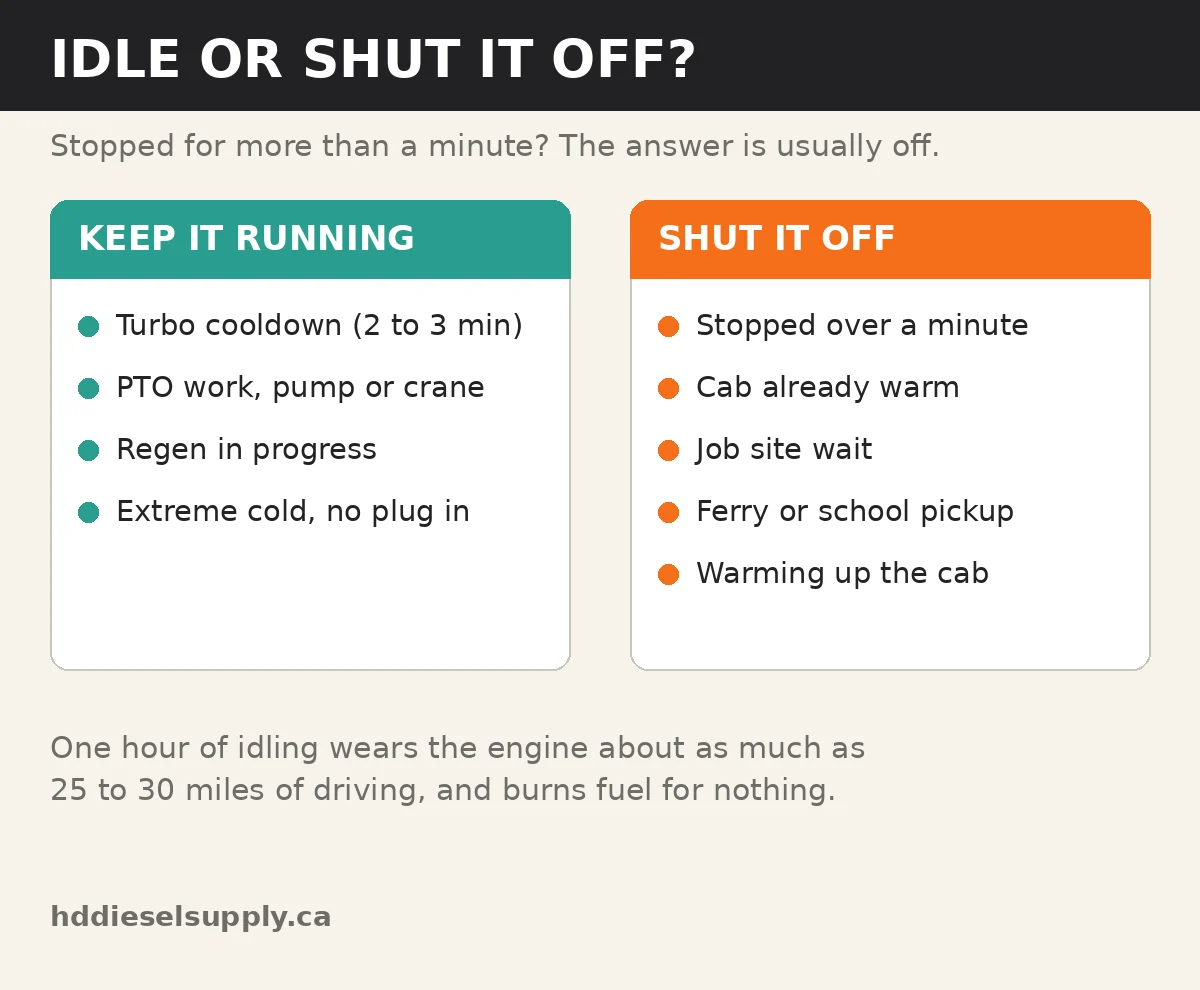
Shut it off. Waiting at a job site. Sitting in a ferry lineup. School pickup. A coffee stop. Warming up the cab in the morning, which a block heater does better anyway.
Keep it running. Two to three minutes after a hard tow, so the turbo cools down. While a PTO is running a pump, a crane, or a dump bed. While a regen is in progress and the dash tells you not to shut it off. In extreme cold with no block heater and a truck you genuinely are not sure will restart, which is a maintenance problem to fix, not a routine to keep.
My full winter diesel survival guide covers the cold weather side of this in detail, including fuel gelling and battery care.
The rule I use on my own truck
I start it, I wait about 30 seconds for the oil to get where it needs to go, and I drive away gently. After a hard pull I give it two or three minutes to cool the turbo, then I shut it off and walk away. Idling is a tool with two real jobs, turbo cooldown and running equipment, and everything past that is habit, comfort, or worry. Habits are free to keep, but this one sends you a fuel bill and a DPF bill, and neither one is small.
Frequently asked questions
Should I let my diesel idle to warm it up in winter?
No. Idling barely warms a diesel, because the engine makes very little heat at idle, and in real cold it can actually lose temperature while it idles. Start it, wait about 30 seconds for the oil to circulate, then drive gently until the temperature gauge moves. A block heater plugged in for two to three hours before you start does far more than twenty minutes of idling ever will.
Idling vs shutting off: which is better for the engine?
Shutting off wins for any stop longer than a minute, with one exception: after a hard tow or a long highway pull, let the engine idle for two to three minutes so the turbo can cool down before the oil stops flowing. Short stops at a light or a drive through are not worth a shutdown. Long waits at a job site, a ferry lineup, or a school pickup are, because idling loads the DPF with soot and wears the engine for zero miles.
How long can I leave my diesel idling?
There is no hard mechanical limit, and a healthy diesel can idle for hours without stopping, but that does not make it a good idea. Long idling causes wet stacking in older engines, soot loading in the DPF, and oil dilution in modern ones, and most Canadian cities cap idling by law. Toronto allows one minute in any 60 minute period. As a rule, if the truck will sit for more than a minute and you are not cooling the turbo or running equipment, shut it off.