
The ash inside a dead DPF is a record of what killed it. Soot burns off in regen, but ash is the mineral leftover from burned engine oil, and it never burns, so it builds up until the filter chokes. Grey powder means normal ash at the end of a long life, hard dark crust points at failed regens, and wet or oily ash means oil or fuel is getting into the exhaust. Read the ash before you pay for a cleaning or a new filter, because the ash tells you whether the filter is the problem or just the victim.
- Soot burns off in regen. Ash does not, and it is the mineral leftover from burned engine oil.
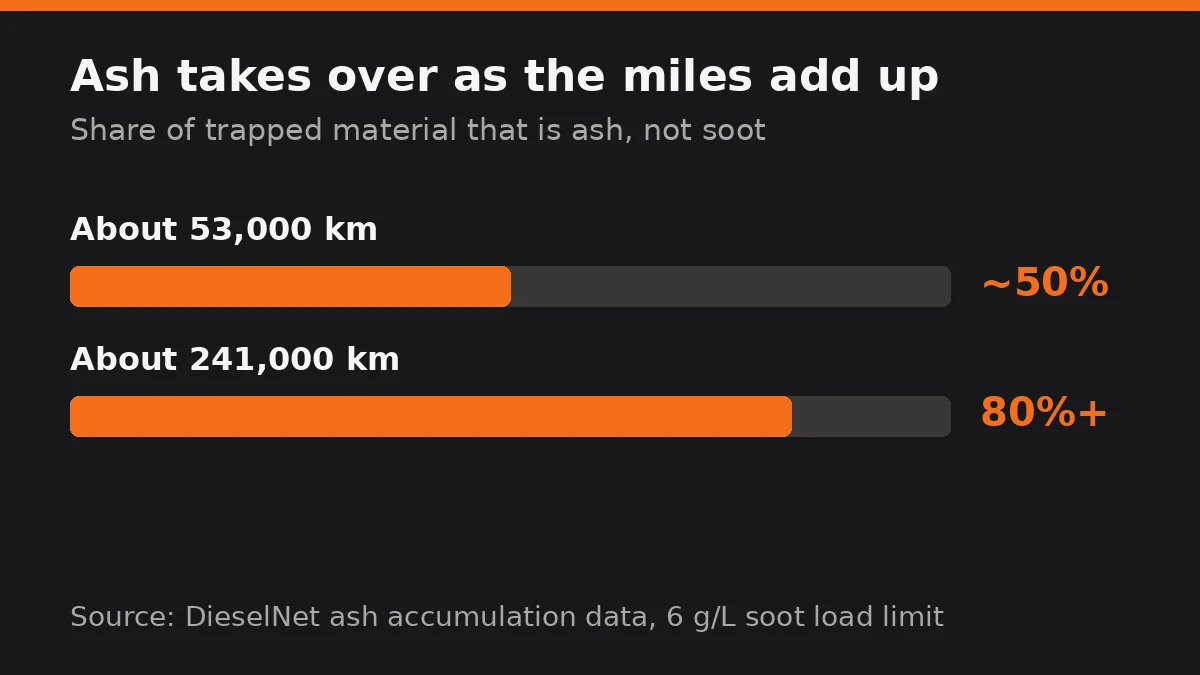
- By about 53,000 km, ash is roughly half of everything trapped in the filter. By 241,000 km it is over 80 percent.
- A scan tool ash load reading, plus how often the truck regens, tells you the filter is full of ash without cutting anything open.
- No chemical or regen removes ash. Only a professional pneumatic cleaning or a new filter does.
A 2017 Ram 2500 came into the shop last winter with 238,000 km on it and a complaint I hear every month. The owner said the truck was regenerating every 150 km, the fuel economy had fallen off a cliff, and his last mechanic had told him the sensor was bad. The sensor was fine. We pulled the filter, cut it open on the bench, and the back of every channel was packed solid with fine grey powder. That powder was ash, and it told the whole story in about ten seconds. The truck was not broken. The filter was simply full of ten years of burned oil, and no sensor or software update was ever going to fix that.
Your DPF keeps a record of everything that has passed through it, and if you know how to read it, the filter tells you whether it died of old age, bad oil habits, or an engine problem upstream that will kill the next filter too.
Soot burns. Ash does not.
Two things fill a DPF. Soot is unburned carbon from diesel combustion, the black stuff regeneration exists to deal with. A regen burns soot off at high temperature and sends it out the tailpipe as gas.
Ash is the mineral leftover after engine oil burns, mostly calcium, magnesium, zinc, and phosphorus from the additive package. It is already fully burned, so no temperature your truck can reach will touch it. Every regen burns the soot and leaves the ash behind. The filter is a furnace that keeps the ashes.
The numbers show how fast the balance shifts. Research published by DieselNet puts ash at roughly half of everything trapped in the filter after only about 53,000 km of driving, measured against a 6 gram per litre soot load limit. By 241,000 km, the minimum EPA ash cleaning interval, ash is over 80 percent of what is trapped. A heavily ashed filter can lose up to 60 percent of the room it has to hold soot, which is why a truck with a full ash load regens constantly. There is nowhere left to put the soot, so the computer keeps trying to burn off a load that has nowhere to go.
What the ash looks like, and what it means
| What you see | What it usually means |
|---|---|
| Fine grey powder, loose and dry | Normal ash from oil additives. The filter lived a long life and reached the end of it. |
| Hard dark crust, baked onto the walls | Repeated failed or interrupted regens, or long periods of short trip driving with no highway heat. |
| Wet black sludge | Unburned fuel or oil reaching the filter, often a failing injector or heavy oil burning. |
| Oily grey paste | Turbo seal leak or serious oil consumption. Fix the oil source before the next filter goes in. |
| White crust | Coolant in the exhaust, usually an EGR cooler or head gasket problem. This one kills filters fast. |
Grey powder is the only finding that means the filter itself was the problem. Everything else means something upstream is feeding the filter material it was never built to handle, and a new filter will meet the same fate if that fault is not fixed first.
Where the ash actually comes from
Almost all of it is your engine oil. Every diesel burns a little oil, past the rings, past the valve seals, and through the turbo. The oil itself burns away, but the metals in the additive package do not. They land in the filter as a fine mineral dust and stay there. Fuel and engine wear add a little, but oil is the main source by a wide margin.
That is why the oil spec matters. CK-4 and CJ-4 oils are capped at 1.0 percent sulfated ash, and that cap was written with the DPF in mind. It is also why the oil burning rate matters more than most owners think. An engine that burns a litre every 8,000 km is sending a steady stream of ash downstream, and a leaking turbo seal or tired valve seals can double or triple that rate.
How to read ash load without cutting anything open
You do not need to open the filter to know it is full of ash.
First, regen frequency. A truck that used to regen every 400 km and now regens every 150 km, with no change in how it is driven, is running out of room for soot because ash has taken the space.
Second, a scan tool ash load reading. Most 2013 and newer trucks report ash load as a percentage or in grams through the OBD port, and any decent diesel scan tool reads it.
Third, the symptoms that follow a full filter. Fuel economy drops because the engine is working against rising backpressure and spending more time in regen. The truck may throw a DPF efficiency code even though the soot load reads low, because the computer can see the pressure but not the reason for it.
Can you clean ash out, or is the filter done?
No regen removes ash. No pour in chemical removes ash. No highway drive removes ash. Those products deal with soot, and if the problem is ash, they are treating the wrong thing. A forced regen on an ash full filter just burns the small amount of soot on top of a pile of mineral powder. My guide on how to clean a DPF filter covers the soot side of cleaning, and the ash problem sits underneath it.
What does remove ash is a professional pneumatic cleaning. A DPF cleaning shop pulls the filter, bakes it, and blows air through it in reverse flow to push the ash out of the channels. It works well on a filter that is structurally sound, and it costs a fraction of a new one. My DPF replacement cost guide lays out the Canadian numbers, and the gap between a cleaning and a new filter is big enough that a cleaning is worth trying first in most cases.
Replacement is the right call when the substrate is cracked, melted, or face plugged with hard crust that will not blow out. A cracked filter will not hold a cleaning, and it will not pass an inspection. Get the ash load read before you approve either one.
How to slow the ash down
You cannot stop ash, but you can slow it a long way. Run the correct low ash CK-4 oil and change it on time. Fix oil burning early, because a turbo seal that drips a little today becomes a filter full of paste in a year. Keep the truck out of endless short trips where it never reaches regen temperature.
The filter is a record of how the engine has been treated, written in mineral dust. Read it before you spend money on it, and it will tell you whether the filter is the problem, or just the part that got blamed for it.
Frequently asked questions
Should I clean my DPF or replace it?
Clean it if the filter is structurally sound and the ash load is the only problem. A professional pneumatic cleaning costs a fraction of a new filter and restores most of the flow. Replace it if the substrate is cracked, melted, or face plugged with hard crust, because no cleaning fixes broken ceramic. Get the ash load read first, and get a cleaning quote before you accept a replacement quote.
Soot vs ash: what is the difference?
Soot is unburned carbon from diesel combustion, and it burns off as gas during regen at high temperature. Ash is the incombustible mineral leftover from burned engine oil, mostly calcium, magnesium, zinc, and phosphorus from oil additives, and it stays in the filter forever. Soot is a fuel problem the truck manages on its own. Ash is an oil problem that only grows, which is why a truck that regens perfectly can still end up with a choked filter.
How do I know if my DPF is full of ash?
The clearest sign is regen frequency. A truck that used to regen every 400 km and now regens every 150 km, with no change in driving, is running out of room for soot because ash has taken the space. A scan tool can read the ash load directly on most 2013 and newer trucks. Rising backpressure, falling fuel economy, and a filter that feels heavy for its size all point the same way.
Does low ash oil really make a difference?
Yes, over the life of the filter. CK-4 and CJ-4 oils are capped at 1.0 percent sulfated ash, and that cap exists for the DPF. An engine that burns a litre of oil every 8,000 km is feeding a steady stream of ash into the filter, so the oil spec and the oil burning rate both matter. Fixing an oil leak or worn turbo seals early saves more filter life than any additive ever will.