

Any amount of gasoline in a modern diesel is a drain the tank problem, not a top it up and hope problem. Gasoline strips away the lubrication your high pressure fuel pump and injectors depend on, and once you start the engine that thin fuel circulates through parts built to tolerances finer than a human hair. If you have not started the engine, a drain and flush usually ends the story for a few hundred dollars. If you drove on the mix, the bill can run into thousands, because a failing pump can shed metal through the whole fuel system.
- If the key never turned, do not turn it. A drain and flush is the cheap ending.
- A splash of gas in a full tank is still contamination in a common rail truck, even though old mechanical diesels once tolerated a small winter mix.
- Once the engine runs on the mix, expect filters, a flush, and possibly a pump and injectors, not just a tank drain.
- Misfuelling is almost never covered by warranty, so the cheapest insurance is the tow truck you call before you start it.
Any amount of gasoline in a modern diesel is a drain the tank problem, not a top it up and hope problem. I have watched this play out at the shop counter more times than I like, usually with an owner holding a gas pump receipt and asking the same question you are asking now: how much did I put in, and does that amount matter? The honest answer is that the amount matters far less than one other fact, and that fact is whether you turned the key.
Gasoline strips away the lubrication your high pressure fuel pump and injectors depend on. Diesel fuel is not just fuel in a modern truck. It is also the lubricant and the coolant for the pump and injectors, which run at pressures above 30,000 psi with clearances finer than a human hair. Gasoline is thinner, it acts like a solvent, and it does not lubricate those parts. Run it through them and metal starts wearing on metal.
How much gas is actually dangerous?
There is no safe number I will give you for a modern common rail truck, and any mechanic who gives you one is guessing with your money. Owners talk themselves into driving on a splash, because a splash sounds harmless. Do the math and it stops sounding harmless. Six litres of gas in a 120 litre pickup tank is 5 percent contamination. Twenty litres in that same tank, less than a normal fill when you are distracted, is about 17 percent. Both amounts reach the pump in exactly the same way, mixed through the fuel, and neither amount lubricates.
The confusion comes from history, and the history is real. Decades ago, drivers in cold country did mix roughly 1 gallon of gas into about 20 gallons of diesel to keep fuel from gelling, and old mechanical injection systems tolerated it. That was a different fuel system in a different era, with lower pressures and far more forgiving parts. Today's trucks have winter diesel, fuel heaters, block heaters and anti gel additives that do the same job without the risk. I wrote about beating gelling properly in my diesel fuel gelling guide, and none of it involves a gas pump.
If your truck is an old mechanical diesel, a 12 valve or a 7.3 with a mechanical pump, a small amount of gas is less likely to be fatal, and old timers will tell you so, often loudly. Even then I would drain it. The saving from skipping a drain is a few hundred dollars, and the risk is a pump rebuild costing several times that.
What does gasoline do inside a common rail fuel system?
Start with lubrication, because that is what kills parts first. Your CP4 or CP3 pump and your injectors are lubricated by the fuel itself. Gasoline thins that fuel and washes the lubricating film away, so precision parts that should glide start grinding. A pump that starts shedding metal does not keep the damage to itself. Metal travels with the fuel into the rails and the injectors, which is why a pump failure can turn into a full fuel system job instead of a single part swap. My post on what kills a CP4 pump walks through that cost.
Then there is combustion. Gasoline ignites differently under compression than diesel does, so an engine running on the mix can knock, run rough, smoke, lose power or quit outright. That knock is pressure arriving at the wrong moment, hammering pistons and rods designed for the slower, controlled burn of diesel. An engine that keeps running on the mix keeps grinding its own fuel system down with every revolution.
Badly burned fuel can also foul sensors and load up the DPF with soot it was never meant to handle, so tell the shop the full story and ask them to check for codes and soot load.
Did you start the engine? That answer decides everything
This walkthrough splits three ways. Find your branch and do not borrow steps from another one.
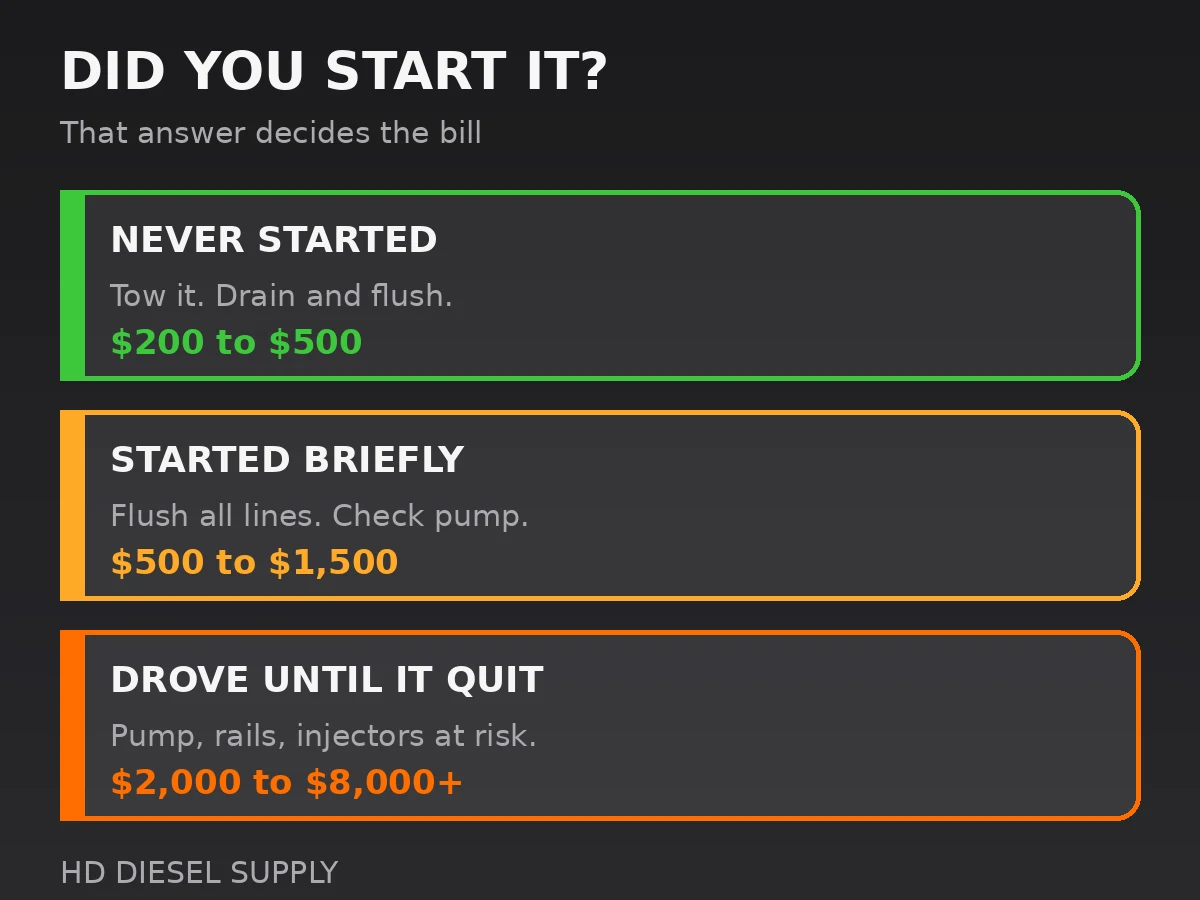
First branch: you caught it at the pump and never started the engine. Do not start it, not to move the truck ten feet, not to see if it sounds normal. Put the hazards on, call a tow truck, and tell the shop the tank has gas in it before the truck arrives. The shop drains the tank, flushes the lines, replaces the fuel filters, refills with diesel and primes the system. That is the cheap ending, usually a few hundred dollars. Your biggest risk in this branch is impatience, because one curious key turn moves you into the next branch.
Second branch: you started it, idled briefly, or drove a short distance before realising. Shut it off as soon as you can do so safely and do not restart it to drive to the shop. The contaminated fuel has now circulated, so a tank drain alone is no longer enough. Expect a flush of the whole system, new filters, and an inspection of the pump and injectors for metal and wear. If the shop finds metal, the job grows, because metal in the system means the pump has already started to fail.
Third branch: you drove until it ran rough, lost power, smoked heavily or quit. Tow it, and brace for the expensive conversation. At this point the shop has to assume the high pressure system is compromised. Ford's own service procedure for its 6.4L and 6.7L Super Duty diesels treats started misfuelling this seriously, calling for full replacement of the high pressure system, pump, lines, rails and every injector, when the engine was run on the wrong fuel.
What will the shop actually do, and what will it cost?
Costs vary by shop rate and by truck, so treat these as typical North American ranges, not quotes. The pattern matters more than any single number: the cost jumps at each branch, and it jumps hard.
| Situation | What the shop does | Typical cost range |
|---|---|---|
| Never started | Drain tank, flush lines, new filters, refill with diesel | $200 to $500 |
| Started or idled briefly | All of the above, plus full system flush and pump inspection | $500 to $1,500 |
| Driven until it quit | All of the above, plus pump, rails and injectors as needed | $2,000 to $8,000 or more |
A full pump failure on a common rail truck can push past the top of that table, especially if injectors and labour stack up, and misfuelling is almost never covered by warranty. The maker did not build the failure, the pump did. That is also why the tow truck in the first branch is the best money in this whole article. A tow and a drain at a few hundred dollars is the price of a mistake. A fuel system rebuild is the price of driving on it.
One more cost people forget: disposal of the drained mix, which cannot go back into your truck. Ask what disposal costs before the work starts, so it is on the quote instead of a surprise on the invoice.
What I would do if it were my truck
If it were my truck, I would not test it, dilute it, or drive it gently to the shop and hope the noise goes away. I would shut it off, call the tow, and tell the shop exactly what went in and how far the truck ran, because the shop can only price the right job with the right story. A splash of gas feels like a small mistake at the pump, and it is, right up until the key turns.
Frequently asked questions
Should I top up with diesel and dilute the gas away?
No, not on a modern common rail truck. Dilution sounds logical, and the math even looks reassuring, since 6 litres of gas in a 120 litre tank is only 5 percent, but the fuel reaching your pump is still part gasoline, and gasoline does not lubricate. The old winter trick of mixing a little gas into diesel belonged to old mechanical injection systems, not to a pump running above 30,000 psi. Drain the tank, flush the lines, change the filters, and start clean. That is cheaper than gambling a pump and a set of injectors on a dilution theory.
Should I drive it to the shop if it still runs fine?
No. Every minute the engine runs, contaminated fuel moves further through the system, from the tank to the pump to the rails to the injectors, and wear that has already started does not undo itself when you finally shut it off. Pull over somewhere safe, put the hazards on, and call a tow truck. Tell the driver and the shop, in plain words, that the tank has gas in it, and leave a note on the dash so nobody starts it out of habit while it sits in the yard.
Gas in a diesel versus diesel in a gas engine: which is worse?
Gas in a diesel is worse, and it is not close. Diesel in a gas engine usually makes the engine run terribly and then quit, and the fix is mostly a drain and flush. Gas in a diesel attacks the lubrication the fuel system lives on, so it can destroy the high pressure pump and injectors before the engine even complains loudly. One mistake leaves you with a tow bill. The other can leave you with a fuel system rebuild.