
Payload is how much weight your truck itself can carry: passengers, cargo, and the trailer tongue or pin weight pressing down on the hitch. Towing capacity is how much weight your truck can pull behind it. On a diesel pickup, payload almost always runs out first, because a fifth wheel trailer puts 20 to 25 percent of its weight onto the truck, and that weight comes straight out of your payload.
- Payload is what the truck carries. Towing capacity is what the truck pulls. They are two separate budgets, and you can be inside one while blowing past the other.
- A fifth wheel puts 20 to 25 percent of the trailer weight on the truck as pin weight. A bumper pull trailer puts 10 to 15 percent on as tongue weight. Both come out of payload.
- A real 2026 Ram 2500 Rebel Crew Cab lists 18,700 lb of towing but only 2,160 lb of payload, and a 12,000 lb fifth wheel at 20 percent pin weight needs 2,400 lb before a single passenger climbs in.
- Your truck's real payload is on the yellow Tire and Loading Information label inside the driver's door jamb, not in the brochure. Read that label before you shop for a trailer.
Payload is the weight your truck carries. Towing capacity is the weight your truck pulls. Mix those two up and you end up with a trailer your truck can pull on paper and cannot legally carry in real life. That mix up is the most common towing mistake I see in the shop, and it usually shows up the day a customer brings in a new fifth wheel that squats their 2500 down to the bump stops. The ad said 20,000 lb of towing. The door sticker said 2,160 lb of payload. Both numbers were true. Only one of them mattered.
What payload actually covers
Payload is everything the truck itself carries. The driver counts. Every passenger counts. Cargo in the bed counts. Tools, a toolbox, a full tank of fuel, the hitch in the bed, and the trailer tongue or pin weight pressing down on the hitch all count. If it sits in the truck or on the truck, it comes out of payload.
The formula is simple. Payload equals GVWR minus curb weight. GVWR, the gross vehicle weight rating, is the most the truck is allowed to weigh on its own, loaded, with nothing attached behind it. Curb weight is what the truck weighs empty. The gap between them is your payload, and on a diesel pickup that gap is smaller than most owners expect, because the engine, the emissions gear, and the heavy frame eat into it before you load a thing.
Your exact number is not in the brochure. It is on the yellow Tire and Loading Information label inside the driver's door jamb, the one that says the combined weight of occupants and cargo should never exceed a certain number of pounds. That number is for your truck, with your options, as it left the factory. Two trucks that look identical on the lot can have payloads hundreds of pounds apart because one has a sunroof, leather, and running boards and the other does not.
What towing capacity actually covers
Towing capacity is how much trailer weight the truck can pull behind it. It is set by the engine, the transmission, the axle ratio, the cooling system, the frame, and the hitch receiver, and it is tested to the SAE J2807 standard so the numbers are comparable across brands. A bigger number here means the truck can pull a heavier trailer without overheating, without struggling on grades, and without the trailer pushing the truck around.
What the number leaves out is just as important. It does not include the weight of the people and cargo inside the truck. It does not include the pin or tongue weight, which is a payload problem, not a towing problem. And the headline number in the ad is always the best case configuration, usually a regular cab work truck with the right axle ratio and the towing package. The crew cab with leather and a sunroof sitting on the dealer lot is not that truck, and its real ratings are lower.
There is a third number that ties the two together. GCWR, the gross combined weight rating, is the most the truck and the trailer are allowed to weigh together. You can be inside your tow rating and inside your payload and still be over GCWR if the truck is loaded heavy and the trailer is loaded heavy. All three numbers have to fit at the same time.
Why payload runs out first on a diesel
Here is the math that catches people. A fifth wheel trailer puts 20 to 25 percent of its loaded weight onto the truck as pin weight. A bumper pull trailer puts 10 to 15 percent on as tongue weight. That weight lands on the truck, so it comes straight out of payload.
Take a real truck. A 2026 Ram 2500 Rebel Crew Cab with the 6 foot 4 bed and the high output 6.7 Cummins, listed at a Quebec dealer, carries a 9,900 lb GVWR, a 2,160 lb payload, an 18,700 lb max tow rating, and a 26,920 lb GCWR. Now hook a 12,000 lb fifth wheel to it. At 20 percent pin weight, that trailer pushes 2,400 lb down on the hitch. The truck only has 2,160 lb of payload. The pin weight alone is over the limit, before the driver sits down, before the hitch goes in the bed, before a single bag goes in the back seat. The truck can pull 18,700 lb on paper and cannot carry the pin of a 12,000 lb trailer in real life.
The same truck with a 10,000 lb bumper pull travel trailer is a different story. At 12 percent tongue weight, the trailer puts 1,200 lb on the hitch. That leaves 960 lb of payload for people, a hitch, and gear. Tight, but workable. The trailer got lighter and the hitch type changed, and suddenly the same truck fits.
Diesel makes this worse in one specific way. The diesel engine weighs more than the gas engine in the same truck, so the diesel truck tows more and carries less. On the 2026 Ram 2500, the gas Hemi tops out at 3,930 lb of payload while the Cummins tops out at 3,600 lb. You buy the diesel for the torque and the tow rating, and you pay for it with payload. That trade is worth it for most owners, but only if you know it is happening.
How the big three compare on paper
These are the 2026 maximum figures for a diesel 2500, properly equipped. They are maximums from different configurations, so no single truck on a lot carries all of them at once. Treat them as a ranking, not a shopping list.
| Truck | Max towing | Max payload | Max GVWR |
|---|---|---|---|
| Ram 2500, 6.7 Cummins HO | 20,000 lb | 3,600 lb | 11,040 lb |
| Ford F-250, 6.7 Power Stroke | 22,900 lb | 4,048 lb | 11,400 lb |
| Silverado 2500HD, 6.6 Duramax | 22,050 lb | 3,615 lb | 11,350 lb |
Ford wins the tow rating and the payload rating on paper, and the Ram trails on both maximums. But maximums hide the spread. A loaded crew cab diesel in any of the three can land near 2,000 lb of payload, which is why the door sticker matters more than the table. Ram also sells the 2500 with a 9,900 lb GVWR option, which is 4,490 kg, just under the 4,500 kg line that triggers heavy vehicle rules in Quebec. That is why the Rebel in the example above carries a 2,160 lb payload instead of the 3,300 lb a similar truck with the 11,040 lb GVWR carries. Same truck, same engine, different paper rating, and the payload changes by more than 1,000 lb.
If you are shopping, compare trucks by the door sticker on the actual unit you would buy, not by the biggest number in the brochure. The spread between trims is bigger than the spread between brands.
Where do I find my truck's real numbers?
Start at the driver's door. The yellow Tire and Loading Information label gives your payload in plain pounds. The white certification label on the same door jamb gives GVWR and the front and rear GAWR, the gross axle weight ratings. The rear GAWR matters on its own, because pin and tongue weight land almost entirely on the rear axle, and you can be inside GVWR while the rear axle is over its rating.
GCWR lives in the owner's manual or the manufacturer's towing guide for your year. If you cannot find it, the dealer can pull it by VIN.
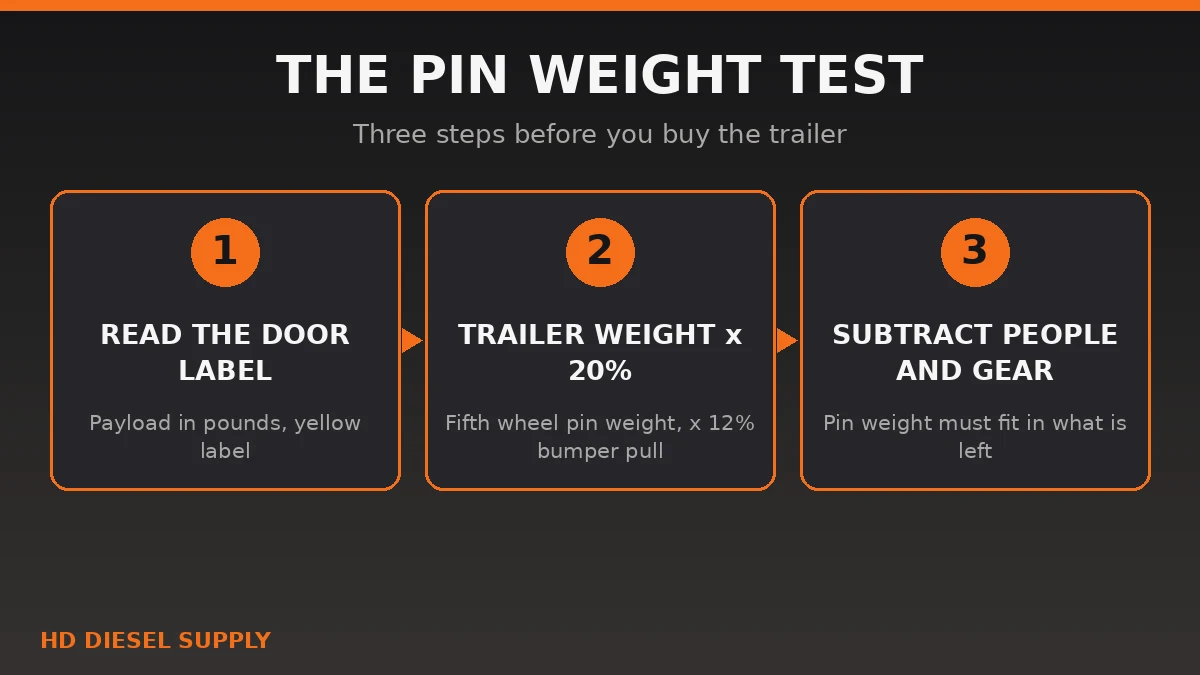
For a number you can trust completely, weigh the truck. A CAT scale at a truck stop costs a few dollars. Weigh it full of fuel, with the family and the gear you actually travel with, and with the hitch installed. Subtract that weight from GVWR and what is left is your real payload that day. Then weigh the trailer the same way, loaded for a trip, and take 20 percent of that for a fifth wheel or 12 percent for a bumper pull. If the pin or tongue weight fits inside the payload you have left, the rig works. If it does not, no tow rating in the world fixes it.
What happens when you go over?
The truck tells you before anything else does. The rear springs sit on the bump stops, the headlights aim at the sky, the steering goes light, and the brakes work overtime on every downhill. The rear tires and the rear axle are past the rating printed on the door, and the transmission runs hotter because it is pulling a load the chassis was not meant to carry.
The paperwork side is slower but real. A manufacturer can deny a warranty claim tied to overloading, and after a crash an insurer will look at weights if the rig was clearly over. Commercial enforcement weighs trucks at scales and fines overloaded rigs, and while a personal pickup is rarely pulled in, the physics does not care about the badge on the door. An overloaded truck stops longer and steers worse, and that is true whether anyone checks or not.
How to check your own truck in two minutes
Read the yellow label on the driver's door and write down the payload. Take the trailer GVWR, the maximum the trailer is allowed to weigh, and multiply by 0.20 for a fifth wheel or 0.12 for a bumper pull. That is your pin or tongue weight. Now subtract the driver, the passengers, the hitch, and whatever lives in the bed. If the number left is bigger than the pin or tongue weight, the trailer fits the truck. If it is smaller, the trailer is too big for the truck, no matter what the tow rating says.
Buy the trailer that fits the truck you own, or buy the truck that fits the trailer you want. The ad number is the tow rating. The number that decides is printed on the door.
Frequently asked questions
Should I buy a 2500 or a 3500 for a big fifth wheel?
Buy the 3500 if the fifth wheel is over about 12,000 lb loaded. A 2500 diesel usually carries 2,000 to 3,500 lb of payload depending on trim, and a 14,000 lb fifth wheel at 20 percent pin weight needs 2,800 lb before you add people, a hitch, and anything in the bed. A 3500 single rear wheel carries roughly 1,000 lb more, and a dually carries far more again, because the rear axle rating and the GVWR are both higher. The 3500 costs more and rides stiffer empty, but it is the truck that lets you load the trailer you actually want without doing weight math every trip.
Payload vs towing capacity: which number matters more?
Payload matters more for most owners, because it runs out first. Towing capacity is the headline number in every ad, and it is almost always bigger than what the truck can really handle once you count the people and gear inside it. A truck rated to tow 20,000 lb with 2,160 lb of payload cannot tow a 20,000 lb fifth wheel, because the pin weight alone would be about 4,000 lb. Check payload first, then check that the trailer weight fits inside the tow rating. If both fit, you are good. If only the tow rating fits, the trailer is too big.
Does towing capacity include passengers and cargo?
No, and that is the trap. The tow rating is about the trailer behind the truck. Passengers, cargo, the hitch, and the trailer tongue or pin weight all count against payload and against gross combined weight rating, which is the truck plus the trailer together. A tow rating tested to the SAE J2807 standard does assume a driver and a passenger and some hitch weight in the truck, but it does not cover your family of four, a bed full of firewood, and a 200 lb hitch. Every pound you put in the truck is a pound the trailer cannot put on the hitch.