
Trucking does not break at one price. It breaks in stages, and the first stage is already here. At the current United States average of $6.35 a gallon, fuel alone costs about 98 cents for every mile a truck runs at 6.5 miles per gallon, which wipes out the margin on any load that pays a 2025 style rate with no fuel surcharge. A pickup owner feels it as a bigger fill up bill, an owner operator feels it as a load that no longer pays, and a fleet feels it when customers refuse the surcharge that would cover it.
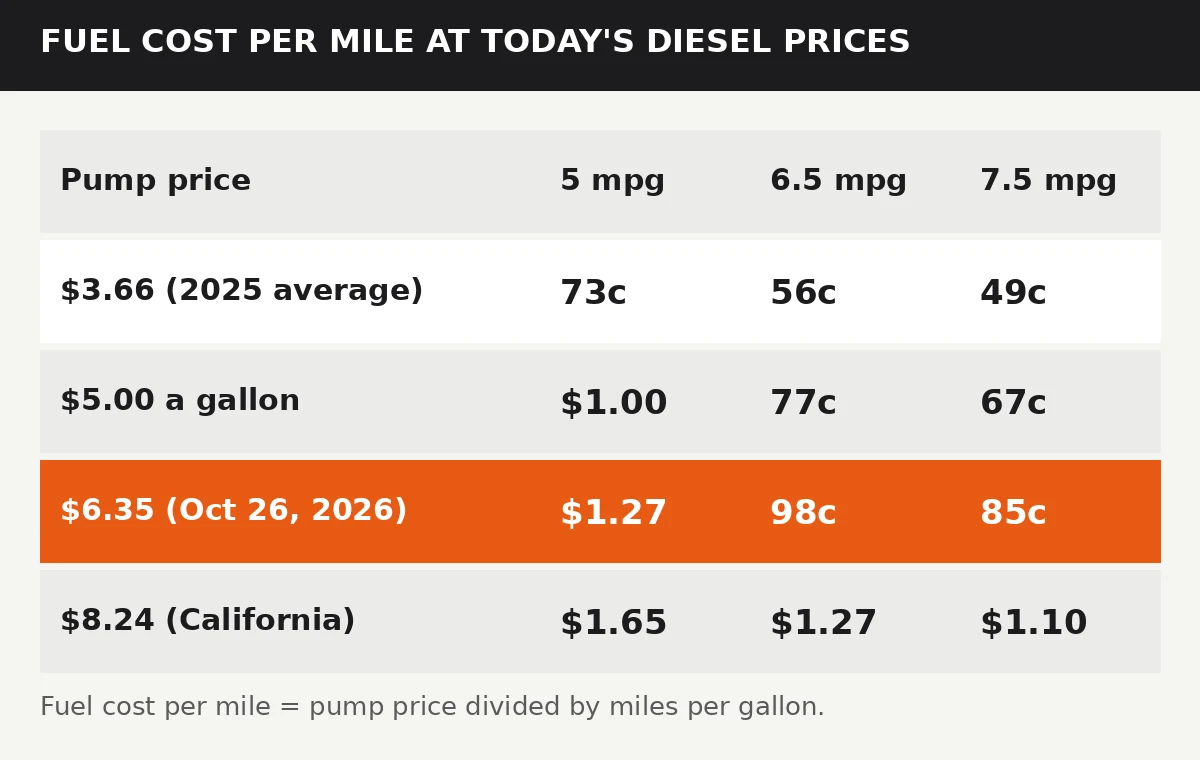
- At $6.35 a gallon and 6.5 miles per gallon, fuel alone costs about 98 cents per mile, against about 56 cents per mile at the 2025 average of $3.66 a gallon.
- Every extra dollar per gallon adds about 15 cents per mile to a truck running 6.5 miles per gallon, and about 20 cents per mile to one running 5 miles per gallon.
- Canada averaged $2.68 per litre in the week ended October 20, 2026, according to Natural Resources Canada, against $1.50 in the same week of 2025.
- The breaking point is not a pump price, it is the gap between your fuel cost per mile and the rate you actually collect, surcharge included.
Trucking does not break at one price. It breaks in stages, and the first stage is already here. The United States average for on highway diesel was $6.35 a gallon for the week of October 26, 2026, according to the Energy Information Administration, after a record $6.53 a gallon in late September. Canada averaged $2.68 per litre in the week ended October 20, 2026, according to Natural Resources Canada, against $1.50 in the same week of 2025. Those are the prices on the pump this week.
I am not an economist. I am a mechanic who watches owners do the same math at my counter, usually with a fuel receipt in one hand and a load sheet in the other. The math they need is simple, and it is the whole article: fuel cost per mile equals pump price divided by miles per gallon. Everything else is commentary.
What does a gallon of diesel cost per mile at today's prices?
Here is the ladder at the fuel economy most working trucks actually get: near 5 miles per gallon for a pickup towing heavy, near 6.5 for a typical linehaul tractor, and near 7.5 for a light fleet tractor on flat highway.
| Pump price | At 5 mpg | At 6.5 mpg | At 7.5 mpg |
|---|---|---|---|
| $3.66, the 2025 United States average | 73 cents | 56 cents | 49 cents |
| $5.00 a gallon | $1.00 | 77 cents | 67 cents |
| $6.35, the week of October 26, 2026 | $1.27 | 98 cents | 85 cents |
| $8.24, California that same week | $1.65 | $1.27 | $1.10 |
Read that middle column first. Fuel alone went from 56 cents a mile to 98 cents a mile in about a year. That is 42 cents a mile of new cost before the driver earns a cent, before a tire wears, before a single repair. On a 1,000 mile week that is $420. On a 2,500 mile week it is $1,050. No maintenance trick recovers that. Only the rate can, and that is where the breaking starts.
Who breaks first when diesel spikes?
The order is almost always the same.
First to break are owner operators on spot market freight with no fuel surcharge. Their rate was agreed when diesel was cheaper, the load is already booked, and the extra fuel comes out of their pay. The American Transportation Research Institute put the average cost of running a truck at $2.34 a mile in 2025, fuel included, in a year when diesel averaged $3.66. Swap in today's fuel cost and that same truck needs roughly $2.76 a mile just to stand still, before any profit. A load paying $2.00 a mile with no surcharge is a week worked at a loss.
Second to break are small fleets whose customers push back on surcharges. If a shipper refuses the surcharge or caps it, the fleet eats the difference across every truck, which is why small fleets park their oldest, thirstiest trucks first.
Last to break are the big fleets and the shippers themselves, because their contracts usually carry a surcharge that moves weekly with the government index. They feel the spike as higher freight bills, not as empty trucks. The driver says trucking already broke. The shipper says freight just got expensive. Both are describing the same price from opposite sides of the invoice.
How much does each dollar at the pump add to your mile?
This is the number to memorize. At 6.5 miles per gallon, each extra dollar per gallon adds about 15 cents per mile. At 5 miles per gallon, each extra dollar adds 20 cents per mile. At 7.5 miles per gallon, each extra dollar adds about 13 cents per mile.
In Canada the same math runs in litres. A truck burning 35 litres per 100 kilometres spends $3.50 more per 100 kilometres for every 10 cents per litre added at the pump. From $1.50 to $2.68 per litre, the jump Canada just lived through, that same truck pays about $41 more per 100 kilometres, or about $410 more on a 1,000 kilometre run.
Fuel is now the biggest single cost of running a truck. In 2025, when diesel averaged $3.66, fuel ran about 48 cents a mile for a fleet tractor at 7.43 miles per gallon, according to the industry cost benchmark. At today's prices that same tractor burns roughly 85 cents a mile in fuel alone.
Why does a fuel surcharge not save everyone?
A surcharge should be the shock absorber, and for contract freight it mostly is. But three gaps swallow owner operators in a spike like this one: timing, deadhead and the base. A surcharge pegged to last week's index pays last week's price while you buy fuel at this week's price. A surcharge that pays only on loaded miles does nothing for the empty miles back, and those miles burn fuel at the same price. And some surcharge tables were built when $3.66 diesel was normal, so their formula quietly underpays once prices run far past the range the table was designed for.
If you run under a surcharge, read the table, not the headline rate. Which index does it follow, and does it match the region you fuel in? California averaged $8.24 a gallon in the week of October 26 while the Gulf Coast averaged about $5.90, so a national index underpays a California truck. Does it pay on all miles or loaded miles only, and how fast does it reset when the index jumps? Those answers tell you whether your surcharge is protection or decoration.
What breaks for a pickup owner who does not haul freight?
A pickup owner does not go broke the same way, but the pain is real. A 136 litre fill at $2.68 per litre costs about $364 in Canada. The same fill at $1.50 cost about $204. That is $160 more per tank, and for a truck that tows a trailer every weekend, that is the difference between going and staying home.
What I actually see is owners stretching everything else to pay for fuel. Oil changes slide past the interval. A DPF warning gets ignored because the repair quote hurts more when the fuel bill already hurts. That is the hidden breaking point for a pickup owner: not the pump price itself, but the maintenance skipped to afford it, which turns a $400 job into a $4,000 job. Cut a trip before you cut a service. The Energy Information Administration expects retail diesel to average about $4.50 a gallon in 2027, which is relief, not a return to cheap fuel.
The number to run before your next load
So how high does diesel go before trucking breaks? There is no single number, but there is a single test, and you can run it tonight. Take your pump price, divide by your real miles per gallon, and write down your fuel cost per mile. Add your fixed costs per mile, maintenance, tires and DEF per mile. That total is your break even rate per mile driven, not per loaded mile. If the load in front of you, surcharge included, pays less than that total once you spread it over loaded and empty miles, the load loses money, and no amount of hard running fixes it. It just loses it faster.
Trucking at $6.35 diesel is not dead. Freight still moves, and the trucks moving it are the ones whose rates moved with fuel and whose owners know their cost per mile to the cent. The trucks that break are the ones running on last year's rate at this year's pump price. Know your number before you take the load.
Frequently asked questions
Should I park my truck until diesel comes down?
Parking only helps if your fixed costs stop too, and they do not. A truck payment, insurance and plates keep billing whether the truck moves or not, so a parked truck loses money faster than a truck running loads that at least cover fuel and fixed costs. Park the truck only for loads that do not cover fuel, maintenance and your fixed cost per mile combined. If a load covers those three and leaves even a thin margin, run it and keep hunting for better paying freight while you roll.
Fuel surcharge or higher linehaul: which one actually covers a spike?
A fuel surcharge covers a spike better, because it moves with the weekly pump price instead of waiting for a rate renegotiation. A higher linehaul rate feels simpler, but it is frozen the day you agree it, and a 40 cent jump the next week comes straight out of your pocket. The catch is that a surcharge only works if it is pegged to the right index for your lanes and it pays on every mile you drive, loaded and empty. A surcharge that pays on loaded miles only leaves you eating the fuel on every deadhead mile, and deadhead is where most owner operators quietly go broke in a spike.
Should I buy a gas truck instead while diesel is this expensive?
For a pickup that mostly runs empty and tows on weekends, maybe, and you should run the numbers on your own miles before you decide. For a truck that tows heavy every day or hauls for a living, no. A gas truck burns more fuel per mile and gives up the low end torque that makes a diesel tow without strain, so the cheaper gallon rarely wins once you count gallons used. Diesel hurts at the pump right now, but switching trucks to escape one fuel cycle usually costs more in payments, depreciation and lost capability than the fuel saving returns.