
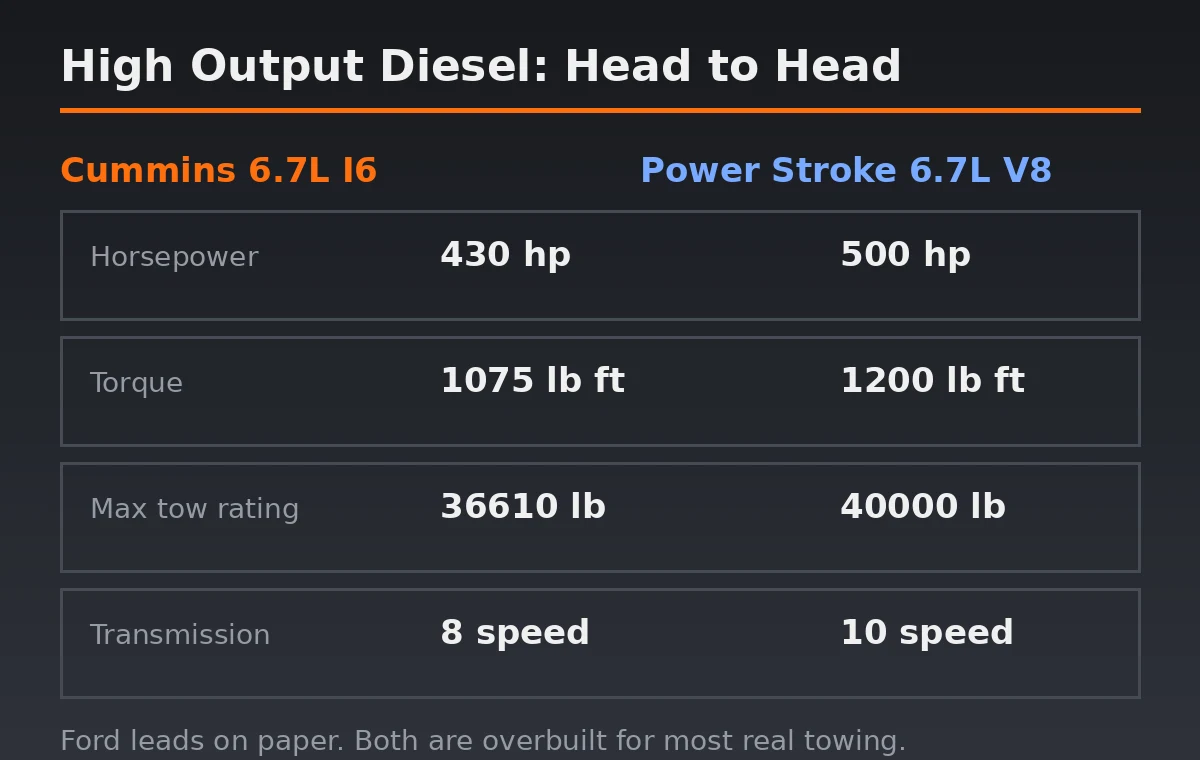
For maximum towing, the 6.7 High Output Power Stroke wins on paper with 500 hp, 1200 lb ft of torque, and a 40000 lb max tow rating. The 6.7 High Output Cummins counters with 430 hp and 1075 lb ft, and in real shop life it pulls just as hard at lower rpm with fewer fuel system worries. Pick the Ford if you want the biggest number, pick the Ram if you want the simplest engine.
- Power Stroke High Output leads on paper: 500 hp, 1200 lb ft, 40000 lb max tow
- Cummins High Output: 430 hp, 1075 lb ft, 36610 lb max tow, pulls hard at low rpm
- Both need a one ton dually to reach those max ratings
- The Cummins inline six has fewer parts to fail; the Power Stroke V8 has a busier engine bay
- For most Canadian towing (fifth wheel, gooseneck equipment trailer), either truck is overbuilt
Fifteen years in an Alberta shop, and this is the question I hear most often at the counter. A guy is buying a one ton, he is towing a big fifth wheel or a gooseneck equipment trailer, and he wants to know which engine pulls better: the 6.7 Cummins or the 6.7 Powerstroke.
Let me save you the brochure talk. Both engines will drag your trailer up a grade and make it feel easy. The differences that matter are not the ones in the commercials. Here is what I have learned with my hands under both hoods.
The numbers first, because everyone asks
The 6.7 High Output Power Stroke in a 2025 Ford Super Duty makes 500 hp and 1200 lb ft of torque, with a max tow rating of 40000 lb on a properly equipped F 450. The 6.7 High Output Cummins in a 2026 Ram 3500 makes 430 hp and 1075 lb ft, with a max tow rating of 36610 lb on a properly equipped dually.
So on paper the Ford wins. Bigger number, done, conversation over? Not quite. Because those max ratings need very specific truck configurations, and very few of the trucks I see in Canadian driveways are configured that way.
How they actually feel under load
Here is the part the spec sheet cannot tell you. The Cummins is an inline six. It makes its torque low, right where a loaded trailer wants it. When you roll into the throttle on a grade, the Cummins grunts and pulls. The Power Stroke is a V8 that makes more power but asks for a bit more rpm to do it.
Neither is wrong. The Power Stroke gets down the road faster, especially with the 10 speed behind it keeping the engine in the sweet spot. The Cummins feels calmer doing it, turning slower and sounding like it has been doing this for forty years. Which it has.
The engine bay test
This is where a mechanic earns his opinion. Open the hood on a Cummins and you see an engine that was designed to be worked on. The inline six is long and narrow, and everything hangs off the side where a person can reach it. The turbocharger sits up top. Injectors are accessible.
Open the hood on a Power Stroke and you see a very full engine bay. The V8 fills every corner. Ford has improved access over the years, and modern trucks mostly need dealer tools anyway, but when something does go wrong the labor bill tends to be bigger on the V8. There is simply more engine packed into the same space, and more parts around it.
Fewer parts that can fail is a real towing advantage. A truck that is sitting in the shop is towing nothing.
Transmissions matter too
An engine is only half the tow rig. The Ram 3500 High Output now runs a ZF 8 speed automatic, a big upgrade over the old 68RFE that I complained about for years. The Ford Super Duty runs the TorqShift 10 speed, which I consider one of the best towing transmissions in the business. It always seems to be in the right gear on a grade, loaded or empty.
For more on what I have seen inside these trucks, read my breakdowns of 6.7 Cummins reliability and 6.7 Powerstroke problems.
Exhaust brakes and grade control
Both trucks now have excellent integrated exhaust brakes. This matters more than most buyers realize. Coming down a mountain pass with 15000 lb behind you, a strong exhaust brake saves your service brakes and your nerves. The Cummins has had a great exhaust brake for years. Ford's tow haul mode and engine braking on the 10 speed is equally confident now. Call this one a draw.
Fuel economy while towing
I get asked this constantly, and I have to be honest: the differences are small and situational. Both engines will return single digit mileage when they are working hard. The Cummins has a slight edge at steady highway towing because the inline six turns fewer rpm. The Power Stroke catches up with the 10 speed's tall overdrive gears. Either way, if towing fuel economy is your deciding factor, buy a gas truck. You chose diesel for torque, not mileage.
Reliability when the truck works for a living
Work trucks tell the truth faster than anything. In my experience, the Cummins has the edge in long term durability of the core engine. The block and bottom end are absurdly overbuilt. The Power Stroke has had its share of fuel system and emissions problems over the years, though the newer trucks are much better than the early ones.
Read the details in 6.7 Cummins reliability and 6.7 Powerstroke problems before you decide. The weak points are different, so your maintenance habits should be too.
The verdict
If you want the biggest tow rating on the spec sheet, buy the Ford. The 1200 lb ft High Output Power Stroke earns that number. If you want the simplest, most proven engine core with the best reputation in the shop, buy the Ram. The Cummins has been pulling trailers longer than most of my customers have been driving.
But here is the honest truth most articles will not print: for the towing most Canadians actually do, a big fifth wheel, a gooseneck equipment trailer, a heavy boat, both trucks are so far above the requirement that the choice should come down to the cab you like sitting in, the dealer you trust, and the transmission you prefer. The engine debate is fun over coffee. In the driveway, both trucks pull.
Frequently asked questions
Which tows more, Cummins or Powerstroke?
The High Output 6.7 Power Stroke has the higher max rating at 40000 lb versus 36610 lb for the High Output 6.7 Cummins. Both ratings require a properly equipped one ton dually.
Should I buy the Cummins or the Powerstroke for towing a fifth wheel?
Either engine handles a typical fifth wheel without breaking a sweat. Choose the Cummins if you prefer a simpler inline six with a legendary service record, choose the Power Stroke if you want the highest ratings and Ford's towing tech like Onboard Scales.
Is the inline six Cummins better than the V8 Power Stroke?
Better is the wrong word. The inline six makes peak torque at lower rpm and has six fewer pistons to worry about. The V8 makes more power overall. Both get the job done.