
The 5.9L Cummins ran in Ram trucks from 1989 to 2007, first as a 12 valve and then as a 24 valve, with common rail fuel injection arriving for 2003. The 6.7L took over mid 2007 and is still in production, now making up to 1,000 lb ft in High Output form. The 2003 to 2007 common rail 5.9 is the sweet spot for most used buyers: strong stock power, a stout CP3 injection pump, and no DPF to fight.
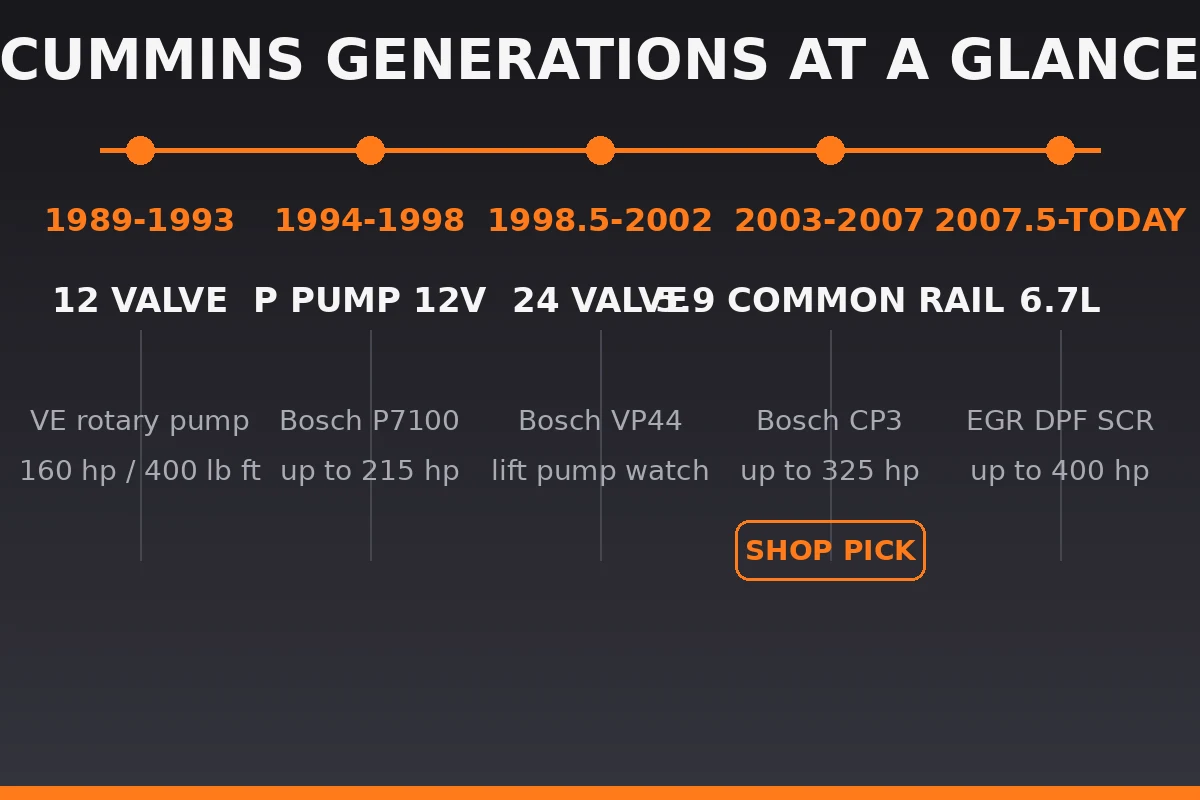
- Gen 1 (1989 to 1993): 12 valve with a VE rotary pump, 160 hp. Simple and slow, now a collector item.
- Gen 2 (1994 to 1998.5): p pump 12 valve, the tuner legend. Gen 2.5 (1998.5 to 2002): 24 valve with the VP44 pump, good engine chained to a fragile pump.
- 2003 to 2007: 5.9 common rail with the CP3 pump, the most loved used Cummins in Canada.
- 2007.5 onward: 6.7L with EGR, DPF, and SCR. More power, more complexity, more emissions maintenance.
Every conversation about used diesel trucks in my shop eventually lands on the same question. Which Cummins do I want. It sounds simple. It is not. Cummins has been building the inline six for Ram trucks since 1989, and the engine changed in big ways along the way. A 1993 12 valve and a 2023 6.7L share a bloodline the way a horse and a race car share wheels. Same family, different animal.
The generation you buy decides your maintenance life. So here is the honest rundown, generation by generation, with the parts I actually care about when one rolls onto my hoist.
First generation: 1989 to 1993
This is the one that started it all. The 12 valve 5.9L with a Bosch VE rotary injection pump, rated at 160 hp and 400 lb ft. For the early trucks there was no intercooler. One arrived partway through 1991. The trucks were simple, the power was modest, and the engine earned a reputation for outliving everything bolted to it.
I almost never see these as work trucks anymore. What I see are restored ones and farm trucks. In Canada they rusted hard and the bodies are mostly gone. If you find a clean one, you are paying collector money for nostalgia, not for a practical tow rig.
Second generation: 1994 to 2002
This is where the legend splits in two. From 1994 to 1998, the 12 valve got the Bosch P7100 inline pump, the p pump. That mechanical pump is why tuners still worship these trucks. Turn a few screws, add fuel and air, and the engine makes big power with zero electronics. It is the simplest hot rod diesel ever sold, and I respect it deeply.
Then mid 1998 brought the 24 valve head and the Bosch VP44 electronic rotary pump. The 24 valve breathed better and drove nicer, but the VP44 pump became the weak link. It lives on fuel for cooling and lubrication, so when the electric lift pump weakens, the VP44 cooks itself soon after. In my shop, a 1998.5 to 2002 Cummins with a dead lift pump is a familiar sight, and the pump replacement is not a cheap afternoon.
One more thing to check on these years: the infamous 53 casting blocks from 1999 to 2001. Certain Brazilian cast blocks can crack along the water jacket. Not every truck has one, but I check the casting number before I let a customer fall in love.
The golden years: 2003 to 2007
In 2003 Cummins switched the 5.9 to high pressure common rail injection with the Bosch CP3 pump. This is the generation I recommend to most used buyers, full stop. Power jumped to as high as 325 hp and 610 lb ft in the later years, the engine runs quiet, the CP3 pump is famously stout, and the whole package arrived before the DPF era. No particulate filter, no DEF, and EGR only in mild form on later ones.
These trucks are not cheap anymore. Everyone in Alberta knows what they are worth. But a clean 2006 or 2007 5.9 is the truck I would buy with my own money if I needed a reliable diesel without emissions headaches. Read my full inspection checklist before you go look at one.
The 6.7L era: 2007.5 to today
The 6.7L arrived mid 2007 with more displacement, an integrated exhaust brake, and a full suite of emissions equipment: EGR, then a DPF, then DEF and SCR on the 2013 and newer trucks. Power climbed steadily. The current High Output trucks are rated at 400 hp and a full 1,000 lb ft of torque. Those numbers would have been science fiction in 1989.
They are strong engines. My 6.7 reliability rundown covers what breaks and what does not. But understand the trade. The emissions equipment is the maintenance story of a modern Cummins. Regeneration cycles, DPF cleanings, DEF quality, EGR soot. All of it is manageable, and I explain the full care routine in my emissions guides, but it is a real line item in the budget that the older trucks simply do not have.
One caution that deserves its own mention: the CP4 injection pump era. Ram used the CP4.2 on the standard output 6.7 from 2019 to 2020, and that pump has a known failure pattern where it sends metal through the fuel system. Ram switched back to the CP3 design after that. If you are shopping a 2019 or 2020, know which pump the truck has. I wrote up what kills the CP4 so you know exactly what to look for.
Which one to buy: my shop ranking
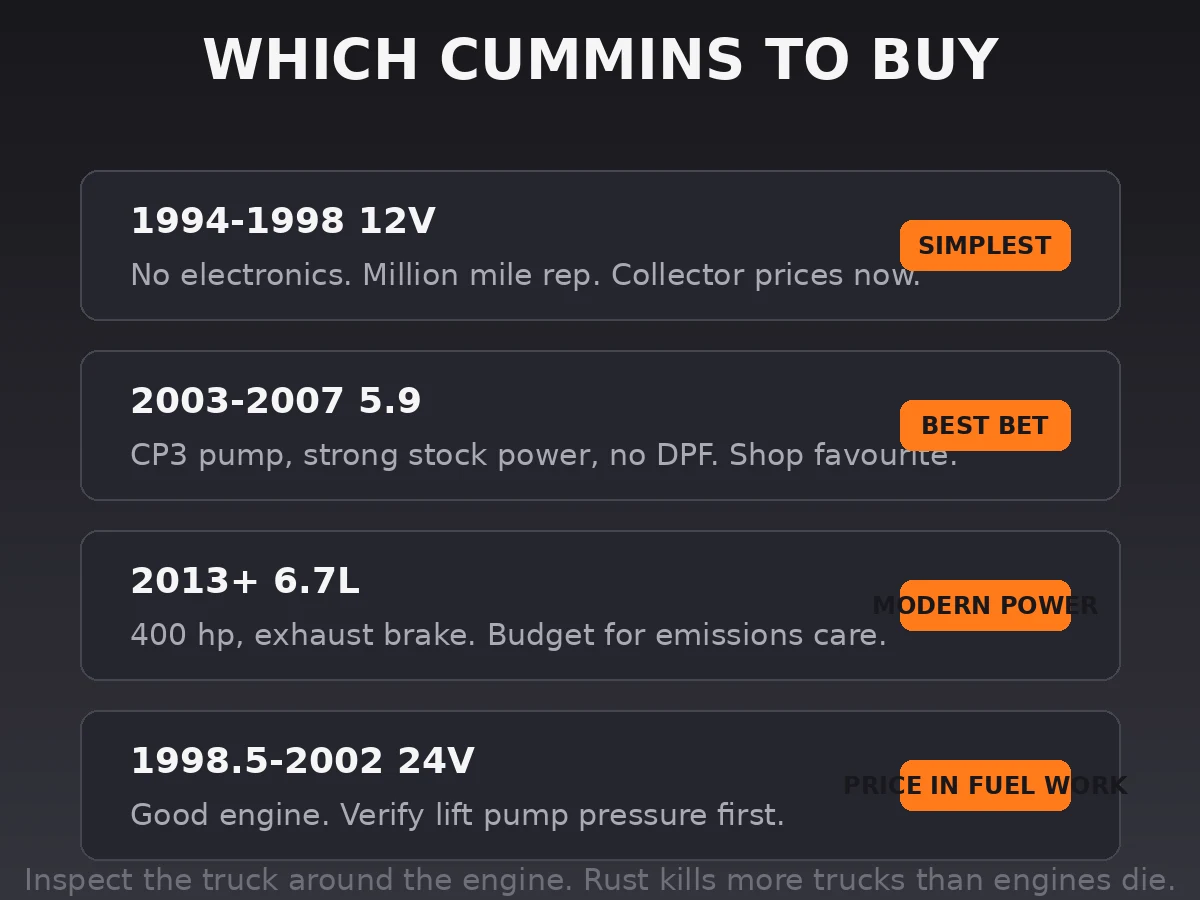
If you want the simplest reliable truck and you can find one that is not rusted out, the p pump 12 valve (1994 to 1998) is the forever answer. No computer to argue with, parts everywhere, and the million mile reputation is real. You will pay a premium and the truck will ride like a 1990s farm implement.
If you want the best all around used diesel in Canada, buy a 2003 to 2007 common rail 5.9. It is the generation that balances power, simplicity, and parts availability better than any other. Budget for front end work and check for rust, because those are the real killers of trucks this age, not the engine.
If you need a modern tow rig with big power and a factory exhaust brake, the 2013 and newer 6.7L trucks are excellent. Just go in with your eyes open about emissions maintenance and avoid the 2019 to 2020 standard output trucks with the CP4.2 unless the pump has been addressed.
And the VP44 trucks (1998.5 to 2002)? I am not telling you to avoid them. I am telling you to price in a fuel system. Verify lift pump pressure, budget for the pump, and enjoy a great engine that just needs that one Achilles heel respected.
The bottom line
Every Cummins generation is a good engine wrapped in a truck of its era. The engines rarely die. The bodies rust, the pumps wear, and the emissions gear needs care. Pick the generation that matches how you actually use a truck, inspect the truck around the engine, and you will get the diesel experience people brag about instead of the one people warn you about. If you are cross shopping against the other brands too, my used diesel buying guide lays out the full Canadian market picture.
Frequently asked questions
Should I buy a 12 valve Cummins in 2026?
Only if you want a project, not a daily driver. A 12 valve in good shape now costs collector money in Canada, and the truck around it is over 30 years old. Every rubber line, brake, and suspension bushing needs attention. Buy it for the love of the engine, and budget for the truck around it.
Is the VP44 injection pump really that bad?
It is not a bad pump by design, but it depends on the electric lift pump to stay cool and lubricated with fuel. When the lift pump weakens, the VP44 dies soon after, and that bill runs into the thousands. If you buy a 1998.5 to 2002 truck, budget for a lift pump upgrade and verify fuel pressure before you hand over money.
Which Cummins generation is the most reliable?
For stock reliability with the least fuss, the 2003 to 2007 common rail 5.9 wins. It has the stout CP3 injection pump, strong stock power, and it arrived before the DPF era. The 6.7L engines are also reliable long term, but they carry emissions equipment that demands attention and money over time.