
You clean a 6.7 Cummins DPF by letting the truck finish its regens, and when that stops working, by booking a forced regen or a professional cleaning with the filter off the truck. A regen burns off soot, the black carbon the filter catches, but it never removes ash, the grey mineral residue left behind by engine oil. Ash builds up slowly over 200,000 km or more, and once the filter is ash loaded, only a shop cleaning or a replacement fixes it.
- A regen burns soot. It never removes ash, and ash is what eventually fills a Cummins DPF past recovery.
- A highway run at steady speed for 30 minutes or more is the first fix, and it costs nothing but fuel.
- A forced regen at a shop runs $200 to $400 and fixes soot loading a highway drive cannot clear.
- A professional cleaning in Canada runs $200 to $650, and a good shop shows you before and after flow numbers.
If your Ram 6.7 Cummins is asking for attention from its DPF, the fix is almost never a bottle of additive or a new filter on day one. Start with a regen, move to a forced regen if the truck cannot finish one itself, and only pull the filter off for a professional cleaning when the numbers say the filter is loaded with ash. A cleaning in Canada costs $200 to $650 while a dealer installed Cummins DPF costs $3,400 to $6,350, so the order matters.
How do you know your Cummins DPF needs cleaning?
The dash is the first witness. A 6.7 Ram shows Exhaust Filter 80% Full when the soot load climbs, and Exhaust Filter Full, Power Reduced, See Dealer when it has run out of patience. A healthy truck regens every few hundred kilometres of mixed driving and you barely notice. A truck that starts a regen every day, or on every short trip, is telling you the filter is loading up with ash.
Codes back up what the dash says. P2463 means soot accumulation has passed the limit the truck can manage. P2002 means the filter is not trapping soot as well as it should. P2453 points at the differential pressure sensor, which measures how hard exhaust has to push to get through the filter. Pressure that stays high at idle, with the soot load reading low, points at ash, not soot.
A truck that tows on the highway cleans itself. A truck that idles at a job site all day and drives ten minutes to the store does not, because the exhaust never stays hot long enough to finish a regen.
What does a regen clear, and what does it never clear?
A DPF traps two different things, and only one of them burns. Soot is the black carbon in diesel exhaust. A regen heats the filter to around 600 degrees C and burns soot into ash, which clears the channels and drops the pressure back down. Ash is the grey mineral residue left behind by engine oil. It never burns, at any temperature, and it stays in the channels until a shop removes it.
That is why a truck can regen perfectly and still end up with a clogged filter. Every regen leaves a little more ash behind. Over 200,000 km or more, the ash load grows until the filter cannot flow enough exhaust even with zero soot in it. No amount of highway driving fixes that.
The 6.7 has run a DPF since the 2007.5 model year, with DEF added from 2013 on, and the cleaning process is the same on both. My guide to how to clean a DPF covers the general regen steps.
Can a highway drive clean your Cummins DPF?
Yes, when the problem is soot. Get on the highway, hold 100 km/h or more for at least 30 minutes, and do not shut the truck off until the dash message clears. Steady speed matters more than speed itself. Tow haul helps by holding a lower gear and keeping the revs up. You will know it worked when the message clears and the idle settles back to normal.
It costs nothing but fuel, which is why it is always step one. It does not work when the filter is ash loaded, when the brick is cracked, or when a sensor fault is stopping the regen from starting at all. If the message comes back within a day or two of a good highway run, the problem is past what a drive can fix.
When is a forced regen the right call?
A forced regen is a parked regen a shop triggers with a scan tool. The truck holds a high idle and high exhaust temperatures for 30 to 45 minutes while the soot burns off, and the tech watches the soot load reading drop in real time. It costs $200 to $400 at a Canadian shop, and it is the right call when the filter is loaded with soot and the truck cannot finish a regen on the road, usually after weeks of short trips.
One warning before you book it. A forced regen on a filter that is already ash packed can push exhaust temperatures high enough to damage the brick, so a good shop checks the soot load and the differential pressure reading first. If the pressure is high and the soot load is low, the filter is ash loaded and a forced regen will not help.
What happens during a professional cleaning?
The filter comes off the truck and the shop works through it in stages. First comes pneumatic cleaning, where compressed air knocks loose soot and ash out of the channels. Then comes a thermal bake in an oven at around 1,000 degrees F for roughly 12 hours, which oxidises remaining soot and loosens hardened ash. Then comes a flow test, with before and after differential pressure readings that prove how much flow came back.
The cleaning itself takes 3 to 4 hours, and the truck is usually down for a full day once removal and reinstall are counted. A West End Rad shop in Winnipeg, Saskatoon, or Estevan charges $200 to $400 and gives a free pressure drop reading before and after. A Mississauga shop publishes $350 to $500 for a DOC and DPF clean.
Ask for the before and after flow numbers. A shop that shows them is proving the clean worked. A shop that will not show them is guessing.
When is cleaning a waste of money?
Cleaning fixes a filter that is loaded with soot or ash and otherwise intact. It does not fix a filter that is damaged, and three kinds of damage end the conversation. A cracked or melted brick cannot be cleaned back to health. A filter soaked in oil from a failed turbo seal, or soaked in coolant from a leaking EGR cooler, keeps getting contaminated and cleaning it is pointless until the leak is fixed. And a filter that stays restricted after a proper thermal clean is ash saturated past recovery.
The other mistake is cleaning the filter without fixing what clogged it. A leaking injector, a stuck EGR valve, or a failed turbo seal will clog a clean filter just as fast as the old one. A shop that refuses to show you the scan data before quoting a filter is a shop you should walk away from.
Removing the DPF is illegal in Canada, so a delete is not a cleaning alternative. My guide to what a DPF delete is covers the legal side in full.
Cummins DPF cleaning vs replacement: the cost in Canada
| Option | What it fixes | Cost in Canada |
|---|---|---|
| Forced regen | Soot load the truck cannot clear | $200 to $400 |
| Professional cleaning | Soot and ash in an intact filter | $200 to $650 |
| Aftermarket DPF, installed | Cracked, melted, or ash saturated filter | $2,700 to $4,500 |
| OEM DPF, dealer installed | Same filter, factory part and warranty | $3,400 to $6,350 |
These are the Cummins numbers from my DPF replacement cost guide, and they show why cleaning comes first. A cleaning costs about a tenth of a replacement, and it works on most filters that are still intact.
Should you try to clean it yourself?
There are two things you can do yourself, and both are worth doing. The first is the highway regen run, which costs nothing and fixes most soot problems. The second is changing the driving pattern that loads the filter, fewer short trips, more highway miles, less idling, and low ash oil at every change. Fuel additives help a little with light soot as maintenance, and they do nothing for a filter that is already badly clogged.
What you should never do is pour anything into the filter, pressure wash it, cut it open, or bake it in a home oven. The ceramic brick cracks with thermal shock, the ash is toxic dust, and a filter that has been cut open is scrap. The $200 to $650 a shop charges is cheap against a $3,400 filter.
The order I work in
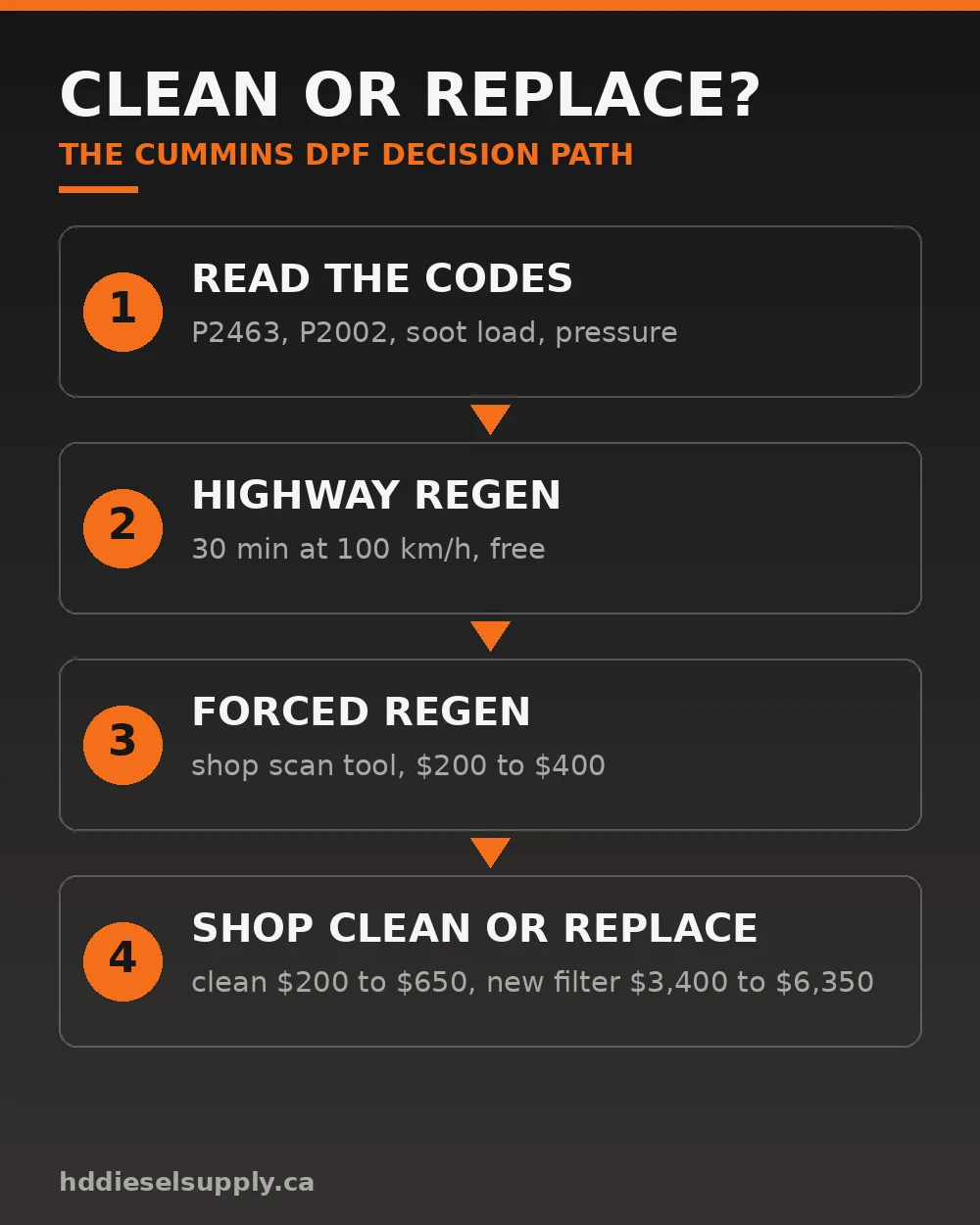
When a 6.7 Cummins comes into my shop with a DPF complaint, I work in this order and I do not skip steps. One, read the codes and the soot load. Two, send the truck out for a proper highway regen run and see if the message clears. Three, book a forced regen if the truck cannot finish one on its own. Four, flow test the filter and book a professional cleaning if the pressure says ash. Five, replace the filter only when the brick is damaged or the pressure stays high after a clean. And at every step, fix whatever clogged it in the first place.
A Cummins DPF is a maintenance item, not a part you throw away at the first warning light. Treat it in that order and most of them last the life of the truck. Skip the order and you will pay for a filter that a $400 cleaning would have saved.
Frequently asked questions
Should I clean my Cummins DPF or replace it?
Clean it first, unless the ceramic brick is cracked, melted, or soaked in oil or coolant. A professional cleaning in Canada runs $200 to $650, against $3,400 to $6,350 for a dealer installed Cummins DPF, and it restores most intact filters to near full flow. Ask the shop for before and after differential pressure readings. If the pressure stays high after a proper thermal clean, the filter is finished and replacement is the honest call.
Forced regen vs professional cleaning: which one does my truck need?
A forced regen is the call when the filter is loaded with soot and the truck cannot finish a regen on its own, usually after weeks of short trips. It burns the soot off in about 30 to 45 minutes at the shop and costs $200 to $400. A professional cleaning is the call when the filter is ash loaded, which a regen cannot fix at any temperature. The filter comes off the truck, gets baked and flow tested, and goes back on. If a forced regen clears the codes and the soot load drops, you did not need the cleaning yet.
How often does a 6.7 Cummins DPF need cleaning?
Ram publishes no fixed cleaning interval for the pickup 6.7, because the truck manages soot itself with regens and cleaning is condition based, not calendar based. Canadian shops that clean filters every day point to roughly 200,000 to 250,000 km for heavy duty use, and sooner on a truck that idles all day or only ever does short trips. Watch the differential pressure reading and the regen frequency, not the odometer. A filter that regens every day is telling you it is loading up with ash.
Will a DPF cleaning fix code P2002 on my Cummins?
It can, if the code comes from a filter that is genuinely loaded with soot or ash. P2002 means the filter is not trapping soot as well as it should, and a clean filter with good flow often clears it. But the code can also come from a cracked filter, a leaking injector that keeps sooting the filter up, or a faulty differential pressure sensor. A shop should read the live data and flow test the filter before quoting a clean, because cleaning a cracked filter fixes nothing.