
A failing 6.7 Powerstroke turbo actuator shows up as sudden power loss, limp mode, surging or whistling under load, and check engine codes like P0299 or P2262. The actuator is the small electronic motor that moves the vanes inside the VGT turbo, and it fails far more often than the turbo itself. A proper diagnosis, including a hands on test of the vane movement, can save you from buying a whole turbo when all you need is the actuator.
- Lost boost with P0299 or P2262 usually points at the VGT actuator or sooted up vanes, not a dead turbo
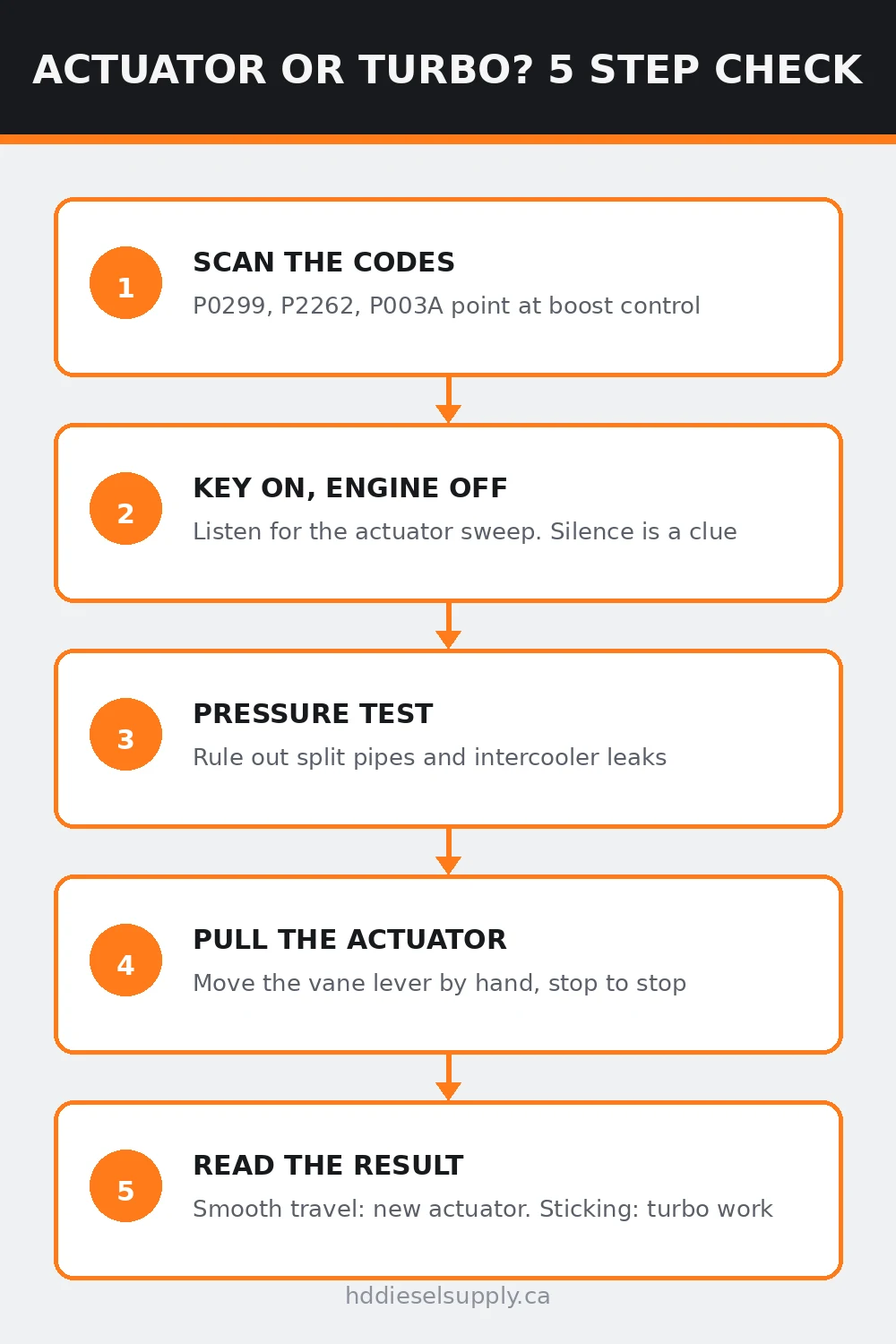
- The shop test: pull the actuator and move the vane lever by hand. Smooth travel means the actuator is bad. Sticking means the turbo needs work
- An actuator part runs a few hundred dollars. A full turbo job runs $2,800 to $3,500 CAD. Diagnose first
- Key on, engine off, and listen. A healthy actuator sweeps the vanes with a clean click. Silence or grinding is your answer
Your 6.7 starts falling flat on hills, the check engine light comes on, and the first quote you hear is for a whole new turbo. Hold on. I have watched a lot of Powerstroke owners pay for a turbocharger when all that died was the little electronic motor bolted to its side.
That motor is the VGT actuator. On your 6.7 Powerstroke it sits on a Garrett variable geometry turbocharger, and its only job is swinging the vanes inside the exhaust housing open and closed to control boost. It is a small part doing a hot, dirty job, and it quits long before the turbo does. If you can tell the difference between a dead actuator and a dead turbo, you keep a few thousand dollars in your pocket.
What the actuator actually does
The 6.7 Powerstroke runs one turbo that pretends to be two. At low rpm the vanes close down so the exhaust hits the turbine wheel hard and boost builds fast with no lag. At high rpm the vanes open up and the turbo breathes like a big unit. The actuator is the electric motor that moves those vanes, following orders from the computer dozens of times a second.
When it works, you never think about it. When it sticks, burns out, or loses track of where the vanes are, boost control falls apart and the truck protects itself by cutting power. That is why a bad actuator feels exactly like a blown turbo.
The symptoms that point at the actuator
Here is what I see in the bay when the actuator is the culprit:
Power falls flat under load. The truck pulls fine empty and then dies on a grade or with a trailer behind it.
Limp mode out of nowhere. The computer sees boost it did not ask for, or no boost when it asked for plenty, and cuts fuel to protect the engine.
Surging or hesitation. Boost comes in waves instead of smooth. Feels like the truck cannot decide how hard to pull.
New noises from the turbo. A healthy VGT changes pitch as the vanes move. A sick one may whistle oddly, click, or go silent where it used to sing.
Sluggish throttle response. You press the pedal and the truck thinks about it. The vanes are stuck in the wrong spot for the rpm you are at.
Black smoke on hard acceleration. The fuel goes in but the air is not there because the vanes never opened up.
Any one of these can have other causes, which is why the codes and the hands on test matter.
The codes it throws
Scan it before you guess. The usual suspects:
P0299, turbocharger underboost. The computer asked for boost and did not get it. Classic actuator or stuck vane code, though a boost leak can set it too.
P2262, turbo boost pressure not detected. Often means the vanes are stuck or the actuator is not responding at all.
P003A or P2563, boost control position issues. These point straight at the actuator circuit or its position sensor. When you see one of these, the actuator is suspect number one.
A code alone is not a diagnosis. P0299 especially can come from a split charge pipe or a tired intercooler, so rule the cheap stuff out first.
The test that settles it
This is the test I run before I quote anything, and any honest shop will do the same. Pull the actuator off the turbo and work the vane lever by hand, stop to stop.
If the lever moves smooth and easy through the full travel, the turbo is fine and the actuator is your problem. Bolt a new one on, calibrate it, and drive away.
If the lever sticks, grinds, or will not make full travel, the vanes are coked up with soot inside the housing. Then the turbo itself needs attention, cleaning or replacement, and a new actuator alone will not save you.
That five minute check is the difference between a few hundred dollars and a few thousand. If a shop quotes you a turbo without running it, get a second opinion.
What the job costs in Canada
When the test points at the actuator, the math is friendly. South of the border, the OEM actuator for the 2015 to 2019 trucks lists around US$343, and the Garrett VGT solenoid around US$172. Landed in Canada with exchange, tax, and shipping, budget several hundred dollars for the part. Labour is one to two hours: unbolt the old unit, bolt on the new one, and calibrate it so the computer knows the vane positions.
Compare that with a full turbo replacement, which I priced out in detail over at the Powerstroke turbo replacement cost guide: $2,800 to $3,500 CAD installed for a reman job, $3,400 to $4,500 CAD for new. That is why the diagnosis matters so much. Guessing wrong costs you ten times the price of being sure.
For the full picture on turbo life and the other ways they fail, my guide on how long diesel turbos last covers the warning sounds and the oil mistakes that kill them young.
When it is not the actuator
Sometimes the actuator is innocent. Rule these out before you order parts:
Boost leaks. A split charge pipe, a blown intercooler boot, or a cracked intercooler end tank will set P0299 all day. Pressure test the charge air system. It is cheap and it catches the easy wins.
Sooted up vanes. Short trips and lots of idling cake the vanes in soot until they stick. If the hand test shows sticking, the turbo needs to come apart for cleaning or replacement.
Sensor faults. The MAP sensor and the exhaust back pressure sensor feed the boost control strategy bad data, and the computer blames the turbo. Check them before you condemn hardware.
Wiring. The actuator lives in a hot, vibrating place. Chafed wires and corroded connectors cause intermittent faults that look exactly like a dead actuator. Wiggle test the harness with the engine running.
If your truck has a stack of other issues, the broader 6.7 Powerstroke problems guide is worth a read too.
Can you keep driving it
Short answer: get it diagnosed soon and go easy until then. Limp mode is the truck protecting itself, but driving for weeks with the vanes stuck can overheat the turbo and load the DPF with extra soot. Light loads and short trips to the shop are fine. Towing the boat to the lake is not.
Frequently asked questions
Should I replace the actuator or the whole turbo on my 6.7 Powerstroke?
Do the hand test first. Pull the actuator and move the vane lever through its full travel. Smooth movement means the turbo is healthy and only the actuator needs replacing. If the lever sticks or binds, the vanes are sooted up inside and the turbo needs cleaning or replacement, because a new actuator cannot fix stuck vanes.
What are the symptoms of a bad turbo actuator on a 6.7 Powerstroke?
Power loss under load, sudden limp mode, surging or hesitation, odd turbo noises, sluggish throttle response, and black smoke on acceleration. The check engine light usually brings P0299, P2262, or a boost control position code. Any one symptom can have other causes, so confirm with a scan and the hands on test.
Can I replace a 6.7 Powerstroke turbo actuator myself?
If you are handy, yes. It is a few bolts and an electrical connector on top of the engine, with no cab removal. The catch is calibration: the computer needs to learn the new actuator vane positions, which takes a capable scan tool. Without calibration the truck may keep setting codes.
Will replacing the actuator fix code P0299?
Only if the actuator is the cause. P0299 means underboost, and a boost leak, a split charge pipe, or a bad sensor can set the same code. Diagnose first: pressure test the charge system, check the sensors, and run the actuator hand test. Replacing parts on a code alone is how you spend money twice.
Does a new turbo actuator need calibration?
Yes. The engine computer tracks vane position through the actuator, and a new unit needs to learn its stops. Most shops do it with a scan tool in a few minutes. Skip it and you can get repeat codes and poor boost control even with a brand new part.