
On a 6.7 Powerstroke the EGR cooler clogs with soot, the EGR valve sticks with carbon, and the cooler can crack and leak coolant into the intake. A clogged cooler usually sets code P0401 and costs power, a sticking valve causes rough idle and black smoke, and a leaking cooler causes coolant loss with no puddle plus white smoke. Cooler replacement typically runs 1000 to 3000 dollars at a shop, valve work is far cheaper, and a leaking cooler is the one you should not keep driving on.
- Three separate failures, three different symptoms: clogged cooler, sticking valve, leaking cooler.
- P0401 means the system cannot move enough exhaust gas, and a soot clogged cooler is the usual cause.
- Coolant loss with no visible leak plus white smoke points at a cracked cooler, so stop and test before towing again.
- Shop cooler replacement typically runs 1000 to 3000 dollars, while a valve job is a fraction of that.
Yes, the 6.7 Powerstroke has real EGR problems, but they are not one problem. They are three, and treating them as one is how owners pay for the wrong part. A cooler clogged with soot, a valve stuck with carbon, and a cooler cracked open and leaking coolant all light the dash, but they feel different, they cost different money, and only one of them should stop you towing today.
Which EGR failure does your truck actually have?
The EGR system routes exhaust gas back into the intake through the cooler, then the valve meters how much enters. When that path clogs, sticks, or leaks, the system sets a code. Start with what the truck is doing, not with what a forum thread told you to buy.
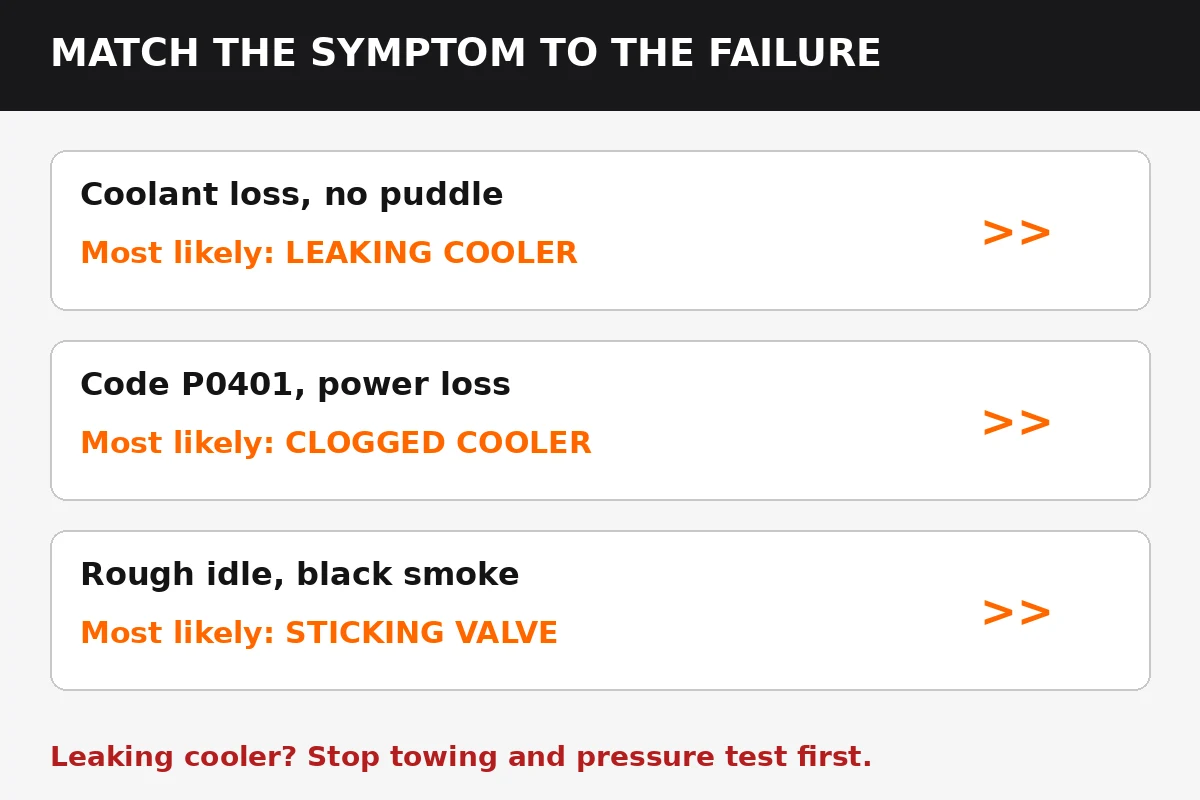
| What you notice | Most likely failure | First test | | Coolant level dropping, no puddle, white smoke, sweet smell from the exhaust | Cooler cracked and leaking | Cooling system pressure test, held at 16 PSI | | Code P0401, power loss, truck runs hotter under load | Cooler clogged with soot | Scan data plus inspection of cooler passages | | Rough idle, stumble at low speed, black smoke on acceleration | Valve stuck or carbon fouled | Valve movement check and intake inspection | | Degas bottle pushing coolant out | Exhaust gas pressurising the cooling system | Pressure test |
Two rows deserve extra care. White smoke on a cold morning is normal condensation and clears in minutes. White smoke that stays and smells sweet, with a falling coolant level, is a different animal. And a P0401 code alone does not prove the cooler is cracked. It proves flow is low. The pressure test separates a cracked cooler from a clogged one.
What does a clogged EGR cooler feel like?
A clogged cooler is the slow failure. Soot builds in the cooler passages, flow drops, and the truck sets P0401, the code for insufficient EGR flow. Power fades, the truck runs hotter when towing, and fuel economy slips. It is most common on trucks that idle for hours or do short trips, because neither gives the system the sustained heat that keeps soot moving. Published shop ranges put cooler clogging in the 80,000 to 120,000 mile window for hard working trucks, and Ford issued a service bulletin for 2011 to 2012 Super Duty trucks on exactly this restriction.
My shop rule is boring and it works: log the coolant level and the code history on the same page. One code is a data point. A code that returns after clearing, plus slow power loss, plus an idle heavy work history, is a pattern. Owners who clear P0401 three times and call it a sensor often end up paying for a cooler and a valve when a flow check in week one would have pointed at the cooler.
What does a sticking EGR valve feel like?
A sticking valve is the drivability failure. Carbon builds on the valve stem and seat until the valve cannot open and close cleanly. The truck idles rough, stumbles at low speed, and puffs black smoke when you get on the throttle. Published ranges put valve carbon trouble in the 60,000 to 100,000 mile window, earlier on trucks that idle all day. Cleaning sometimes buys time, and our EGR valve cleaning steps walk through that call. But if symptoms return within a few months, replacement beats a second cleaning. Valve work is the cheapest of the three failures, which is exactly why you diagnose first: nobody wants to learn they bought a cooler when a valve was the fault.
What does a leaking EGR cooler feel like, and why is it urgent?
A leaking cooler is the expensive failure and the one that can turn into engine damage. An internal crack lets coolant into the intake or exhaust side. You get white smoke, a sweet smell, coolant loss with no puddle, and sometimes pressure building in the degas bottle. Left alone, coolant in a cylinder can hydro lock an engine on a cold start, and that turns a cooler job into an engine job. Our EGR cooler failure symptoms guide covers the signs in detail, and our Powerstroke problems list ranks this as the most common expensive repair on these trucks, worst on 2011 to 2014 models.
Here is the test that settles it. Pressure test the cooling system to 16 PSI and watch whether it holds. If pressure falls with no external leak, coolant is going somewhere internal, and the cooler is suspect number one. Then pull the EGR valve: one that looks steam cleaned in a sooty system, or coated in a tar like goo, is telling you coolant has been through there.
What does each repair cost?
Prices vary by year and region. Treat these published ranges as planning numbers, not quotes, and get a written quote before approving work.
| Repair | Parts range | Shop total range | | EGR valve replacement | 400 to 800 dollars | Under 1,000 dollars in most shops | | EGR cooler replacement at a shop | 600 to 800 dollars for an OEM cooler core, 400 to 600 for a quality aftermarket kit | 1,000 to 3,000 dollars | | Cylinder head work if coolant damage went too far | Thousands per head | The repair you are trying to avoid |
The spread on the cooler job is mostly labour and access. Seized bolts, brittle hoses, and a valve that also needs attention all push the bill up. Ask the shop to quote the cooler core, gaskets, coolant, and hoses as separate lines.
How do you keep a good EGR system good?
You cannot make an EGR system maintenance free, but you can stretch its life. Give the truck regular highway runs so the exhaust reaches full temperature. Keep idle time down where the job allows it. Change fuel filters on schedule. Watch the coolant level weekly, and scan for codes every few months, not just when the light comes on. A stored P0401 caught early is a cleaning or a valve. A P0401 ignored for a year is a cooler.
The 2015 to 2019 trucks are the sweet spot. But year alone is not a buying strategy. A 2013 truck with a highway life and a full service file will beat a 2018 truck that idled at a jobsite for five years. Ask about idle hours, not just kilometres: idle hours are the number that predicts EGR trouble.
My call for a 6.7 Powerstroke owner
If your truck sets P0401 and loses power, diagnose flow before buying parts. If it idles rough and smokes black, suspect the valve. If coolant is vanishing with no leak, stop towing, pressure test, and fix the cooler before it fixes your engine for you. The EGR system on the 6.7 Powerstroke is not a reason to avoid the truck. It is a known system with known failures, known tests, and known prices. Keep the paperwork, because the next owner will pay more for a truck with a cooler receipt than for a truck with a story.
Frequently asked questions
Should I replace the EGR cooler or the EGR valve first on my 6.7 Powerstroke?
Let the symptoms decide, not the parts catalogue. If the truck sets P0401, loses power, and shows no coolant loss, start with flow: check the valve movement and the cooler passages before buying either part. If coolant is disappearing with no leak and white smoke is showing, the cooler is the suspect and the valve will not fix it. Replacing both at once is common when the truck is high mileage and already apart, but on a lower mileage truck it is money spent on a guess.
Should I delete the EGR system on my 6.7 Powerstroke instead of repairing it?
On a truck used on public roads, deleting emissions equipment is illegal in the United States and in Canada it will fail inspection in provinces that test, plus it can void warranty and hurt resale. The legal fix is a proper repair with a quality cooler or valve, and for trucks that idle all day, a change in driving habits so the system gets the highway heat it needs. If you are weighing delete against repair, read the full picture in our delete kit guide first and talk to a shop that will put the legal position in writing.
6.7 Powerstroke EGR vs 6.7 Cummins EGR: which one gives more trouble?
Both clog, both stick, and both cost money at high mileage, but the failure that owners fear most is different. On the Powerstroke the headline failure is the cooler, either clogged with soot or cracked and leaking coolant, and it is worst on 2011 to 2014 trucks. On the Cummins the valve and intake soot get more of the attention. Neither engine is free of EGR work, so buy on service history and idle history, not on brand loyalty.