

Most cold long cranks on a 6.0 Powerstroke come down to three things: weak batteries dragging FICM voltage under 48 volts, injection control pressure that cannot reach 500 psi while cranking, or HEUI injectors sticking in cold oil. Test in that order, with a scan tool on the truck, and you will find the fault before you buy a single part. Glow plugs matter too, but on this engine they are rarely the first thing that fails.
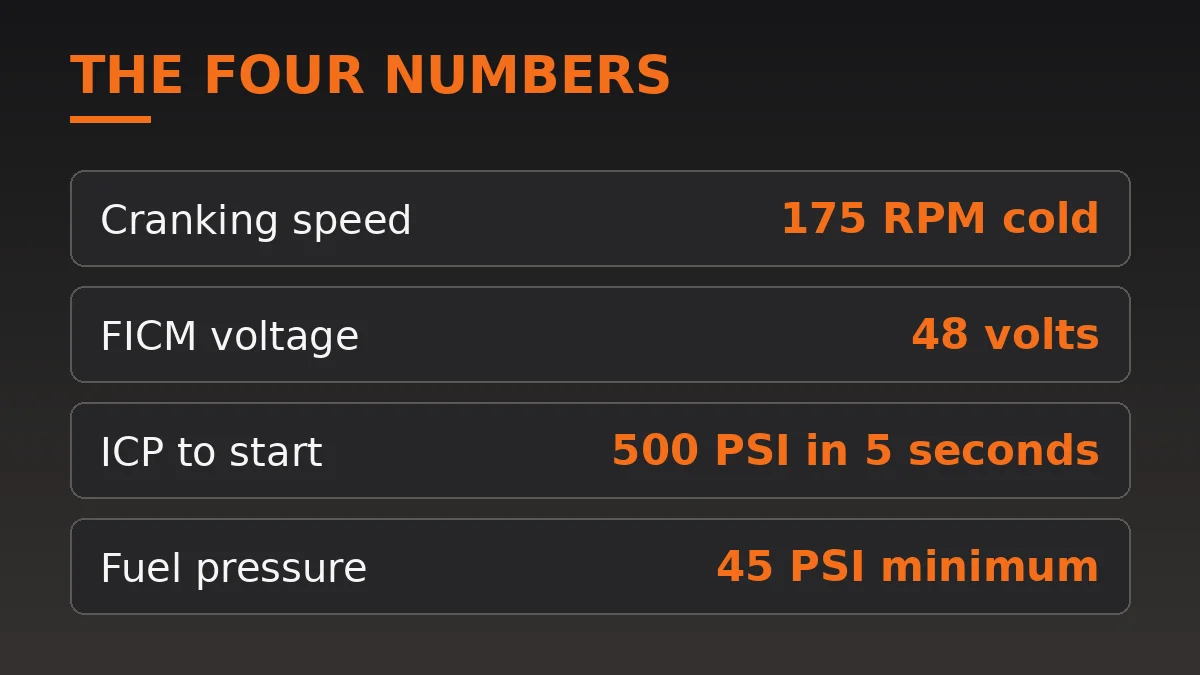
- A 6.0 needs 500 psi of injection control pressure to fire. If cranking ICP stays under that number, the injectors never get the signal to open.
- FICM voltage must hold 48 volts while cranking. Anything under 45 volts while cranking means the module is suspect, and weak batteries kill FICMs.
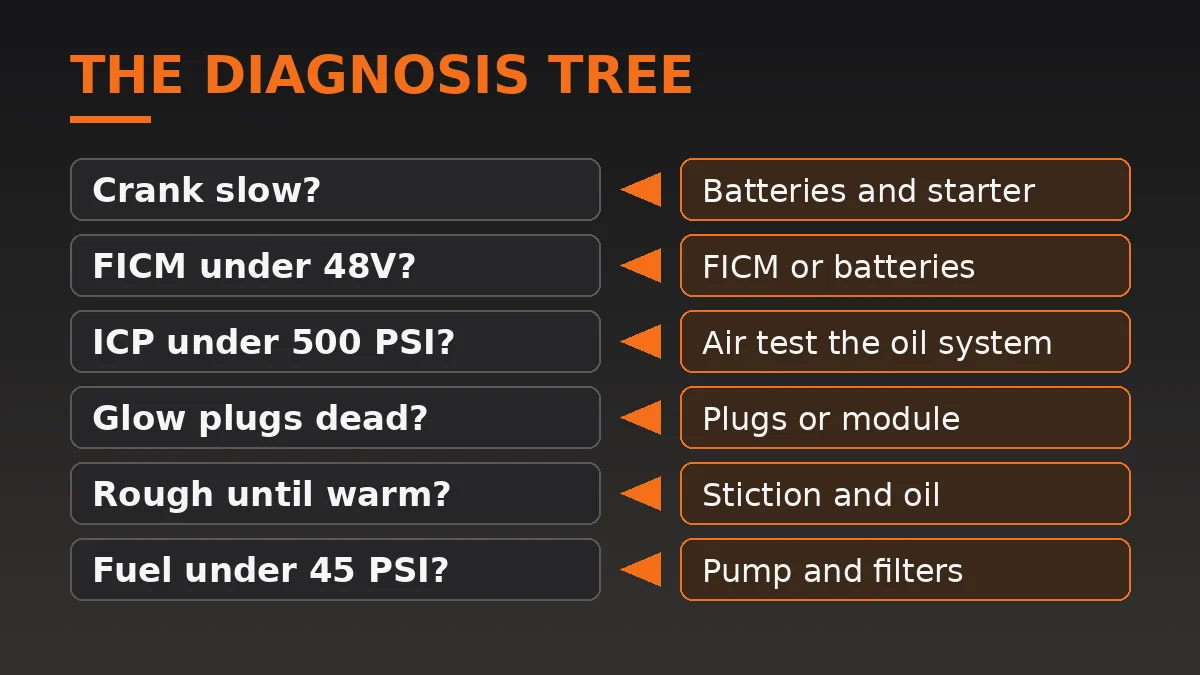
- Cold oil makes HEUI injector spool valves stick. The truck cranks long, runs rough, then smooths out as the oil warms. That pattern points at stiction, not a dead injector.
- Fuel pressure must hold 45 psi or more. Low fuel pressure starves injectors and looks like an oil problem until you put a gauge on it.
A 6.0 Powerstroke that cranks and cranks on a cold morning, then finally catches and runs rough for a minute, is almost always short on one of three things: voltage to fire the injectors, oil pressure to open them, or clean oil to let them move. The engine needs 500 psi of injection control pressure before a single injector will fire, and it needs the FICM holding 48 volts while the starter is turning. Work through those two numbers first, with a scan tool on the truck, and the truck will tell you what is wrong before you spend a dollar on parts.
I see this truck every January. An owner tells me it started fine all summer, then the first minus 25 morning arrived and the starter just kept turning. By the time it catches, the cab is full of white smoke and the engine shakes. Then the oil warms, the injectors free up, and the truck runs fine all day. That pattern is the diagnosis: cold only, rough at first, fine when warm.
Step 1: Is it cranking fast enough?
The 6.0 needs cranking speed to build oil pressure, find sync, and fire the injectors. Ford's own numbers are about 175 rpm cold and 215 rpm warm. A slow starter can look exactly like a high pressure oil problem, and I have seen good HPOPs replaced over a tired starter. One weak battery drags the pair down. Load test both batteries separately, and check the cables and grounds for corrosion. If the crank sounds slow, fix the electrical side first. Nothing else here means anything until the engine spins fast enough.
Step 2: Is the FICM holding 48 volts?
The FICM steps battery voltage up to 48 volts to fire the injectors, and it lives on the driver side valve cover, where heat and vibration wear it out. Watch FICM main power on a scan tool while cranking: it should stay at 48 volts, and anything under 45 volts means the module is suspect. The two supply feeds, FICM L power and FICM V power, both need to stay above 11.5 volts. If they sag, the batteries are the problem, not the module. The codes to look for are P0611, P1378, and U0105. Replace weak batteries before you condemn a FICM, because low system voltage kills a new FICM too.
Step 3: Is ICP reaching 500 psi?
Injection control pressure decides whether the engine starts at all. The injectors fire on engine oil pressurized by the HPOP, and the engine needs more than 500 psi while cranking, inside five seconds, before it will fire. Watch ICP and IPR together: if the IPR is commanded to 85 percent and ICP still will not climb past 500, oil is leaking out of the high pressure system. On 2005 to 2007 trucks the usual leak is the STC fitting at the pump outlet, or the dummy plugs and standpipes under the valve covers. On 2003 and early 2004 trucks, a worn HPOP is the likelier leak. Ford's 2008 service bulletin on this fault prescribes an air test of the high pressure oil system before buying parts. Pull the IPR, feed shop air in, and listen for the leak. Codes P2284 to P2291 cover ICP faults, with P2291 meaning pressure was too low while cranking.
Step 4: Are the glow plugs doing their job?
Glow plugs get blamed for every cold start problem, and on the 6.0 they are rarely the whole story. A 6.0 with dead glow plugs usually still cranks and fires, it just smokes and stumbles longer. Wait for the wait to start light to go out, then crank. If the light never comes on, or it flashes, the glow plug control module or its wiring is where to look. A resistance check across each plug finds the dead one. Check them, but check them after the FICM and ICP numbers. I have seen owners replace all eight glow plugs and still crank for twenty seconds, because the FICM was the real fault the whole time. More glow plug symptoms by engine are covered in glow plug failure symptoms.
Step 5: Is it stiction, or is it the oil?
HEUI injectors have spool valves that slide on engine oil, and when the oil is cold and varnished those valves stick. The symptom is unmistakable: long crank, rough idle, and white smoke on a cold start, all gone once the oil warms past about 70 degrees. That pattern points at stiction, not a dead injector, and a dead injector does not heal itself by lunchtime. The oil matters here. A 5W40 synthetic flows far better on a minus 20 morning than the 15W40 most trucks run in summer, and Ford's own cold start bulletin ties rough cold running to the FICM and the injectors, with an oil service and a calibration update as part of the cure. A stiction treatment in the oil can free a sticking spool valve. If the cold start improves, the injectors were sticking. If nothing changes, the problem sits elsewhere in this tree.
Step 6: Is fuel pressure holding 45 psi?
Fuel pressure is the last number in the tree, and most owners skip it. Normal fuel pressure on a 6.0 is 45 to 60 psi, and it has to hold 45 psi or more even under load. Low fuel pressure starves the injectors, and the truck cranks long and runs rough in a way that looks like an oil problem until you put a gauge on the test port. A weak pump or a clogged filter is a cheap fix next to injectors, so check it first. If fuel pressure is good and every number above it checks out, run a buzz test and a contribution test, and let the scan tool point at the weak cylinder.
What the fix usually costs in Canada
Here is the one price I can stand behind, checked today. A remanufactured Sinister Diesel FICM for a 2004 to 2005 6.0, the version for trucks built between September 23, 2003 and January 1, 2005, lists at PartsEngine Canada in Richmond Hill, Ontario at 633.27 Canadian dollars on sale, against a regular price of 728.26. That is the part only, before labour, and the module needs programming to the truck. Dummy plug and standpipe work is a valve cover off job, a few hours of labour plus seals, and an STC fitting job means digging down to the pump, so labour dwarfs the part. A full set of eight injectors is the expensive end of this tree, into the thousands installed, which is exactly why the FICM test comes before the injector order.
The order I would spend money in
Batteries first, because they are the cheapest part of this tree and weak batteries kill FICMs. Then a scan tool session, watching FICM voltage and ICP while cranking, because those two numbers split the tree in half. Then an air test if ICP will not build, and an oil service with 5W40 synthetic if the pattern smells like stiction. Injectors come last, and only after a buzz test and a contribution test point at a specific cylinder. A 6.0 that cranks long on a cold morning is not a mystery. It is a short list of numbers, tested in the right order, and the truck will tell you which one is wrong.
Frequently asked questions
Why does my 6.0 Powerstroke crank so long on cold mornings?
Because cold thickens the oil the injectors fire on, and three weak points show up at once: the FICM struggles to hold 48 volts, the high pressure oil system has to build 500 psi to fire, and varnish makes the injector spool valves stick. Test cranking speed, FICM voltage, and ICP in that order, and the scan tool will show which one is falling short.
Should I replace my FICM or my injectors first?
The FICM, every time. A remanufactured FICM costs a few hundred dollars and a voltage test takes five minutes with a scan tool. A set of eight injectors costs thousands installed. If FICM voltage holds 48 volts while cranking, the module is fine and you move on to ICP and stiction. Buying injectors before testing the FICM is the most expensive guess in this tree.
What ICP does a 6.0 Powerstroke need to start?
More than 500 psi while cranking, reached within five seconds. Watch the ICP sensor voltage too: it should sit near 0.2 volts with the key on and the engine off, and rise past 0.8 volts while cranking. If the IPR duty cycle is pinned at 85 percent and ICP still will not reach 500, the high pressure oil system is leaking, and an air test will find where.
6.0 Powerstroke vs 7.3 Powerstroke: which one is harder to start cold?
The 6.0. The 7.3 is a simpler engine: give it good batteries, working glow plugs, and a plugged in block heater, and it usually fires. The 6.0 adds the FICM and a high pressure oil system to the cold start, so it has two more ways to refuse. That is the trade for the extra power. If cold mornings are your daily reality, the 7.3 is the easier truck to live with.